
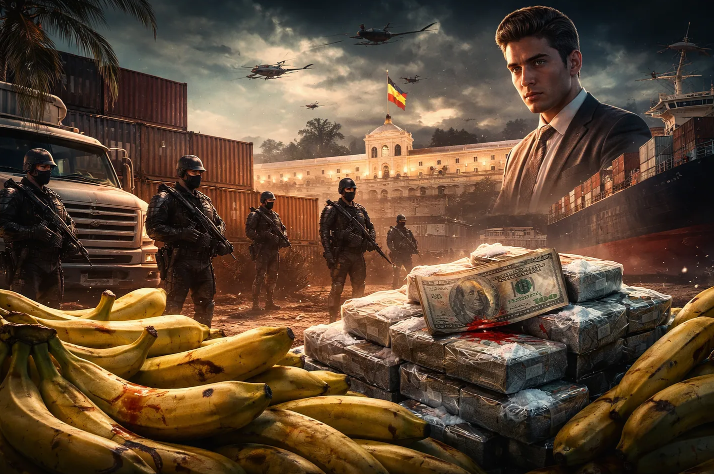
A new report by The Grayzone challenges former U.S. President Donald Trump’s claim that Venezuela is the main hub of cocaine shipments to the U.S. It argues that Ecuador, not Venezuela, is currently the region’s primary exit point for cocaine, even as Trump publicly embraces Ecuador’s president, Daniel Noboa, and frames him as a key ally in the “war on drugs.”
Investigative journalist Andrés Durán, now living in exile after threats to his life, has uncovered multiple links between Noboa family companies—including Noboa Trading, Blast SA, Transnabo, and properties owned by the Noboa Group—and repeated cocaine seizures since 2020. These include a 193-kilogram cocaine seizure at the San Luis ranch, a property ultimately tied to the Noboa Group through offshore shell companies. In each major case, authorities arrested only low-level workers while ignoring the company owners, despite the crimes being legally “flagrant” and requiring preventive detention.
Durán argues that Ecuador’s worsening security crisis is rooted in political decisions that dismantled financial oversight, weakened controls on the banana export sector, and allowed deregulated corporate structures to become fronts for criminal activity. The country’s dollarized economy, simplified corporate laws, and lack of effective monitoring have turned it into a crucial node in an international cocaine trafficking and money-laundering network. He estimates that 18–22% of Ecuador’s GDP may now rely on criminal activity.
The report details how banana exports—controlled in part by Noboa-linked companies—have become ideal cover for cocaine shipments. European prosecutors and investigative outlets such as OCCRP and KRIK uncovered encrypted communications suggesting Balkan traffickers had exclusive access to smuggle cocaine in bananas exported by the Noboa family’s firms. Cocaine-laden containers tied to these companies were intercepted in Italy, Croatia, and Spain. Yet Noboa Trading paid zero income tax on nearly $290 million in 2023 revenue, and the company has not produced traceability or contamination records that would exonerate it.
High-level political and military figures connected to the government also appear in investigations. Former agriculture minister Bernardo Manzano, who previously worked for Noboa companies, modified export controls in ways that made cocaine shipments easier. Police reports link him to the Albanian mafia. Other Noboa-associated officials and relatives face allegations of fuel trafficking, tax fraud, and involvement in illegal mining.
Despite soaring violence (53 homicides per 100,000 people), the government defunded key security units, including ports and airports intelligence, reducing its budget to just $7,500 by mid-2024. Meanwhile, Ecuador’s banks are posting record profits—despite the country’s economic crisis—raising concerns that the financial sector may be absorbing large flows of illicit dollars.
The report argues that Ecuador’s institutions—from the assembly to regulatory agencies—are deeply infiltrated by criminal networks. A decade of austerity, beginning under Lenín Moreno and continuing through Guillermo Lasso and Daniel Noboa, has hollowed out the state, weakened oversight, and created favorable conditions for organized crime to expand across sectors including drugs, illegal mining, arms trafficking, and public contracts.
Ecuador, once one of the region’s safest countries, now shows how state dismantling and austerity policies can enable criminal economies to overtake formal institutions. Whether President Noboa is personally directing these networks or whether cartels infiltrated his companies, the outcome is the same: a state overwhelmed by criminal structures, political complicity, and international trafficking interests.
The report ends by questioning whether the alignment between Trump and Noboa—both wealthy, politically connected figures who benefit from deregulated environments—is accidental or part of a broader pattern.
Watch the full report here:
With his articles, he tries to make a modest contribution to debunking the omnipresent propaganda of the mainstream media for those who don’t have the time (and that’s most people) to do the research to see through it.