
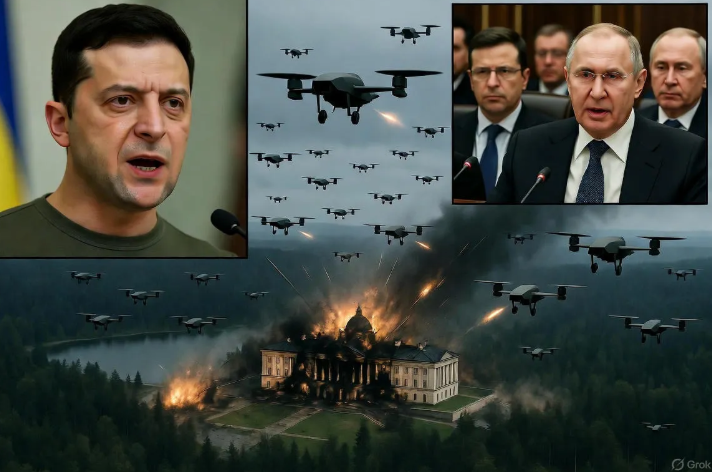
A Christmas Call for Deadly Violence, Not Reconciliation
On December 25, 2025, President Volodymyr Zelensky delivered a pointed message to the nation. He suggested that many might secretly wish for the death of Vladimir Putin, proclaiming:
“Today we all share a dream … may he perish.”

Russian Account
Moscow released a map of the alleged flight paths and video footage of wreckage described as a Ukrainian Chaklun-V drone carrying explosives. Later, it was claimed that flight logs showed the drones had targeted government buildings; the data was reportedly shared confidentially with U.S. officials.
Foreign Minister Sergey Lavrov stated that Ukraine had fired 91 drones. All were intercepted by Russian air defense systems without causing damage or casualties. The Ministry of Defense clarified that around 89 drones were intercepted nationwide, with 18–41 in Novgorod depending on the source. The Kremlin described the incident as an act of state terrorism and an attempt to sabotage peace negotiations.
Moscow also said that Putin personally informed Trump, who reportedly called the action “irrational.” Russia indicated it might reassess the negotiations while keeping the dialogue open. Additionally, Russia accused the British intelligence service MI6 of orchestrating the operation behind the scenes.
U.S. and Ukrainian Perspective
U.S. officials, speaking on behalf of the CIA, rejected Russia’s account. Almost simultaneously, the New York Times reported in “The Separation: Inside the Unraveling U.S.-Ukraine Partnership” that the CIA, together with the U.S. military, had extensively supported Ukraine in attacks on Russian oil facilities, refineries, and “shadow fleet” tankers with intelligence, targeting assistance, and technical support.
As expected, Zelensky denied any involvement in the attack and called the report a Russian “fabrication.” Numerous Western media outlets – from France24 to The Guardian – immediately adopted the Ukrainian narrative, before Russia released its version.
Who Is Pulling the Strings?
Ukraine has a long history of targeted operations on Russian soil, including attacks on high-ranking military and civilian officials. Kyrylo Budanov, head of Ukraine’s military intelligence, trained by the CIA and MI6 and described by intelligence experts as their “man,” confirmed previous failed attempts to kill Putin, including a drone strike on the Kremlin roof in 2023.
Operations have also been carried out outside Ukraine against tankers, infrastructure, and military targets. Experts emphasize the technical and strategic challenges of reaching a heavily guarded residence like Valdai undetected. CIA analyst Larry Johnson noted that such an attack would be nearly impossible without U.S. support.
MI6 chief Blaise Metreweli had previously stated that her agency would “outsmart” Moscow and was prepared to take proactive risks when Britain’s vital interests were threatened – details remain classified.
Broader Context and Motives
The incident is seen as a Western escalation that tests Russia’s red lines while shifting risk onto Ukraine. Moscow accuses NATO countries, especially the UK, of gray-zone tactics, as outlined by the MI6 chief.
An attack on Zelensky himself is considered unlikely. Russia views him as incompetent and detrimental to Ukraine’s military interests, whereas a more capable successor would pose a far greater threat to Moscow.
Diplomatic Consequences
The incident complicates U.S.-mediated negotiations. Russia now demands security guarantees, territorial recognition (including Crimea and parts of Donetsk, Luhansk, Zaporizhzhia, and Kherson), as well as the demilitarization and neutrality of Ukraine.
Ukraine faces growing pressure: military setbacks, economic strain, and waning Western support could prompt desperate or symbolic measures.
Zelensky’s credibility is once again called into question: he wished for Putin’s death, only to deny any involvement in the attack a few days later.