
For years, analysts and media outlets have hailed India as “the next China,” an emerging Asian powerhouse poised to surpass its northern neighbor. With its vast and youthful population, rapidly expanding economy, and democratic system, India is often cast as the world’s next breakout success. Yet a closer look reveals that the comparison is overstated. While India is indeed growing quickly, it remains decades behind China across nearly every critical domain—from technology and infrastructure to human capital, governance, and global influence.
Below are the core reasons India is unlikely to surpass China anytime soon.
1. Technology Self-Sufficiency vs. Reliance on Western Platforms
One of the starkest differences is technological independence. China has built a largely self-sufficient digital and hardware ecosystem, while India is dependent on Western infrastructure.
China created domestic equivalents to nearly every major Western platform:
- WeChat instead of WhatsApp
- Baidu instead of Google
- Alibaba instead of Amazon
- Douyin instead of Instagram or YouTube Shorts
Beijing limited Western tech dominance early on, fostering homegrown innovation. As a result, firms like Huawei, Tencent, Alibaba, and ByteDance dominate the domestic market and expand globally.
India’s ecosystem remains heavily reliant on U.S. companies. Its most widely used digital services—WhatsApp, Instagram, Facebook, Google, and AWS—are foreign-owned. This creates dependencies and vulnerabilities, including foreign pressure, influence operations, and exposure to disruptions outside India’s control.
In hardware, the gap is even wider. China designs and manufactures its own phones, chips, and 5G systems, and operates its own global navigation system (BeiDou). India largely assembles imported components, and its navigation system NavIC remains regional.
In an era where technological sovereignty defines national power, China is self-reliant. India is not.
2. Manufacturing Dominance vs. Services Dependence
China’s rise was built on manufacturing. India’s rise has been built on services.
China:
- Produces nearly 30% of global manufacturing output¹
- Exports over $3.4 trillion in goods annually³
- Built dense, world-class industrial clusters with unmatched supply-chain depth
India:
- Produces less than 3% of global manufacturing output²
- Exports around $770 billion in goods and services combined³
- Relies heavily on IT and outsourcing rather than large-scale industry
China’s integrated logistics, reliable energy systems, and streamlined industrial policy enable factories to be built in months—not years. India still struggles with power gaps, costly logistics, lengthy permits, and bureaucratic uncertainty. Even when companies like Apple shift assembly to India, most components still come from China.
India assembles. China manufactures.
That difference defines the development gap.
3. Human Capital: Social Stratification, Education Quality, and Meritocracy
India’s social and educational structure further widens the gap:
Caste and Social Fragmentation
The lingering effects of caste limit India’s economic potential through:
- Unequal access to education and opportunity⁴
- Fragmented labor markets and informal hiring networks⁴
- Reduced social mobility and talent utilization⁴
Education System Weaknesses
India’s education challenges include:
- Large rural–urban quality disparities⁵
- Overemphasis on rote learning over vocational training⁵
- Skill mismatches that undermine workforce readiness⁵
Meritocracy and Governance Culture
China has long cultivated a meritocratic administrative system, incentivizing competence and performance. India’s outcomes depend more heavily on social background, networks, and structural inequalities. Gender inequality further restricts India’s effective talent pool, while China draws deeply from its entire population⁶.
These factors don’t fully explain the gap—but they reinforce every other structural disadvantage.
4. Governance: Rapid Execution vs. Bureaucratic Gridlock
China’s centralized political system allows for large-scale, long-term projects to be executed efficiently in coordination with local authorities. When China decides to build something—a port, metro system, industrial zone, or high-speed rail line—it often comes to fruition in just months or a few years.
China built a 40,000 km high-speed rail network in under a decade⁷.
India’s first high-speed rail line, between Mumbai and Ahmedabad, has been delayed by nearly a decade and may not be completed until the 2030s.
Democracy brings many advantages, but in India it also produces:
- Prolonged land disputes
- Court interventions
- Policy reversals
- State–center coordination failures
China’s governance is built for stability and long-term development; India’s, by contrast, is frequently driven by short-term political agendas.
5. Global Influence and Diplomacy
China has reshaped global diplomacy by financing and building infrastructure across Asia, Africa, and Latin America via the Belt and Road Initiative, deepening ties with over 150 countries⁸. It plays a leadership role in BRICS and the AIIB, shaping financial systems outside the Western orbit.
China is the largest trading partner for more than 120 countries⁹.
India, by contrast, is not the top trading partner for any major economy and often aligns with Western strategic goals—particularly through the Quad—limiting its autonomy and influence.
6. Economic Scale and Investment Capacity
China’s economy, at $18 trillion, is nearly five times India’s $3.7 trillion¹⁰. Its per capita income is almost five times higher, enabling vastly greater investment in:
- Infrastructure
- Education
- R&D
- Global expansion
China spends 8% of GDP on infrastructure; India spends under 3%¹⁰.
China’s supply-chain dominance—from electronics to solar energy—gives it unparalleled economic leverage. India’s economy, while strong in services, has not yet reached comparable strategic importance.
Hard to Catch Up?
India is a rising power with genuine long-term potential. But China’s lead is vast. Its technological self-reliance, manufacturing strength, global influence, education system, and economic scale give it overwhelming advantages.
India may be growing on its own terms, but it remains far from catching up with China—and the distance is steadily widening. One potential path to narrow this gap could lie in a bold idea: a Common Market with China and Russia.
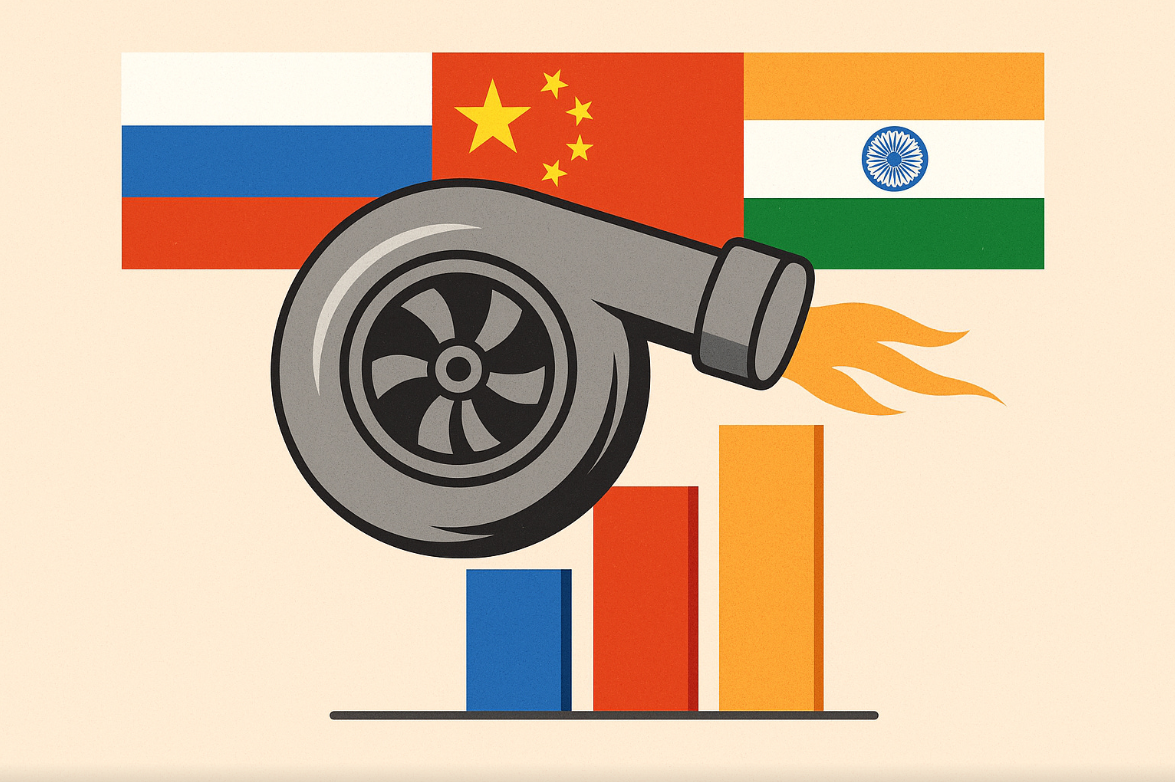
A Common Market With China and Russia: A Potential Turbocharger for India
A Russia–China–India common market could offer major economic gains—cheaper industrial inputs for India, stable energy demand for Russia, and expanded investment opportunities for China. It could reshape global trade and create a powerful Eurasian supply-chain bloc. But political, regulatory, and security barriers remain high.
Economic Logic
- Russia: abundant energy
- China: capital and industrial depth
- India: labor and demographic scale
A Massive Consumer Market
Stronger integration could create supply chains in which Chinese firms manufacture in India using Russian raw materials, exporting across all three markets. Local-currency trade could reduce reliance on the dollar, while infrastructure and investment flows expand.
The combined populations of Russia, China, and India total roughly 3 billion people, nearly 40% of the world’s population. This vast and diverse market—from India’s youthful demographic to the older populations of China and Russia—would drive demand for everything from everyday goods to advanced healthcare, education, and technology. Businesses could leverage economies of scale, producing and selling at unprecedented volumes. Such scale would significantly boost the competitiveness of producers within the bloc, enabling them to capture market share from manufacturers outside the region while creating more jobs domestically.
Beyond consumer goods, such a market would carry significant geopolitical and economic weight, influencing global trade and investment flows. Realizing this potential requires overcoming challenges in economic integration, infrastructure, and regulatory alignment across three very different countries.
Barriers
- Deep India–China strategic distrust
- Mismatched regulatory systems
- Sanctions constraints on Russia
- Enormous infrastructure needs
Most Realistic Path
A phased approach:
- Energy and Investment Corridor (near-term)
- Sectoral common market with selective integration (medium-term)
- Full EU-style common market (unlikely in the foreseeable future)
Why China Might Shift Industry to India
China’s rising manufacturing costs are pushing low-margin industries abroad. India is an attractive candidate due to lower wages and industrial incentives, though political and logistical challenges slow progress.
A hybrid model—joint ventures, indirect investment through Singapore/Hong Kong, technology partnerships—is the most realistic pathway.
Foxconn’s Lesson
Foxconn’s retreat from India underscores the challenge: India has potential, but its manufacturing ecosystem lacks China’s reliability, skill depth, and integrated supply chains. Growing pains are normal, but catching up requires far deeper reforms.
Overall
A trilateral economic bloc could bring major benefits for all three countries—but reaching that point demands strong political leadership, long-term vision, and structural reforms that India has not yet completed.
Bottom Line
A Russia–China–India economic bloc could unleash huge advantages—cheaper inputs, bigger investments, and a surge of new industrial jobs—while reshaping global trade and lifting 3 billion people into greater prosperity. Yet political mistrust, regulatory gaps, and infrastructure bottlenecks make a fully integrated common market a distant prospect. For now, gradual, sector-by-sector integration is the most realistic path forward.
Footnotes
- China accounts for nearly 30% of global manufacturing output – World Bank/SIPRI 2024.
- India accounts for less than 3% of global manufacturing output – World Bank/SIPRI 2024.
- Exports: China $3.4 trillion, India $770 billion – UN Comtrade 2024.
- Caste-related inequalities in education and labor markets – NITI Aayog 2023.
- Education quality gaps rural vs. urban – ASER Report 2023.
- Gender equality and female workforce participation – World Economic Forum 2024.
- China’s high-speed rail network 40,000 km – China National Railway 2023.
- Belt & Road Initiative reach and global projects – AIIB Annual Report 2024.
- China as largest trading partner of 120+ countries – WTO 2024.
- GDP and per capita income comparison – IMF 2024.
- STEM graduates: China produces largest pool globally – CSET/Georgetown 2020.