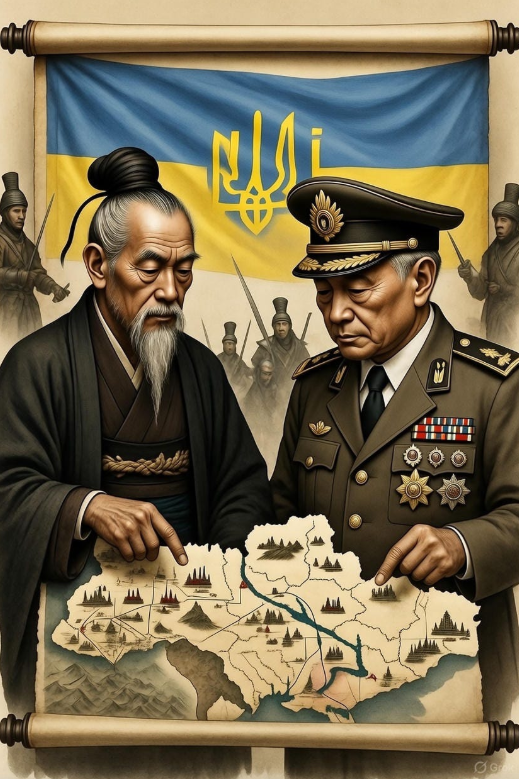
What if two of the greatest Asian strategists in history—Sun Tzu and Võ Nguyên Giáp—had judged the war in Ukraine completely differently from Western experts? Their writings suggest this: military strength is meaningless when the economic foundation collapses. While the West still follows Clausewitz’s thinking, Asian strategists show that cost, time, and societal stability are often more important than battles and rhetoric. Anyone who wants to understand why modern conflicts fail—and how they might be prevented—must read strategy as an economic balance sheet. This is precisely where the story unfolded in this article begins.
The West’s Clausewitz Problem
Western dependence on Clausewitzian doctrine—with its focus on decisive battles and predictable escalations—has repeatedly underestimated political will, strategic patience, and economic endurance.
Sun Tzu and Giáp’s Alternative Diagnosis
Had Sun Tzu and Giáp analyzed the war in Ukraine, they would have pointed out that drawn-out, half-hearted engagements are far more costly than decisive, well-thought-out strategies. The essential factors would have been mobilizing society, preserving industry, and setting realistic goals—always with the awareness that half-measures strengthen the enemy.
The Trust Crisis
To persuade citizens to finance the conflict, the West repeatedly spread a false narrative for years: that Russia was suffering heavy losses, its soldiers were poorly trained and under-armed and deserting, and that it was on the brink of losing the war. In doing so, it jeopardized public trust—the most important “loss” of the Western propaganda war. Confucius, who lived slightly earlier than Sun Tzu (around 500 BCE), emphasized that trust is the indispensable foundation of every legitimate government: “First give up the army, then the grain, and lastly the trust.”
Half-Hearted Aid as “Life Support”
Western aid to Ukraine was always a form of “life support”—insufficient financial packages with no realistic prospect of victory, while NATO states were neither willing nor able to send troops. Sun Tzu and Giáp would have clearly advised against such half-hearted engagement.
Why Asian Strategists Prioritize Economics Over Battles
Time and Society Beat Raw Power
History shows that time, society, and economic strength are often more effective than raw military force. Sun Tzu’s maxim “to subdue the enemy without fighting” is practical cost avoidance: victory is not measured in captured territory, but in preserving resources, keeping the economy functional, and maintaining societal stability. Prolonged campaigns destroy morale, logistics, and political coherence—even tactical successes are meaningless when the economic base collapses.
The Ancient Chinese Stress Test
Sun Tzu’s lessons from the late Spring and Autumn period and the early Warring States era in China illustrate this point vividly. In a landscape of fragmented kingdoms, each convinced it could unify the world, armies grew exponentially. Campaigns required vast quantities of grain, metal, labor, and money, and war became a comprehensive stress test for state economies.
War as a Dangerous Balance Sheet
Every march, every supply convoy, every chariot drawn was a loan taken against the future. Sun Tzu recognized that the greatest danger to a state was not its enemies but its depleted treasury. Prolonged campaigns undermined agriculture, labor, trade, and political cohesion. A victory was meaningless if the finances had been hollowed out.
He treated war like a balance sheet, a table, long before tables existed: “War is of vital importance to the state… vital in the sense of dangerous, disruptive, and capable of destroying precisely the society it claims to defend.” From the first chapter on, his focus was on containment, control, and cost minimization; heroic deeds, glory, moral superiority, and symbolic battles were of secondary importance.
Logistics: The Hidden Killer
Sun Tzu’s fixation on costs runs through every page of his work. Supply lines, troop movements, and logistics are not side notes but central pillars of his strategy. Transporting a hundred bushels of grain to the front could consume two hundred along the way. Maintaining armies in the field strained agriculture, crafts, and trade across the entire hinterland.
A wasteful commander could win skirmishes and still drive the state into ruin.
Intelligence as a Low-Cost Superweapon
Sun Tzu’s logic of information and intelligence was inseparably linked to economically optimized war management. Gathering information, espionage, and intelligence operations were central tools for achieving maximum strategic benefit at minimal cost. Reliable insights into enemy troop movements, supply lines, and tactical decisions cost comparatively little but enabled the avoidance of heavy losses, preserved resources, strengthened morale, and maintained political cohesion.
For Sun Tzu, military decisions had to be based on solid facts—not, as often seen in the war in Ukraine, on mere wishful thinking.
Sun Tzu in the Corporate Age
Sun Tzu’s financial logic can be applied directly to the modern corporate world and geopolitics: hedge funds that cleverly exploit market data are spies; tech companies that monopolize markets use maneuver strategies; cyberattacks, economic pressure, and proxy wars all serve the same purpose—achieving maximum effect at minimal cost.
How Clausewitz Led the West Astray
Escalation Without Strategy
Clausewitzian doctrine led the West astray: it overestimated the importance of individual battles, relied on stable political will, and encouraged escalation that grew like an advancing front line—first training and arms deliveries to Ukraine, then tanks, drones, artillery, aircraft, and finally missiles capable of striking deep into Russian territory.
Each new stage of escalation increased risks and made control more difficult, while time continued to be treated as a passive variable instead of a decisive strategic factor.
Russia’s Real Strategy: Attrition
The West claimed Russia was fighting a war of conquest, although in reality it was fighting a war of attrition, aiming to keep its own losses low and the enemy’s high. Clausewitz’s 3:1 rule states that an attacker needs roughly three times the defender’s strength to achieve a decisive victory. Russian forces on Ukrainian soil numbered about 165,000–200,000 soldiers, while Ukrainian forces (active troops plus early reserves) were around 290,000–310,000. For a classic conquest plan, Russia would therefore have needed roughly 900,000 soldiers.
Sun Tzu’s Warning
Sun Tzu would have warned the West not to allow itself to be drawn into a war of attrition that destroys morale, resources, and political stability. He recommends swift, decisive victories through strategy, deception, alliances, and breaking the enemy’s will.
Giáp’s View: Attrition Only With Purpose
Giáp accepts wars of attrition only as part of a long-term strategy to break the political will of a stronger opponent. He avoids senseless sacrifice and relies on slow, strategic attrition when a short, decisive war is not possible.
The Fundamental Truth Both Strategists Share
Vague Goals Are Fatal
Sun Tzu and Giáp agree on a fundamental truth: undefined end goals are dangerous, moral rhetoric does not replace strategy, and economic and political realities determine success more than material superiority.
Historical Lessons: From Napoleon to Vietnam
When Economics Beats Armies
Napoleon’s Russian campaign, Giáp’s victory over the French colonial army in 1954, and the Vietnam War show that the economic front is often more decisive than military strength. Giáp recognized that threats stem not only from enemy armies but also from economic and political dominance.
Giáp’s Strategic Discipline
I once asked him:
“You defeated and expelled the foreign invaders—the Japanese, the French, the Americans. Now they return in another form: as powerful corporations from East and West. They could easily dominate Vietnam’s comparatively weak SMEs and once again endanger your country’s independence.”
Giáp’s military success at Điện Biên Phủ was based on strategic discipline, patient mobilization, and careful allocation of resources. His book Điện Biên Phủ, taught at military academies worldwide, documents how a numerically inferior army could triumph through intelligent planning.
Vietnam’s Post-War Economic Defense
After reunification, Vietnam initially relied on protectionist measures to fend off economic dominance, and then built its economy in a targeted way to withstand global challenges later on—very much in the spirit of the general.
Modern Lessons for Ukraine and Europe
Diplomacy Missed, Risks Ignored
Only with the presidency of Donald Trump did diplomacy have another chance. The EU refused to negotiate with Russia—a course of action Sun Tzu would have clearly disapproved of. He would have recommended the exact opposite: for him, diplomacy is the central key to understanding one’s own position, the opponent, and the overall situation accurately.
Sun Tzu’s Checklist
Sun Tzu would also have examined whether unity and financial stability were ensured, whether the goals were narrowly defined, clear, and realistic, and whether European industry could endure costly alternatives to cheap Russian energy without losing significant competitiveness to industrial powers like China—which benefits from subsidized Russian and Iranian energy.
A Smarter Strategy
Under this logic, likely decisions would involve limited, targeted support, early economic and diplomatic pressure, and asymmetric military assistance—intended to shape negotiations rather than force battlefield victories.
The Final Lesson
The War That Didn’t Need to Happen
Sun Tzu and Giáp repeatedly emphasize: undefined end goals, moral rhetoric, or half measures are expensive. Time, resources, and societal endurance are decisive. Those who neglect economic stability and political cohesion lose in the long run, no matter how bravely the soldiers fight.
Their conclusion would be clear: whether Napoleon’s Russian campaign, Vietnam, or modern proxy wars—military victories alone do not guarantee success as long as the economic and societal foundations remain weak.
Understanding Sun Tzu more as a financial strategist than as a classical general fundamentally changes how we view strategy and modern geopolitical decisions: the best war is the one that does not have to be fought at all—because resources are preserved and society remains functional.
A Preventable Conflict
In an age of globalized economies and proxy wars, these lessons are more relevant than ever: war is extremely costly, and those who wage it poorly risk everything—the economy as the backbone, the army as the striking front. Every mistake can determine the outcome of the entire conflict. If the assessments had been made through the lens of Sun Tzu and Giáp, the war in Ukraine might have been prevented, or at least ended much earlier.