
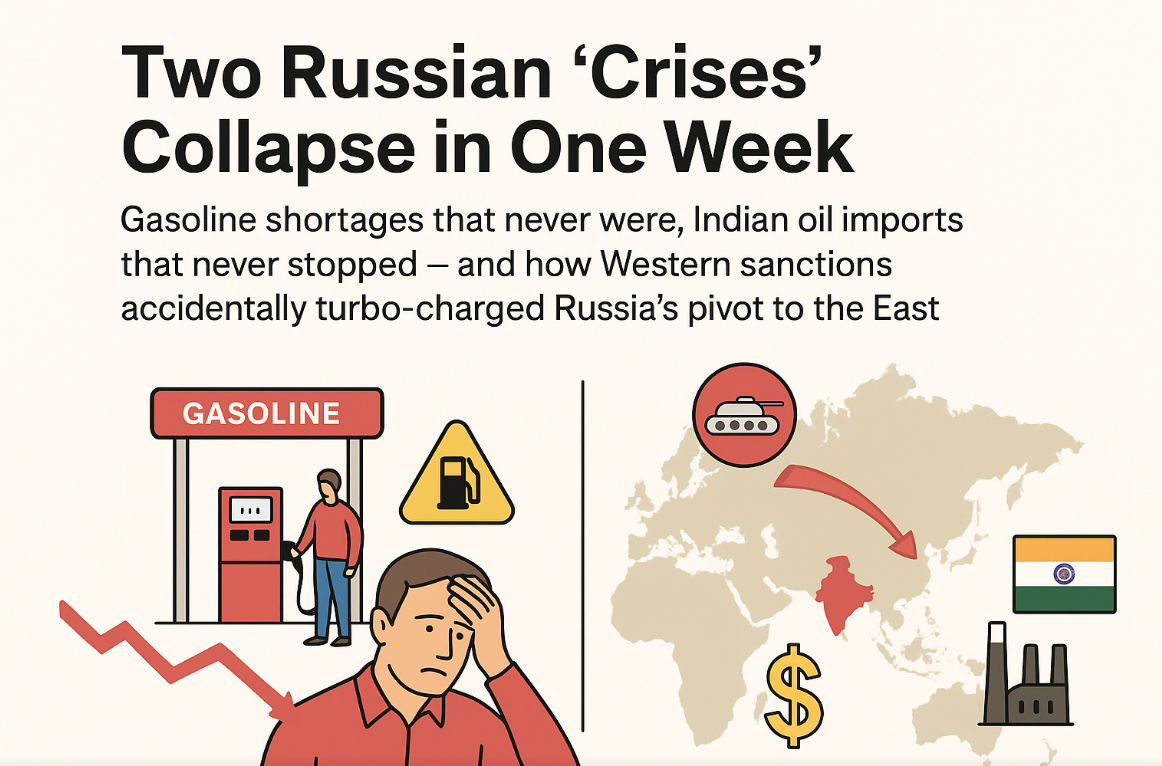
Over the past week, two dominant Western media narratives about Russia’s impending collapse have crumbled under the weight of evidence.
First, the supposed “gasoline crisis” triggered by Ukrainian drone strikes on refineries – a story amplified for months as proof of a decisive Ukrainian strategic success.
Second, the claim that U.S. sanctions on Rosneft and Lukoil, combined with India’s alleged halt to Russian oil imports, would cripple Moscow’s budget and force a humiliating capitulation.
These tales fueled endless speculation about domestic unrest and financial meltdown inside Russia. Yet data from openly hostile sources (the Amsterdam-based Moscow Times) and more neutral ones (Financial Times, Goldman Sachs, Bloomberg) show that neither story held water. What they actually reveal is a resilient Russian economy accelerating its eastward pivot – ironically strengthened by the very sanctions meant to weaken it.
This is no isolated fluke. In his 2024 analysis, economist James K. Galbraith convincingly argued that sanctions against a vast, resource-rich economy like Russia’s have backfired spectacularly. After the initial shock, they have effectively operated as enforced trade protectionism, industrial policy, and capital controls—reforms the Kremlin could never have pushed through domestically without fierce oligarch resistance.
The sanctions have by no means weakened Russia’s war effort, but have instead given Moscow valuable market share in sectors previously dominated by Western companies, drastically reduced the cost of domestic raw materials and enabled complete independence from Europe – while Europeans now pay two or three times as much for energy, which systematically undermines their industrial competitiveness and fuels their deindustrialisation and decline in prosperity.
Smaller, vulnerable nations such as Cuba and Venezuela are indeed crushed by such measures. Resource giants like Russia and China, however, simply adapt and thrive.
The pivot is already in full swing: during Putin’s December 2025 visit to India, the two countries signed a Labour Mobility Agreement under which India has formally offered to send hundreds of thousands of guest workers to help Russia fill its projected 12-million-job shortfall by 2035.
A perfect illustration of the broader trend: Germany’s BASF, the world’s largest chemical producer, is now slashing capacity at home and building massive new plants in China – precisely because China still enjoys abundant, low-cost Russian energy, while Germany, having deliberately cut itself off from the same supply, has shot itself in the foot.
Part 1: The Phantom “Gasoline Crisis”
In late summer 2025, headlines screamed of a Russian fuel apocalypse: Ukrainian drones had allegedly knocked out over a third of refining capacity, triggering nationwide shortages and long queues. Donald Trump tweeted that Russians should “ask who was responsible” for their misery, and think-pieces proliferated about impending unrest and budget shortfalls.
Reality arrived on December 3 with a detailed investigation by the Moscow Times – an Amsterdam-based, virulently anti-Putin outlet long favoured by Western media for Kremlin-intrigue stories. Its article, “Did Russia Really Have a Gasoline Crisis? New Data Suggests Otherwise,” by Dmitry Nekrasov, was based on a nationwide survey of 1,600 respondents (narrowed to 1,158 active drivers, including Crimea and Sevastopol). The key findings:
- Only 24% encountered their preferred fuel grade missing in the prior three months; most simply refueled elsewhere.
- Just 2.4% of the total sample (10% of those who saw any shortage) couldn’t find fuel anywhere that day.
- Queues affected 18%, but half waited less than 20 minutes.
- Purchase limits hit only 6%, with repeated limits under 1%.
- Problems were confined to a few failing private chains that soon closed.
Crimea experienced genuine disruption (70% reported empty pumps), but even there the issues were short-lived and localized. Verdict: no crisis – just the predictable seasonal surge from millions of Russians driving to Black Sea resorts, a phenomenon that occurs every August. Gasoline prices have now fallen for three straight weeks, and the “shortage” narrative has quietly vanished.
The Moscow Times itself notes that media hype, not facts, shaped perceptions – and predicts the same “crisis” will be rediscovered next summer, again wrongly blamed on drone strikes. Russia’s vast energy complex absorbed the attacks with barely a scratch.
Part 2: Oil Exports to India – Rerouted, Not Halted
The second story exploded after U.S. sanctions on Rosneft and Lukoil took effect on November 21, with Trump claiming Modi had personally assured him India would end imports by year-end. Pundits forecast a $1.13 billion weekly revenue black hole, budget collapse, and Putin begging for peace.
No reputable Indian source ever confirmed the claim; Reliance issued carefully worded compliance statements but never announced a halt, and Modi’s office flatly denied any such conversation took place.
Last week’s Financial Times quietly admitted the truth: the Rosneft-backed Nayara refinery (India’s second-largest) continues buying Russian crude, and a complete halt is “unlikely” given the attraction of discounted barrels.
The numbers confirm it: Rosneft/Lukoil exports fell by about 1.1 million bpd, but non-sanctioned Russian producers instantly increased output by roughly 1 million bpd. Total seaborne exports actually rose after the sanctions, reaching 3.94 million bpd in the latest week (up 690,000 bpd), with weekly value steady at around $1.13 billion.
India took 38% of Russia’s seaborne crude in October; December volumes are running 1–1.2 million bpd – lower than peak but still triple pre-war levels and rebounding through various workarounds.
During Putin’s December 4–5 visit – greeted personally at the airport by Modi, a rare honour – the leaders unveiled an ambitious 2030 roadmap: trade diversification beyond last year’s $52.7 billion (mostly oil), rupee-ruble settlements, and the Labour Mobility Agreement mentioned above. Putin promised “uninterrupted fuel supplies”; Modi targets $100 billion in annual bilateral trade by 2030. India is rejoining the Su-57 fifth-generation fighter programme with full technology transfer and localised production (something the U.S. refuses with the F-35), alongside further S-400 deliveries and joint engine development.
Secondary sanctions on India remain a non-starter: Washington has spent years trying to win New Delhi over as a counterweight to China; pushing India even further into the arms of the BRICS would be strategic madness from a U.S. perspective.
The Resilient Russian Economy: Stability, Growth, and a 24/7 Service Sector Europe Can Only Dream Of
Western predictions of Russian bankruptcy by February 2025 have been spectacularly disproved. GDP grew 4.1 % in 2024 even as the Central Bank deliberately cooled the post-boom economy with interest rates peaking at 21 %. Inflation, which briefly touched an annualised 10–11 % in March, has fallen to around 8 % and is expected to close the year below 6 %. Unemployment remains at a historic low of 2.3 % – effectively full employment.
The projected 2025 budget deficit is a modest 2.6 % of GDP, caused mainly by temporarily lower tax receipts during the slowdown; it will shrink again as growth normalises. Oil and gas revenues now represent only about 25 % of the federal budget (roughly half from domestic sales) – far below the exaggerated figures often cited in the West. Sanctions reroute rather than reduce trade flows, and the current-account surplus reached $16.6 billion in Q3. A bumper harvest boosted agriculture, while the services PMI stays comfortably above 50.
Even Janet Yellen, long the most forceful advocate of sanctions, has now quietly conceded that they are underperforming. Sectoral challenges persist – above all labour shortages – but they remain manageable. Russia’s immense size, abundant resources, and rapidly expanding network of partners (visa-free travel with China, Mir card acceptance in the UAE, Saudi Arabia, Egypt, and beyond) provide more than sufficient insulation.
One personal impression from my visit to Russia last year: the service sector genuinely never sleeps. Restaurants, flower shops, pharmacies, and even law firms are open 24/7 – a level of round-the-clock convenience and energy that Europe lost long ago.
Full video here:
Sectoral hiccups exist—labor shortages, war demands—but they’re manageable. Russia’s scale, resources, and partners (China’s visa-free deal, Saudi/UAE MIR cards) insulate it. EU’s 19th package bypassed Hungary/Slovakia vetoes, but the 20th will flop like the rest. No one believes Brussels will sanction Riyadh.

The Sanctions Backfire: Galbraith’s “Unintended Gift”
Galbraith’s dissection exposes the folly: sanctions aimed to slash export earnings, block tech, and incite revolt. None panned out. Volumes fell, but prices rose—revenues climbed. Stockpiled components fueled the war; import bans cut consumer spending, swelling surpluses. Western exits handed assets to locals cheap, birthing Russian champions.

Russia’s advantages—its vast territory, resources, expertise in STEM fields, and relationships with BRICS countries and Africa—enabled the country to adapt. Before 2022, displacing Western companies was politically sensitive, but sanctions that indiscriminately affected Russian oligarchs made this inevitable without the Russian government being held responsible. Europe urgently needs cheap Russian resources; Moscow is foregoing “goods it does not need.” China has led the way: US chip bans have led to domestic innovation, an infrastructure boom, and an increase in trade with non-Western countries – while Europe, which voluntarily gave up the large Russian procurement and labor markets, suffered a significant loss of jobs at the same time.

Conclusion: Pivot Complete, Accountability Absent
Ukrainian drones? Barely a scratch. The Indian “halt”? Rerouted resilience. These were never crises – they were manufactured fictions designed to prop up a failing narrative.
Meanwhile, Russia’s economy stands stable and self-strengthening, pivoting decisively toward BRICS giants: India (Su-57 revival, hundreds of thousands of Indian guest workers on the way) and China (pipelines running full bore). It is thriving in exactly the places sanctions were meant to strangle it. Galbraith’s verdict remains perfect: an “unintended gift” that has accelerated Russia’s march toward genuine self-sufficiency.
Do not hold your breath for Western mea culpas. There will be no corrections from the Financial Times or Bloomberg. The phantom gasoline queues and the mythical Indian oil cutoff will simply disappear down the memory hole. Instead, we will be told – once again – that the EU’s upcoming 20th sanctions package is the long-awaited silver bullet.
Four years on, the pattern is unchanged: hubris triumphs over evidence. The real outcome is now undeniable: sanctions have isolated Europe, not Russia. As Putin and Modi raised their glasses in Delhi, the East quietly took the pen and began writing the future.