
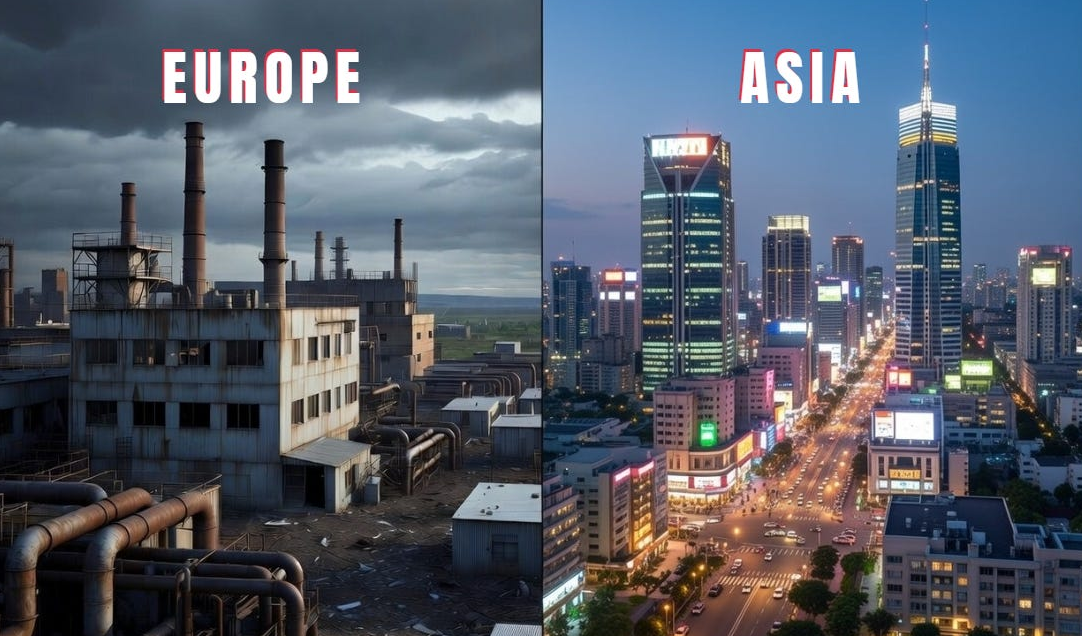
A Decision of Historic Absurdity
The European Union’s latest decision on gas imports from Russia is almost absurdly bizarre. Over the past five years—since before the start of Russia’s “special military operation”—the EU has made a series of extremely poor decisions regarding Russia, which have severely damaged Europe’s economic and social cohesion.
Twenty sanctions packages have barely affected Russia, but they have hit Europe very hard. Germany, in particular, has lost not only an important export market but also a crucial source of supplies: cheap Russian raw materials and energy that had significantly contributed to Germany’s former economic success.
None of these decisions, however, was as grotesquely absurd as the one the European Council made over the past two days. It has received minimal attention in British and Anglophone media, somewhat more in continental European outlets, but nowhere near the attention it deserves.
Another Energy Crisis Echoing 2021
Europe is currently experiencing a cold spell. Gas storage levels were already fragile before this temperature drop; the intense usage of the past two weeks has further depleted reserves. Storage levels are now as low at this point of the year as they have been in five years—namely since 2021, when a gas price crisis shook Europe.
Back then, high winter demand and a dry summer pushed consumption up and caused prices to explode. At the time, the EU sourced about 40% of its gas from Russia via pipelines.
European companies once had long-term contracts with Gazprom, Russia’s gas export monopoly, but at the urging of the EU they increasingly switched to the spot market. This was sold as a market-friendly reform, but in times of scarcity it led to even sharper price increases, since spot purchases were far more expensive than stable long-term deliveries.
All Russian Pipelines Shut Down
Today’s situation resembles 2021 but differs in key ways: it is early winter, the summer ahead is uncertain, and the EU has now shut down all Russian pipelines. Poland closed the Yamal pipeline, Germany suspended Nord Stream 2 in February 2022 and later moved to end all Russian gas imports.
A terrorist attack—attributed by some to the U.S. and by German authorities to Ukraine—destroyed nearly all the Nord Stream pipelines; one intact pipe was never put into operation and is likely unusable by now. The Druzhba network was gradually wound down; the EU stopped importing through it, and although Hungary continued for a time, Ukraine blocked the transit route about a year ago.
Europe’s Accelerating Deindustrialization
All this is happening amid an accelerating deindustrialization crisis in Europe. As early as February 2022 it was predicted that suspending Nord Stream 2 would trigger deindustrialization in Germany—a prediction that has been exceeded in both scale and speed.
Factories are shutting down across Europe (including the UK) due to high energy prices, which far exceed those of competitors such as the U.S., China, and Asia more broadly. This worsens the cost-of-living crisis for consumers.
The Total Gas Ban – A Decision With Global Consequences
Against this backdrop, the EU has now decided to completely ban all imports of Russian natural gas—whether via pipeline or LNG—introducing penalties for violations and additional monitoring. Only the TurkStream pipeline remains active. Although Russian gas now accounts for only around 10% or less of EU demand (down from 40%), the decision structurally locks in permanently higher gas prices in Europe, since replacements (mainly U.S. LNG) are far more expensive than Russian pipeline gas or Russian LNG. Europe is rejecting the world’s largest, cheapest, and nearest supplier and forcing itself to rely on costlier alternatives.
How Asia Gains
Globally, this fragments the gas market: Russian gas shifts eastward to Asia (e.g., China via Power of Siberia 1 and 2, and likely India), keeping Asian prices low while European prices rise. This permanently locks European industry into uncompetitiveness—an illogical decision if economic health were the priority. Instead, it shows that the EU has become a geopolitical-ideological project that prioritizes conflict with Russia over prosperity—driven by Germany, France, Italy, and Spain.
Legal Norms Bent for Political Goals
Russia is adapting and redirecting its exports eastward while Europe suffers. Additionally, the European Council’s decision sidesteps major legal norms: originally sanction-based (requiring unanimity), it is now being rebranded as “trade policy” (requiring a majority vote) to bypass vetoes from Hungary and Slovakia. Both countries depend on Russian gas via TurkStream and had previously received exemptions—now rendered meaningless. They plan to challenge the decision before the European Court of Justice; they have strong legal grounds, though the political outcome is uncertain (the court, which aligns closely with the EU Commission, may reject or stall the case for years).
Similarly, last year the EU abused emergency powers to freeze Russian assets in Euroclear indefinitely—a move some EU officials themselves described as “insane” and illegal. As an entity built entirely on treaties and law, the EU risks undermining its own foundations by bending rules arbitrarily.
Growing Dependence on the United States
This obsession continues despite recent tensions with the United States (e.g., Trump’s threats regarding Greenland, tariff disputes). A looming economic clash was narrowly avoided last week; yet the U.S. holds all the leverage—from cloud-service domination to LNG supplies on which EU states have made themselves dependent. A NATO deal postponed the conflict for now, but dependence deepens. Banning Russian gas increases Europe’s vulnerability to U.S. suppliers.
Economic Hegemony: Familiar Patterns
Whereas Russia—and previously the Soviet Union during the Cold War—never used energy as a geopolitical weapon against Europe, the United States has for decades systematically used its currency, domestic market, legal system, and global trade dominance to pressure other states—not only adversaries but also supposed allies.
A striking example: in the late 1980s, when Toshiba became the world leader in microchips, the U.S. forced Japan into submission through massive economic and political pressure, clearing the way for American dominance in memory chips and microprocessors.
A Europe Lost in Obsession
Europe today is trapped in an obsessive fixation on Ukraine, Russia, and Putin, ignoring economic damage, U.S. pressure, and the reality of the war. European politicians welcomed the decision to fully ban Russian gas (e.g., Denmark’s Prime Minister Frederiksen) and applauded Zelensky even as he sharply criticized and insulted European leaders. Only Italy’s conservative politician Matteo Salvini reacted angrily to what he saw as Zelensky’s impertinence.
Asia Constructs – Europe Deconstructs
Russia will easily weather the blow; meanwhile, Asian countries continue expanding their industries. Recently, the Russian president guided the King of Malaysia through a museum in St. Petersburg—not just as a polite host, but clearly as an effective salesman for Russian energy.
By 2030, Vietnam will massively expand or add 400 industrial parks. Vietnam and many other Asian nations will power their growing industries with cheap Russian energy. Their competitors in Germany and the rest of Europe will have to watch: they are forced to rely on far more expensive energy sources from the U.S. and elsewhere.
Here in Asia, confidence is high—starkly contrasting with the mood in Europe.