
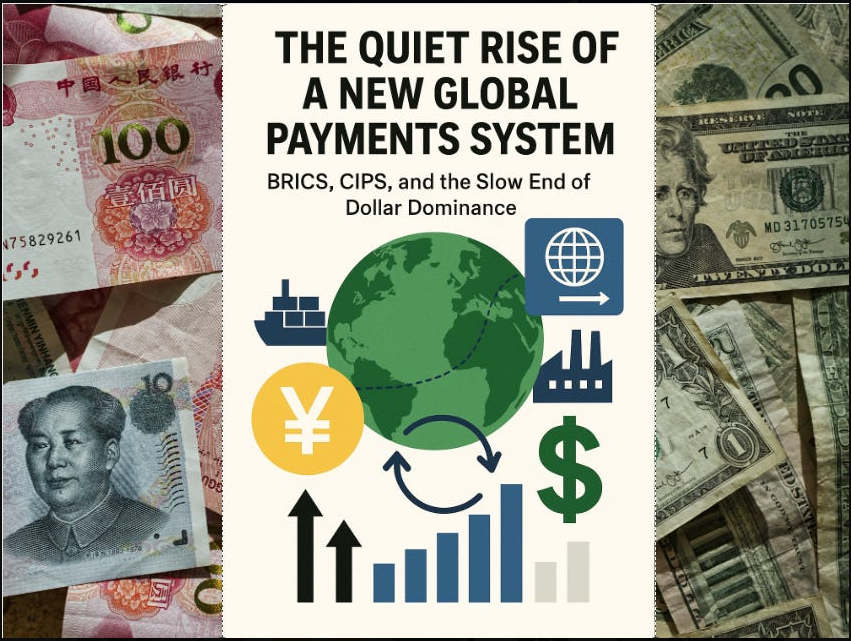
Last week, one of the most important geopolitical shifts of 2025 unfolded with almost no Western media attention: the BRICS bloc—Brazil, Russia, India, China, and South Africa—officially launched a new global payments system that enables more than 180 countries to conduct trade in Chinese currency, bypassing the US dollar entirely¹. There were no breaking-news banners, no think-tank emergency briefings, no prime-time discussion panels. Yet the implications of this development may ultimately prove more consequential than many of the economic headlines dominating Western news feeds today.
A large part of the Western discussion about China still revolves around familiar narratives—youth unemployment, demographic decline, or China’s relentless drive toward factory automation.

Issues like youth unemployment or population decline in China are undoubtedly relevant—even if they do not seem extraordinary compared to other East Asian countries. However, they often obscure a deeper, globally significant trend: over the past decade, China has spent its efforts building the world’s most extensive non-dollar financial infrastructure². What was once dismissed as a peripheral experiment has quietly evolved into a sprawling, fully operational global system. This has surprised many observers, as China is led not, as is often the case in the West, by lawyers and bankers, but by engineers.
At the center of this transformation is CIPS, the Cross-Border Interbank Payment System, China’s alternative to SWIFT. Historically treated as a technical curiosity, CIPS now links thousands of financial institutions across nearly every continent³ and processes tens of trillions of renminbi (RMB) annually⁴. With BRICS adopting CIPS as the backbone of its new payments network, a mechanism originally designed to support China-centric trade has become the architecture of a parallel global financial system—one capable of operating independently of US oversight.
Countries across Africa, Latin America, the Middle East, and Southeast Asia are increasingly seeking alternatives to a dollar-dominated order vulnerable to sanctions and political pressure. Forecasts by major economic institutions reflect this momentum: BRICS+ could account for nearly half of global GDP by mid-century, while the G7’s share may fall below 20%⁵. Even France, a founding G7 member, has floated the idea of inviting China to the 2026 summit—an idea that would have been unimaginable ten years ago⁶.
On the financial front, demand for RMB-denominated products has surged. More nations are borrowing, lending, and settling trade in RMB than ever before. For years, critics argued the RMB could not become a true global currency without full convertibility. But the data now tells a different story. Chinese banks have sharply expanded overseas RMB loans, deposits, and bond holdings, quadrupling their offshore renminbi business in just a few years⁷. Developing countries increasingly rely on RMB financing to reduce exposure to dollar volatility and US monetary policy.
This shift is visible in real decisions: Kenya, Angola, and Ethiopia have shifted major loans from USD into RMB; Indonesia and Slovenia have issued RMB-denominated bonds; Kazakhstan’s Development Bank recently raised billions of RMB in offshore markets at competitive yields⁸; and China and South Korea renewed a massive currency swap agreement enabling bilateral trade to bypass the dollar entirely⁹.
These financial flows reflect a broader realignment especially visible in Asia. After a wave of US diplomatic activity in Southeast Asia, ASEAN quietly upgraded its free-trade agreement with China—reinforcing the region’s deep economic integration with Beijing.
With a total population of 670 million and an economic output of over USD 10 trillion in purchasing power parity (PPP), ASEAN ranks among the 5th–6th largest economic regions in the world and has been China’s largest trading partner for several years, with bilateral trade exceeding USD 770 billion¹⁰. Shortly after the agreement was signed, Indonesia issued its first major RMB “Dim Sum” bond. Investor demand far exceeded expectations, highlighting how widely RMB instruments have now become normalized across emerging Asia¹¹.
The institutional infrastructure supporting this shift is expanding just as quickly. Global payment data shows that the RMB’s share of trade finance has quadrupled in recent years, reaching second place globally behind only the dollar¹². Cross-border RMB payments are at record levels, and CIPS participation now spans more than 180 countries. BRICS development banks are increasingly issuing loans in RMB, embedding the currency in multinational infrastructure finance. China and South Africa recently completed the first BRICS development loan issued entirely in RMB—an arrangement that would have been nearly impossible under the old dollar-centric order¹³.
Taken together, these developments point to an unmistakable trend: roughly one out of every twelve global trade transactions is now settled in RMB, and that share is rising quickly¹⁴. With the BRICS payments system now live, the pace of diversification away from the dollar is almost certain to accelerate.
For many emerging economies, this moment represents the beginning of genuine financial autonomy—an opportunity to develop, finance, and transact without relying on a single currency or a single geopolitical sphere. These countries form the backbone of global supply chains, serving as critical suppliers of energy, raw materials, and manufactured goods. Their financial evolution matters not only for their own futures but for the economic stability of the entire world.
The era of the dollar will not end overnight—but quietly and steadily, a multipolar financial system is emerging, driven by the Global South or the Global Majority. The world is changing: the dollar may still reign, but the future belongs to this new system.
Footnotes
- MeObserver. BRICS Expands Yuan Payments Network to 185 Nations. 2025.
- SWP Berlin. China’s Currency Campaign and Global Financial Strategy. 2024.
- China Daily. CIPS Cross-Border Payments System Annual Report. 2024.
- Ibid.
- Financial Times. China’s Global RMB Loans Quadruple in Five Years. 2025.
- The Guardian. France Floats Inviting China to 2026 G7 Summit. 2024.
- Financial Times. China’s Global RMB Loans Quadruple in Five Years. 2025.
- MeObserver. BRICS Expands Yuan Payments Network to 185 Nations. 2025.
- Jamestown Foundation. Hong Kong’s Pivotal Role in RMB Internationalization. 2023.
- MeObserver. BRICS Expands Yuan Payments Network to 185 Nations. 2025.
- Financial Times. Indonesia Issues First RMB ‘Dim Sum’ Bond. 2025.
- SWIFT Institute. Global Trade Finance Currency Usage Report. 2025.
- MeObserver. BRICS Expands Yuan Payments Network to 185 Nations. 2025.
- SWIFT Institute. Global Trade Finance Currency Usage Report. 2025.