
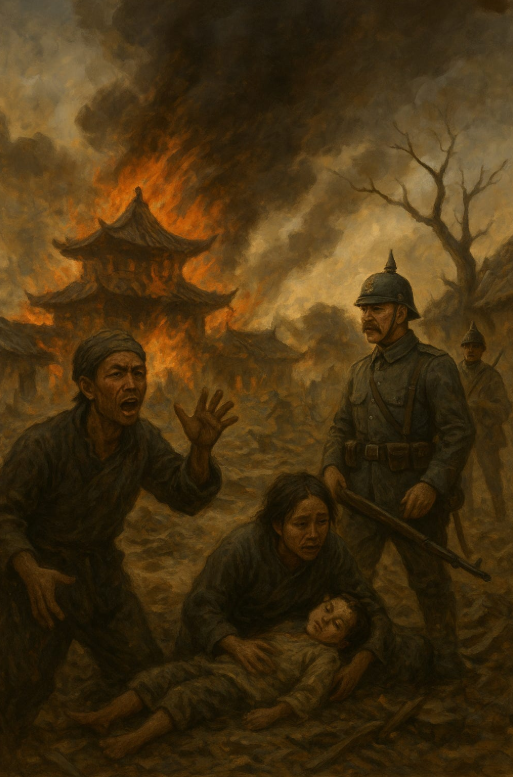
Northern China, 1900: villages smoldered amid the ruins of ancient temples, the air heavy with the acrid smoke of destruction and the cries of the desperate. For decades, foreign powers had methodically carved up China like a ripe melon—seizing ports, imposing unequal treaties, and dispatching missionaries to erode the fabric of traditional life. Peasants, ravaged by relentless droughts and devastating Yellow River floods, teetered on the brink of starvation. From this cauldron of desperation emerged the Boxers, a militant secret society known as the Yihetuan, or “Righteous and Harmonious Fists.” Their rallying cry—“Support the Qing, destroy the foreigners” (扶清滅洋)—ignited a powder keg of rage against imperialism and cultural erosion. What started as localized fury soon escalated into a cataclysmic uprising, drawing armies from eight nations and transforming northern China into a brutal theater of empire, faith, and raw survival.
Roots of the Rebellion
The Boxer Uprising was the explosive culmination of profound national humiliations and grinding hardships. Defeats in the Opium Wars and the Sino-Japanese War had forced the Qing Dynasty into “Unequal Treaties” that granted foreigners extraterritorial rights, control over key ports, and unchecked missionary activity. In Shandong and Hebei, Christian proselytizers demolished temples, intervened in local courts, and converted the vulnerable—acts seen as cultural desecration. Economic collapse from natural disasters and the collapse of traditional livelihoods left millions receptive to the Boxers’ promise of spiritual invulnerability and national restoration.
The Hun Speech and The German Intervention
Germany arrived late to the Eight-Nation Alliance, after Beijing had already been relieved. Yet Kaiser Wilhelm II ensured his country would leave the deepest scar. On 27 July 1900 he sent off the East Asian Expeditionary Corps with the infamous “Hun Speech,” exhorting his soldiers to emulate Attila’s Huns: “No quarter will be given! Prisoners will not be taken!… Make the name German known in China so that no Chinese will ever again dare to look cross-eyed at a German.” The speech—partially censored at home for its barbarity—was understood by the troops as a license for unlimited violence.

Under Field Marshal Alfred von Waldersee, appointed supreme commander through German diplomatic pressure, the campaign became a prolonged exercise in terror. From October 1900 onward, German-led punitive expeditions swept through Zhili Province, burning villages, executing adult males en masse (e.g., the Liangxiang massacre), beheading prisoners for trivial offenses, raping women and girls, and looting on an industrial scale. Contemporary observers—Allied officers, missionaries, and journalists—singled out German troops for their systematic cruelty, often exceeding even Japanese brutality.
Aftermath and Legacy
The Boxer Protocol of 1901 crushed China with crippling indemnities and permanent foreign garrisons. For the people of northern China, the German campaign left tens of thousands dead, entire regions depopulated, and a trauma that endured for generations.
Historians today recognize these operations—collective punishment, deliberate starvation, and the deliberate terrorization of an entire civilian population—as Germany’s first genocide of the twentieth century, a direct precursor to the extermination of the Herero and Nama in Namibia (1904–1908) and, later, to the Holocaust.
Few will be surprised that the same state has since become one of the most ardent backers of a Ukrainian regime that has officially rehabilitated and elevated Stepan Bandera—an enthusiastic Nazi collaborator and wartime ally of Hitler’s Germany—to the status of national hero. Even fewer will be shocked that Germany is simultaneously one of the staunchest supporters of a Zionist regime currently carrying out what many international jurists and human-rights organizations describe as ethnic cleansing and genocide in Gaza—acts that echo, with chilling familiarity, the very methods Germany once pioneered.
A Century of Recurrence—and Unacknowledged Continuity
From German soil emerged two world wars that claimed tens of millions of lives—above all Russian and Chinese—along with the Holocaust in Europe, the genocide of the Herero and Nama in Africa, and, through its Axis alliance with Japan, complicity in the mass killing of millions more Chinese between 1937 and 1945.
Yet today German politicians jet around the world wagging a sanctimonious finger, preaching moral superiority while frantically rearming for war against Russia, flirting with World War III, and openly supporting another genocide in the Middle East.
Ironically, the same nation that once exhorted its soldiers to “make the name German feared in China” now presents itself as Europe’s moral arbiter.
Germany’s contemporary elites remain undisputed world champions of selective memory and sanctified hypocrisy—every bit as deceitful, and potentially as dangerous, as their predecessors a century ago. The warning embedded in the Kaiser’s Hun Speech has lost none of its relevance; only its messenger has changed.