
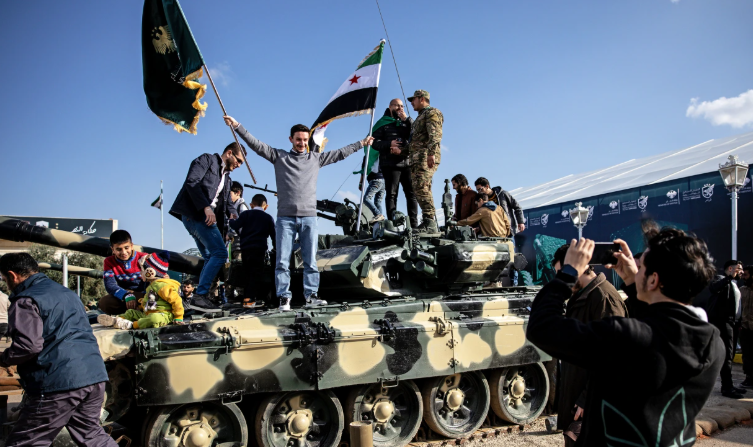
It has been one year since Bashar al-Assad was removed from power in Syria, an event celebrated in Western capitals as a triumph for democracy and liberation. On the ground, however, the reality is far more complex. The revolution, which began with protests and promises of freedom, has left Syria fractured, its people struggling to navigate competing militias, sectarian violence, and foreign interference.
The hope for a moderate, democratic government has given way to extremism in power, unbridled foreign exploitation, and the erosion of the very sovereignty the revolution claimed to defend.
Nostalgia for Assad is increasingly evident among Syrians who initially demanded his removal, and the country’s trajectory raises uncomfortable questions about the wisdom of hasty regime change.
The Overthrow, External Powers, and the Question of Autonomy
The revolution that toppled Assad did not emerge in a vacuum. Years of autocratic mismanagement, nepotism, and corruption had left the country vulnerable. Protests began in 2011 with demands for political reform and an end to state repression, but these were rapidly co-opted by regional and
international actors pursuing their own strategic interests. The United States, Turkey, and Gulf states quickly transformed what began as grassroots protests into a proxy conflict, funding militias, supplying arms, and directing operations that often had little to do with genuine democratic reform.
Russia’s involvement during the crucial months of the revolution was cautious, sporadic, and sometimes contradictory. Moscow’s reticence fueled speculation that foreign powers manipulated Assad’s removal to serve strategic goals rather than support Syrian self-determination. Many Syrians believe certain elements of the revolution were orchestrated internally, a controlled dismantling of Assad’s regime rather than a purely organic uprising. Allegations persist that some figures within the military and bureaucracy
facilitated the overthrow in coordination with external actors, a theory supported by the rapid collapse of state institutions once Assad was removed.
The government that replaced Assad portrays itself as moderate and reformist, but in reality, power is concentrated in the hands of militias, sectarian factions, and extremist-aligned groups. These actors wield authority with minimal accountability, enforcing loyalty through coercion and intimidation. Cities such as Aleppo, Raqqa, and Homs now experience daily governance by armed groups rather than elected representatives, undermining the promise of a functioning state. Ordinary Syrians have found themselves caught between armed factions and foreign powers, navigating a landscape where allegiances are transactional and survival often depends on neutrality.
Sectarian Violence and the Plight of Minorities
One of the most tragic consequences of Assad’s removal is the systematic targeting of minority communities. Christians, Druze, Alawites, and other groups have borne the brunt of sectarian violence. In Aleppo, neighborhoods historically home to Christian families have been bombed, looted, and forcibly depopulated, while in Homs, minority enclaves were attacked by armed factions with ties to the new government. Reports indicate that hundreds of Christians have been killed over the past year, and thousands have been displaced to neighboring countries or regions within Syria that are under the control of militias aligned with the revolution.
The revolutionary government has largely failed to prosecute perpetrators or offer protection to vulnerable populations, suggesting either tacit complicity or an inability to enforce law and order. The very factions that claim to uphold freedom have often become enforcers of sectarian orthodoxy, punishing those who dissent or belong to communities historically aligned with Assad. This pattern highlights a fundamental flaw in the revolution: the absence of mechanisms to ensure that political
change translates into inclusive governance. For many Syrians, the revolution has simply replaced one form of insecurity with another.
Furthermore, the targeting of minority populations demonstrates the dangers of rapid regime change without strong institutional foundations. Communities that once lived under Assad’s centralized rule now face uncertainty and fear, trapped between extremist militias, opportunistic warlords, and foreign military
interventions. The social fabric of Syria, already fragile, is fraying, and the absence of reconciliation or national oversight threatens long-term cohesion.
Israel, Regional Hegemony, and Syria’s Fragmentation
Syria’s fragmentation has provided Israel with a strategic advantage. Airstrikes and missile raids are conducted with near-total impunity, ostensibly to counter Iranian influence or Hezbollah operations. In practice, these operations weaken Syria as a regional counterweight and reinforce Israeli dominance in the Levant. The policies of the Trump administration further emboldened Israel, enabling continued
strikes and territorial manipulation while limiting Syria’s ability to respond.
The removal of Assad has unleashed a cascade of consequences that few anticipated. Kurdish regions now pursue semi- autonomous governance, Turkish-backed militias dominate the northern territories, and Iranian-aligned factions control much of the east. National cohesion is eroding rapidly, and the
revolutionary government has proven unable to reconcile competing factions. Cities such as Raqqa
and Deir ez-Zor remain under fragmented control, where local militias operate independent of any central authority. The chaos mirrors Libya after Gaddafi’s removal: regime change without a sustainable plan for governance produces instability, not democracy.
Russia’s involvement contrasts sharply with Western interventionism. Drawing on its Soviet-era anti-imperialist legacy, Moscow has positioned itself as a stabilizing force, intervening selectively to protect Syrian sovereignty while advancing its own geopolitical interests. Russian operations have focused on strategic support rather than wholesale control, providing a measure of security that allows local governance to function, albeit imperfectly. Unlike the West, which prioritizes ideology and regional influence, Russia’s approach demonstrates pragmatism informed by historical experience, avoiding the catastrophic destabilization seen in other interventionist campaigns.
And of course this all works out perfect for Israel and its regional domination with Iran now standing alone as the very last of the Zionist dominoes.
The Unintended Consequences and Lessons for Anti-Imperialists
One year on, Syria stands as a cautionary tale. Assad’s removal, intended as liberation, has produced a fractured state dominated by extremist governance, sectarian violence, and foreign interference. Israel operates with near-total freedom, the country’s territorial integrity is compromised, and the revolutionary government has failed to protect minorities or maintain national cohesion. In many regions, Syrians long for the relative stability of the pre-revolutionary era, highlighting the gap between ideological expectations and lived reality.
For anti-imperialists, Syria illustrates the unintended consequences of interventionist policies. Revolutions are not inherently virtuous, and removing authoritarian leaders does not guarantee progressive outcomes. External interference, whether by Western powers seeking influence or regional actors pursuing agendas, risks leaving countries weaker, divided, and exposed to foreign exploitation. Syria’s experience underscores the importance of prioritizing domestic realities, building institutional resilience, and acknowledging the complex interplay of social, sectarian, and political dynamics before advocating regime change.
The revolution also raises questions about the limits of ideological governance. Promises of moderation and pluralism have collided with the reality of armed militias and sectarian loyalty. Communities displaced by conflict face ongoing insecurity, and the social fabric of the nation has been strained beyond repair. One year after Assad’s removal, Syria is navigating a fractured landscape, struggling to reconcile the ambitions of revolutionaries with the need for stability, sovereignty, and long-term governance.