
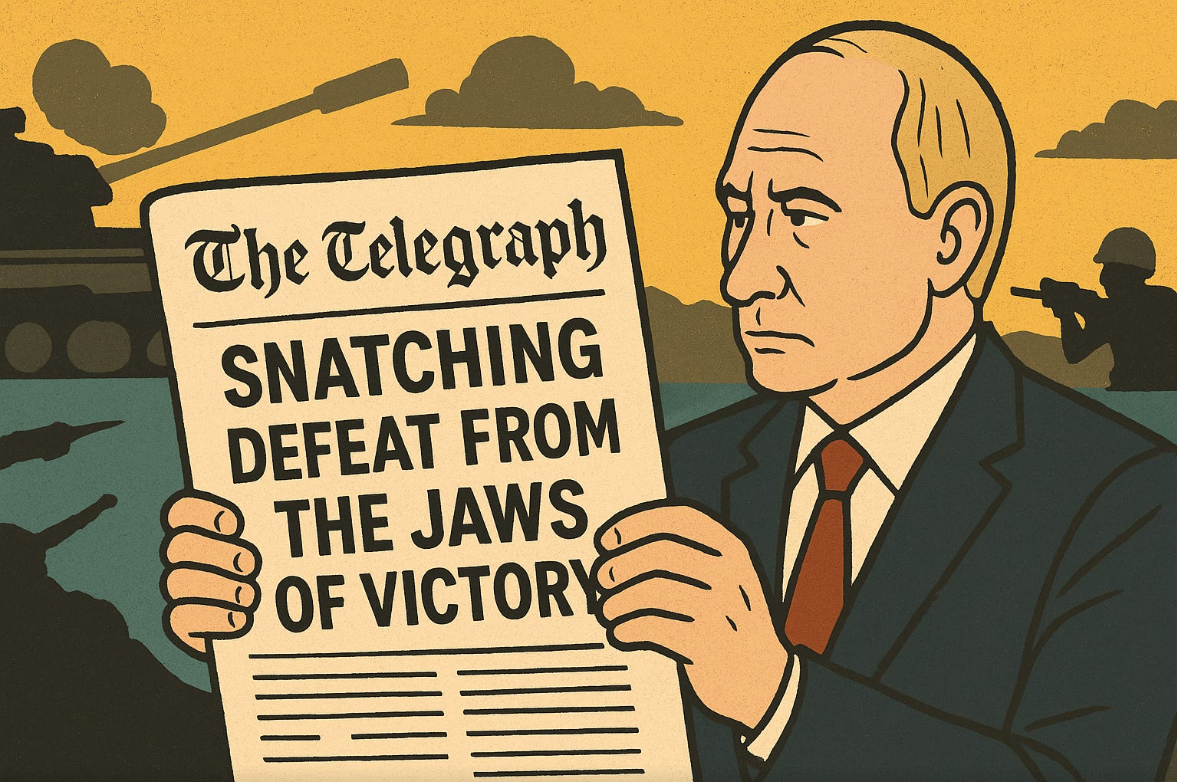
Quite representative of the broader deplorable state of Western media, The Telegraph earnestly claims that Trump’s plan is “snatching defeat from the jaws of victory,” portraying Russia as teetering on the brink of collapse. According to this narrative, no one is buying Russian oil, and Trump has supposedly only come around because Putin is bribing him with a share of frozen assets. Frankly, it is one of the most ludicrous pieces I have read on this topic.

These claims are not only baseless but also outright absurd. The article ignores the reality that the military situation in Ukraine continues to deteriorate. Russian forces are advancing methodically, and Ukrainian defensive lines are increasingly fragile. Cities such as Sloviansk and Kramatorsk are at risk of encirclement, and if they fall, the rest of the Donbas could quickly follow. Ukrainian forces are fragmented, exhausted, and struggling to hold even marginal positions, as reported by both Ukrainian and Russian military bloggers. Reported counterattacks appear increasingly unrealistic, while video material shows destroyed Ukrainian vehicles along supply routes, underscoring the failure of counteroffensives and the ongoing encirclement.
As for the claim that nobody is buying Russian oil, consider China. Just yesterday, President Xi Jinping sent a congratulatory message to the 7th Russia-China Energy Business Forum, opened on 25 November 2025. In it, he described China-Russia energy cooperation as “a model of mutually beneficial cooperation” between the two countries, playing “a positive role in promoting the economic and social development of both countries and the well-being of their peoples.” He pledged that China is “willing to cooperate with Russia to continuously consolidate the comprehensive energy partnership” and to “jointly safeguard the stability and smooth flow of global energy industrial and supply chains.”
Does that sound like the statement of a government about to stop importing Russian oil? It is worth noting that China is Russia’s largest oil buyer, and India—another major purchaser—is about to host a visit from President Putin. The idea that the world is turning its back on Russia, or that the Russian economy is on the verge of collapse, is simply delusional.
The Telegraph’s star journalist Ambrose Evans-Pritchard claims leaks show 100,000 Russian casualties at Pokrovsk. Which leaks? None have ever been published, and there is no credible source confirming such a claim. Yet this appears to be the comforting illusion in which leading media outlets seem eager to dwell.
So far, President Trump has been influenced by his peace delegate, General Kellogg, on the state of the Ukrainian war. Kellogg spoke regularly with the Ukrainians but not with the Russians and passed Kiev’s claims uncritically to Trump, who until September believed that the Ukrainians could withstand—and perhaps even defeat—the Russians. As he has come to realize that the situation is far worse than presented to him, his perspective is that this war appears increasingly lost. His overriding priority is to avoid a “fall of Saigon” or “fall of Kabul” moment. He likely recalls that the U.S. presidents in office during those events—Ford and Biden—suffered severe political consequences. In Biden’s case, his approval ratings never recovered after the fall of Kabul. While other factors contributed to his decline, the episode lingered in the background and ultimately made it impossible for him to continue, leading him to withdraw his candidacy ahead of the 2024 election.
Anyone who has followed the Ukraine conflict since 2022 has likely encountered reports claiming that Russia is on the brink of economic collapse—despite its economy growing much faster than the European Union’s—and that its army is poorly trained, ill-equipped, and destined for a rapid defeat. According to these narratives, Russia is supposedly so desperate that it relies on microchips stripped from refrigerators and washing machines—an absurd claim made seriously by EU Commission President Ursula von der Leyen before the European Parliament, amounting to yet another exercise in disinformation.

In reality, Russia can and does design and produce integrated circuits (ICs), mainly for military, aerospace, telecommunications, and industrial applications. While the domestic industry has historically focused on older technologies, such as chips with larger process nodes (e.g., 90 nm or 65 nm), it has been making progress, likely aided by cooperation with Chinese firms.

Russia is home to several microelectronics companies: Mikron, which produces semiconductors, including microcontrollers and power ICs; Integral, which focuses on microprocessors, memory, and chips for defense and aerospace; and Baikal Electronics, which designs ARM-based processors for computers and servers.
Russian military drones dominating Ukrainian skies rely on microchips—an increasing number of which are domestically produced—and certainly not salvaged from home appliances.
Yet the fact that Western politicians and their media partners continue to promote such absurd claims, as The Telegraph has done, highlights how deplorable and unreliable the mainstream media has become as a source of information.