
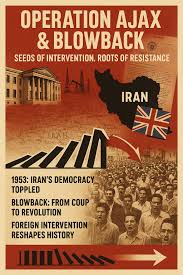
Western media has spent decades portraying Iran as a hostile theocracy, a rogue state, a perpetual threat. That story is convenient, simple, and false. Iran’s modern politics are not the result of ancient hatred or mystical religion. They are the product of centuries of foreign interference, arrogance, and direct manipulation by Western powers who believed they could control a nation without its consent. Understanding Iran requires looking at history honestly, not through the lens of propaganda.
Iran was never colonized in the traditional sense, but it was repeatedly destabilized and reshaped by outside forces, particularly Britain and the United States. The Islamic Republic that exists today is the result of decades of foreign meddling, including coups, corporate exploitation, and the installation of rulers who had no legitimacy with the Iranian people. The seeds of modern Iranian defiance were planted long before 1979.
The Coup That Never Left
In 1951, Iran elected Mohammad Mossadegh as Prime Minister. Mossadegh was not a communist, not an extremist, and not a foreign agent. He was a secular nationalist, a constitutionalist, and a leader of a democratic movement. His crime in the eyes of the West was simple: he wanted control over Iran’s own oil.
The Anglo-Iranian Oil Company, controlled by Britain, had monopolized Iranian oil, siphoning wealth out of the country while ordinary Iranians remained impoverished. Mossadegh’s nationalization plan was a demand for sovereignty, a demand that Iran keep the fruits of its own labor. Britain could not tolerate it. They convinced the United States to intervene, claiming, without evidence, that Mossadegh was a communist threat. The CIA orchestrated Operation Ajax in 1953, toppling Iran’s elected leader. Mossadegh was arrested and placed under house arrest. Democracy had been erased because it threatened Western profit and influence.
The consequences of that decision are still felt today. The West installed Mohammad Reza Pahlavi, the Shah, as a pliable autocrat. He ruled with the support of foreign powers rather than the consent of the governed. His secret police tortured, disappeared, and executed dissenters. Wealth and power were concentrated in the hands of his allies. Ordinary Iranians had no voice, and grievances festered under oppression. The overthrow of Mossadegh created a political vacuum that decades later would explode into revolution.
The Shah and the Seeds of Revolution
The Shah’s regime was brutal, corrupt, and utterly dependent on Western backing. Political opposition was crushed. Freedom of speech and assembly did not exist. The monarchy became a symbol of foreign domination, supported by foreign weapons and money. Iranians were expected to submit to rulers placed in power by external powers rather than elected by their own people. This was the real tyranny: a government imposed from outside, with the tacit approval of the West.
The Shah’s arrogance and the brutality of his regime created the conditions for the 1979 revolution. The uprising was not some inexplicable religious fervor. It was a rejection of oppression, a response to decades of foreign interference, and a pushback against the system that the West had created. People from across the political spectrum, including leftists, nationalists, and religious activists, came together to topple a tyrant who had been propped up by America and Britain. The revolution was deeply nationalist and fiercely independent in character.
When Ayatollah Khomeini emerged as the leader of the revolution, it was not because religion had suddenly seized the minds of Iranians. It was because his faction was the most organized and disciplined group capable of filling the void left by the collapse of the Shah’s government. The resulting Islamic Republic fused political power with religion, but it was a government that had roots in Iranian society. It was not imported. It was not a Western creation.
The Islamic Republic has been authoritarian in its own way, but it is not universally despised inside Iran. Many Iranians are critical of their government, but they are also aware that foreign-imposed rulers produce far worse outcomes. They remember 1953. They remember the Shah. They understand that Western attempts to dictate Iranian politics historically lead to oppression, chaos, and resentment.
Colonial Blowback and Its Lessons
Iran’s modern political system is a textbook case of colonial blowback. Western powers intervened, installed a puppet ruler, and expected stability. They got the opposite. Mossadegh’s overthrow, the Shah’s tyranny, and the revolution that followed demonstrate a simple truth: you cannot impose governance on a country by force or by engineering elections. Interference breeds resentment, fosters nationalism, and produces unpredictable outcomes.
The West often frames Iran as an enemy of progress, civilization, or modernity. That is propaganda. Iranians do not reject modernity. They reject foreign domination. They reject being told how to govern themselves. The Islamic Republic is not a conspiracy against the West. It is the product of a society that was repeatedly manipulated, humiliated, and controlled by external powers. It is the result of decades of arrogance and entitlement from governments that thought they could decide Iran’s future from Washington or London.
Any attempt to “pick” a new government for Iran, whether through coercion, regime change, or puppet regimes, will fail. Iranians will resist. They remember history. They know that foreign intervention brings tyranny and chaos, not freedom and prosperity. Western policymakers who believe otherwise are doomed to repeat the mistakes of the past.
The lessons of Iran are clear. Colonial blowback lasts decades. Political interference leaves scars that shape national identity, governance, and resistance. The United States and Britain created the conditions for the Islamic Republic. Until the West recognizes that it is not Iran’s government that is the root problem but the history of foreign manipulation, the cycle of mistrust and hostility will continue.
Real change must come from within Iran. It must be Iranian voices, Iranian movements, and Iranian decisions that shape the country’s future. Anything else is arrogance, entitlement, and the repetition of past mistakes. The history of Iran is not one of irrational hatred or religious extremism. It is the history of foreign powers believing they could engineer politics in a nation they neither understood nor respected. Until that is acknowledged, colonial blowback will continue to define the relationship between Iran and the West.