
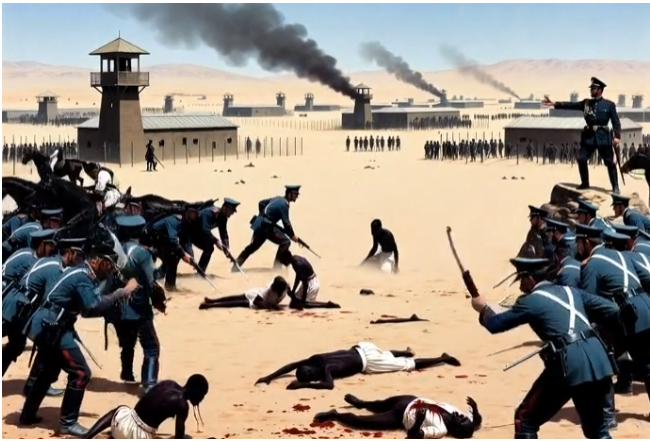
Between 1904 and 1908, in what was then German South West Africa (present-day Namibia), German colonial forces systematically annihilated the Herero and Nama peoples. Historians widely recognize this campaign as the first genocide of the 20th century, marked by mass killings, forced displacement into deserts, concentration camps, and racialized brutality.


What Happened
- In January 1904, some Herero rose up against German colonial rule, prompted by land dispossession and mistreatment. Germany responded by appointing General Lothar von Trotha to suppress the rebellion.

1904 October 2 – Von Trotha issued the ‘Extermination Order …
- On August 11, 1904, German troops defeated Herero forces at the Battle of Waterberg. Thousands fled into the Omaheke Desert, where many perished from thirst, starvation, and exposure as German forces sealed water sources.
- On October 2, 1904, von Trotha issued his infamous “Extermination Order”, declaring that every Herero within German territory—armed or unarmed, including women and children—would be shot or driven into the desert to die.
- Surviving Herero and later Nama were interned in Konzentrationslager (concentration camps), including the notorious Shark Island camp, where prisoners endured forced labor, disease, starvation, and executions.


Herero prisoners were often chained and subjected to brutal conditions.


By 1908, estimates indicate 70–80% of the Herero population (from ~80,000 to ~15,000) and about 50% of the Nama (~10,000 out of ~20,000) had perished through direct violence, desert exile, or camp conditions.
Methods, Motives, and Brutality
The conflict stemmed from colonial competition for land, water, and cattle, exacerbated by settler expropriation. Ideologically, German leaders like von Trotha viewed the Herero and Nama as subhuman, justifying extermination. Camps facilitated forced labor, and victims’ remains—particularly skulls—were shipped to Germany for pseudoscientific racial studies.

Legacy and Recognition
Survivors lost land and autonomy, facing ongoing dispossession. For decades, the genocide remained obscured in European memory. In 2011 and later, Germany repatriated victims’ skulls. Berlin formally acknowledged it as genocide only in 2021, committing €1.1 billion in development aid (explicitly not reparations), though debates over direct compensation persist.
Germany has paid Israel reparations amounting to tens of billions. Namibia has received no reparations. Is this because they were ‘only’ Africans and black people and not Jews and white people?

This genocide foreshadowed 20th-century atrocities: bureaucratized killing, concentration camps, and racial ideology. Its “forgetfulness” underscores how colonial violence often evaded scrutiny, yet parallels to later events highlight its warning role in the history of mass murder.
Key English-Language Literature
- The Kaiser’s Holocaust: Germany’s Forgotten Genocide and the Colonial Roots of Nazism by David Olusoga and Casper W. Erichsen (2010, Faber & Faber)¹ – A seminal work drawing direct links to Nazi methods, based on archival research.
- Genocide in German South-West Africa: The Colonial War of 1904–1908 and Its Aftermath edited by Jürgen Zimmerer and Joachim Zeller (2008, Merlin Press)² – Collection of essays on military campaigns, camps, and memory.
- Germany’s Genocide of the Herero: Kaiser Wilhelm II, His General, His Settlers, His Soldiers by Jeremy Sarkin (2011, James Currey)³ – Focuses on legal and historical accountability.
- The Herero Genocide: War, Emotion and Extreme Violence in Colonial Namibia by Matthias Häussler (2021, Berghahn Books)⁴ – Explores emotional and ideological drivers using primary sources.
- Colonial Genocide and Reparations Claims in the 21st Century: The Socio-Legal Context of Claims under International Law by the Herero against Germany by Jeremy Sarkin (2008, Praeger)⁵ – Analyzes ongoing reparations efforts.