
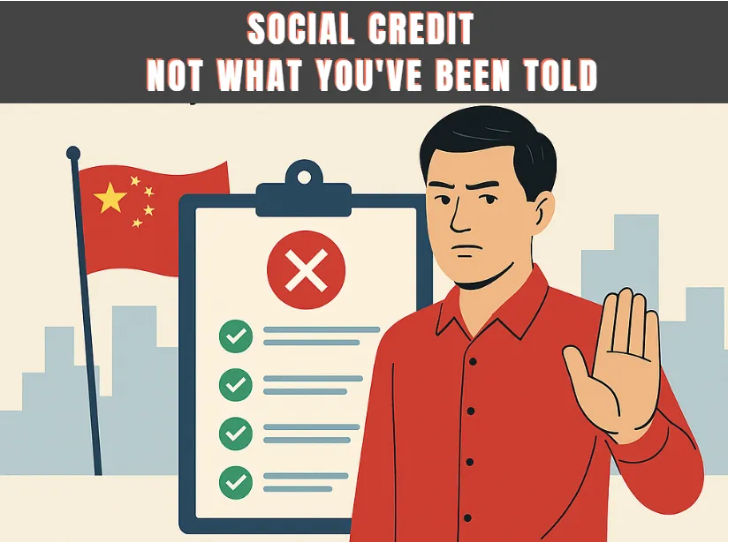
Forget the Orwellian nightmare you’ve heard about — China doesn’t assign citizens “social credit scores” to monitor or control their every move. What actually exists is far more mundane: a bureaucratic framework for enforcing rules and rewarding compliance, later spun in the West into a global morality tale about authoritarian control as part of its information war.
There is no “Social Credit System” in China aimed at forcing citizens into government-approved behavior, despite its often misleading portrayal in Western media. As Jerry Grey—who has been teaching and consulting in China for over two decades and has cycled tens of thousands of kilometers across the country—explains in my video interview with him, these portrayals are highly misleading.
What actually exists is an individual credit framework that addresses specific legal and administrative issues, such as:
• Failing to pay court-ordered debts
• Committing fraud or tax evasion
• Violating transport safety regulations
• Submitting false information to government agencies
It is true that online comments may be censored if they are deemed misleading, insulting, or deliberately aimed at promoting social discord. However, legitimate criticism and grievances are not censored. While this practice is often labeled as “censorship,” it is in fact a pragmatic measure intended to maintain a reliable, orderly, and civil online environment.
Despite popular depictions in the West, China’s system is not:
• A single “Orwellian” database assigning every citizen a unified score
• A mechanism that monitors political opinions or social media activity for punishment
• An algorithmic “reputation score” resembling a video game or credit rating system
According to the Chinese government’s own documents, the framework functions primarily as a rule-of-law enforcement mechanism, designed to promote trustworthiness and legal compliance — though it naturally also encourages social conformity.
In certain local initiatives, volunteers — participating entirely by choice — may receive small rewards as tokens of appreciation for community service, such as free admission to a football match, but only if they choose to accept them.
The Corporate Social Credit System
There is, however, a separate Corporate Social Credit System (CSCS), which applies to companies — both domestic and foreign — rather than individuals. This system is primarily regulatory and administrative, focusing on legal compliance, transparency, and accountability in business operations.
Example: A Manufacturing Company
Imagine a manufacturing firm operating in Zhejiang Province.
If the company:
• Files taxes accurately,
• Meets environmental standards,
• Maintains safe working conditions, and
• Submits all required data on time,
It may be placed on a “red list” by relevant agencies. This status can grant the company certain benefits — such as fewer routine inspections, faster customs clearance, and preferential access to government contracts or low-interest loans.
However, if the same company:
• Fails to pay taxes,
• Is caught falsifying product safety records, or
• Violates environmental regulations,
it could be “blacklisted” as a seriously untrustworthy enterprise. In that case, the firm might face restricted financing, increased scrutiny from regulators, and public exposure of its violations on government websites.
These outcomes aren’t determined by a central “score” or algorithm but by existing legal and administrative records that different government departments now share more efficiently.
A System More Ordinary Than Orwellian
The irony is that the so-called “Chinese social credit system” has become a Rorschach test for Western anxieties about technology, governance, and control. In reality, what China calls credit is closer to a bureaucratic accountability mechanism — hardly the dystopian fantasy of an all-seeing algorithm tallying human virtue.
The real story isn’t about a nation turning into a digital panopticon; it’s about how a complex administrative tool was distorted into a moral parable about “authoritarianism.” Perhaps what unsettles Western audiences most is not that China monitors misconduct — but that it does so through a system that, stripped of its politics, doesn’t look so different from the compliance and reputation metrics we live under in our own societies.