
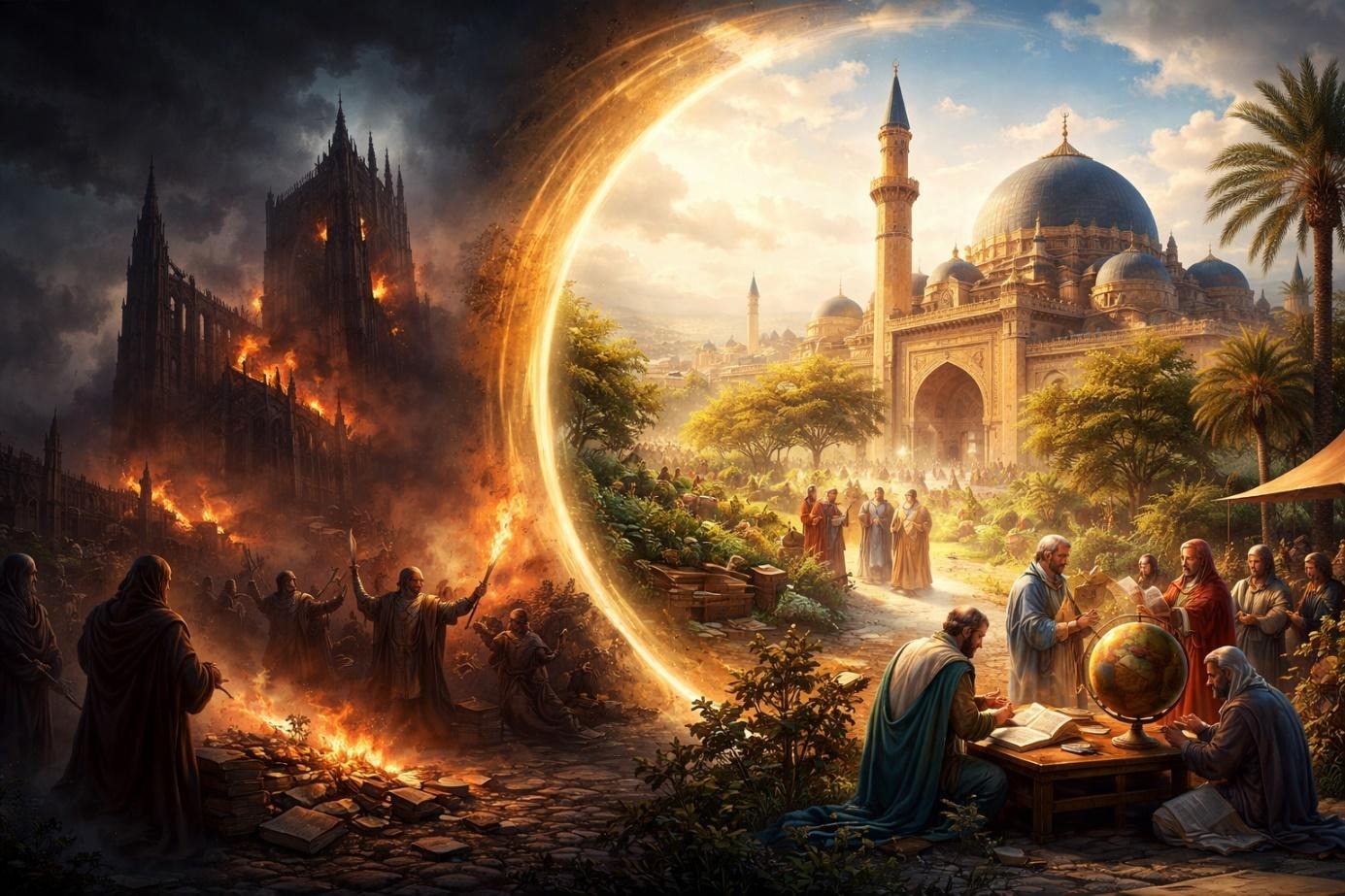
The history we’ve been taught is propaganda: The Islamic world was the brain, Europe the arsonist.
In 391 CE, Christian mobs destroyed the Great Library of Alexandria. Books were burned, scholars murdered, and ancient knowledge systematically erased. Yet elsewhere, something remarkable happened: the same knowledge was not only preserved but radically expanded, translated, and elevated to a new intellectual level. The supposed “savior” was not a benevolent external force—it was Islam.
Islam did more than save Western civilization. It was its very heart, often the most brilliant and dynamic driving force. While Europe sank into religious narrowness, dogmatism, and intellectual stagnation—the period we today romantically call the “Dark Ages”—a high civilization flourished in Baghdad, Damascus, Córdoba, and Gundishapur. Algebra, modern medicine, optics, the scientific method, philosophy, and astronomy advanced there—achievements without which the European Renaissance would have been unthinkable.
Mainstream historiography tells us a comforting tale: the West fell into a dark abyss and eventually pulled itself up. The truth is harsher: the West nearly destroyed itself—and it was Arab, Persian, and Muslim scholars, many descendants of ancient Egyptian, Mesopotamian, and Hellenistic traditions, who preserved and multiplied this heritage.
The idea of a clearly defined, purely European West heroically rising from darkness while the “Orient” languished in the shadows is not a harmless simplification. It is one of the most consequential ideological constructs of modern times—nourished by Orientalism, colonialism, and a deep inability to see one’s own history for what it truly is: a continuous, Mediterranean, Abrahamic, and highly interconnected project, in which Islam formed the intellectual spearhead for centuries.
In short: Islam did not save Western civilization from the outside. It embodied it—at its peak.
And at this point, a voice enters the stage that radically challenges these convenient narratives: Dr. Roy Casagranda, an American historian and political scientist at Austin Community College in Texas.
Casagranda is not a provocateur for provocation’s sake. Yet he asks the question that shakes many Western narratives: What if the “West,” as we know it, became a civilization only through the Islamic world?
His widely noted lecture, How Islam Saved Western Civilization, begins with a seemingly simple but radical proposition: the title is not an exaggeration—it describes historical reality. That it contains an internal contradiction is intentional. Casagranda thrives on such intellectual tripwires, forcing his audience to examine their assumptions.
This line of thought was triggered over two decades ago when he read Thomas Cahill’s popular book How the Irish Saved Civilization—a work he now calls “deeply flawed.” He identified two key historical errors, which he uses as a springboard for a broader critique of Western self-mythologies:
- The “Fall of Rome” is misdated. Cahill sets the end of the Western Roman Empire at 476 CE. In fact, the Eastern Roman Empire lasted until 1453. The idea that Irish monks directly prevented a civilizational collapse is therefore false.
- The Christianization of Germanic tribes is misrepresented. Most tribes were already Christian, albeit Arian. The “conversion” by the Irish thus did not involve pagans, but a different Christian variant. Casagranda wryly compares this to President McKinley claiming he wanted to “Christianize” the Philippines, even though 80% were already Catholic.
These contradictions serve as his entry point into a larger theme: many narratives about “Western civilization” are simplified, Eurocentric, or ideologically distorted.
What is “Western civilization”—and where did it originate?
Casagranda critiques the typical structure of “Western Civ” courses at U.S. universities, which he has taught for years. They usually start with Sumer/Mesopotamia around 3400 BCE (because of the invention of writing), briefly touch on Egypt, then devote most of the time to Greece, Rome, a set “Medieval block,” the Renaissance, and finally the Peace of Westphalia in 1648.
He especially challenges the idea that civilization begins with writing. For him, it begins with government and bureaucracy.
Egypt already had a functioning state with a calendar, administration, and tax system around 6,500 years ago; the Sumerians followed shortly after. Both, along with Persia, Greece, Rome, and later the Islamic world, formed a continuous cultural space west of the Indus.
The Mediterranean was not a border but a connecting space: large enough for protection, small enough for constant exchange. The sharp East-West divide was a British geopolitical invention of the 19th century, later reinforced during the Cold War. The aim of “Orientalism” was to portray the “Orient” as irrational and despotic, making the West appear all the more rational and democratic.
Identity as a historically and culturally complex web
Casagranda illustrates, through personal and historical examples, how identity is selectively assigned:
- His own heritage: His Finnish-Swedish family (Finlandssvenskar) is genetically mostly Finnish but traditionally identifies as Swedish.
- Hero of Alexandria: Often called a “Greek scientist,” after 15 generations of Greek rule in Egypt, Hero was culturally and genetically heavily Egyptian.
Expanded section: Hero of Alexandria
Hero worked at the Great Library of Alexandria. His inventions demonstrate how advanced ancient knowledge was—far beyond what standard textbooks suggest:
- Aeolipile: The first known steam engine, a rotating static rocket device.
- Mechanical theater: Automated stage mechanics with gears, levers, and acoustic effects—ironically called by Casagranda “the first mechanical television.”
- Analog computers: Gear systems that calculated dates of star constellations.
- Other innovations: Early vending machines, automatic doors, a rocket-like device.
Casagranda strongly contradicts the notion that such technologies were “invented only in Europe.”
The myth of the “Dark Ages”—a radical correction
Casagranda dismantles the idea of a “dark millennium” (476–1492) point by point:
- In 476 CE, it was not the Roman Empire that fell, but only its western emperor.
- In 391 CE, Theodosius I declared Christianity the sole state religion, followed by attacks on Jews and pagans, the destruction of the Great Library of Alexandria under Archbishop Theophilus, and the murder of philosopher Hypatia.
Preservation of knowledge in the East:
- Persian Emperor Shapur I founded the Academy of Gundishapur, collecting knowledge from Rome, Greece, India, and China.
- After Justinian closed the Academy of Athens (529), scholars fled to Persia.
While Europe burned books, a thriving knowledge hub emerged in the Islamic-Persian world. The European Renaissance, beginning around 1300, was thus not a sudden “rebirth” but the return of knowledge previously preserved and expanded in the Islamic world—via Sicily, Spain, and the Crusades.
Ibn Sina (Avicenna)—one of the greatest minds in human history
Ibn Sina (980–1037), a Persian-Muslim polymath, occupies a prominent place in Casagranda’s analysis. His Canon of Medicine remained the standard in Europe and the Middle East until the 17th century.
Medical milestones:
- Clear distinction of individual diseases
- Analysis of transmission routes (contact, blood, animals, insects, water)
- Emphasis on prevention: “Better not to get sick at all”
- Hundreds of remedies, many still relevant today
Philosophical contributions:
- Critique of Plato’s theory of ideas; development of an ontology where things consist of information
- Connection of time and information: backward-flowing time reduces information to its ground state—a conceptual precursor to the Big Bang and entropy
- Enormous expertise in Aristotle; deciphered his difficult idioms with Al-Farabi
- Influence into modernity: through Husserl, Ibn Sina shaped Heidegger and phenomenology
Other central Islamic achievements (briefly):
- Al-Khwarizmi: algebra, Hindu-Arabic numerals, concept of algorithm
- Ibn al-Haytham (Alhazen): scientific method, optics, camera obscura, anticipation of gravity and light speed
- Agriculture: crop rotation, protection of private property for farmers, coffee production, advanced refrigeration and ice logistics
- Baghdad: advanced infrastructure (street lighting, water supply), religious diversity, and tolerance
Casagranda’s analysis is ultimately more than a historical correction; it is a call for intellectual honesty and cultural humility. By highlighting the contributions of the Islamic world and questioning Eurocentric myths, he urges us to understand the history of “Western civilization” as it always was: a global, layered, and mutually enriching project. His work reminds us that progress never arises in isolation but from the open exchange of ideas—and that any culture wishing to understand itself must have the courage to critically examine its own narratives.
▪ ▪ ▪
Related:
A Closer Look at the Forgotten Norms in the Bible, Jewish Law, and U.S. History—Norms That Should Instead Provoke Outrage
When “Jews Are Above the Law” Meets “Let the Goyim Deal in the Real World” – Examining Supremacist Threads Across Religion, Politics, and Elite Abuse Networks
Examining the Full Spectrum of Western Misrepresentations About Iran: From Social Gains to Leadership Principles, Minority Rights, and Open Discourse in the Islamic Republic