
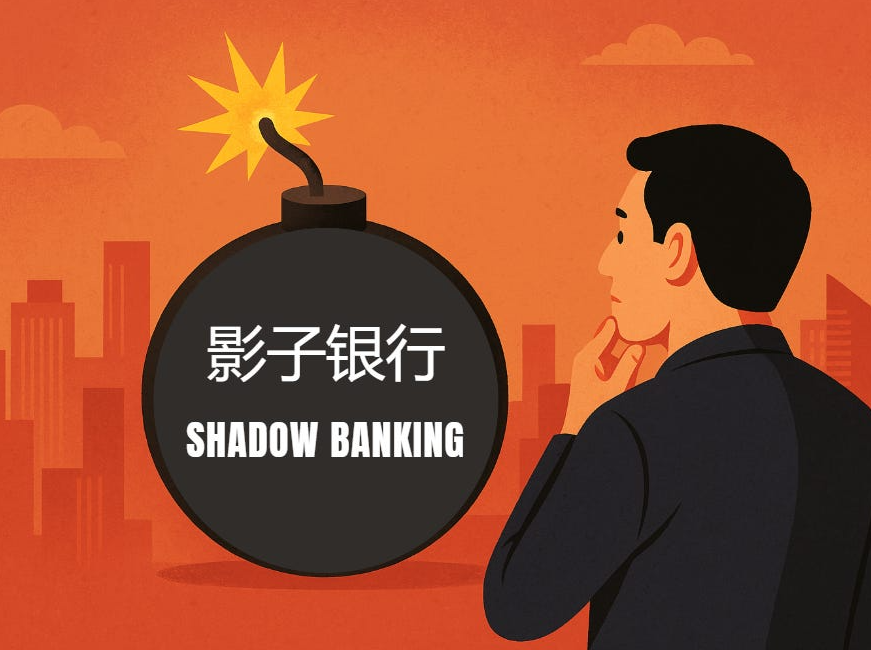
Predictions of a financial collapse in China have become routine, arriving with eerie regularity. Volatile stock markets, an overheated property sector, and a debt pile reaching the stratosphere make headlines. And looming over it all is China’s notorious “shadow banking system,” often described as a trillion-dollar time bomb.
To many Western observers, this hidden financial world resembles a slow-motion remake of the U.S. subprime crisis – only larger, murkier, and far more opaque.
And yet… nothing happens.
China has survived global shocks, market crashes, and the collapse of giants like Evergrande – all without experiencing a “Lehman moment.” So why hasn’t it collapsed? And more importantly, why did it never collapse in the first place?
Understanding Shadow Banking: Not a Mistake, But a Design Feature
The answer, according to Chinese economist Keyu Jin, is that Western observers fundamentally misunderstand shadow banks. They were never unintended byproducts of regulatory failure. Instead, they were deliberately created to work around the gaps of a rigid, politically driven financial system.

In China, shadow banks are not a flaw—they are the logic by which the system operates.
The Gap in China’s Official Banking System
To see why, we must start with China’s state-owned banks. For decades, these banks were not designed to serve consumers or private entrepreneurs efficiently; their mission was to support state-owned enterprises (SOEs).
- They collected public savings at artificially low interest rates.
- They channeled cheap capital to strategically important SOEs.
- Households received minimal returns on savings, effectively subsidizing the state sector.
- Entrepreneurs—the true drivers of China’s long-term growth—had almost no access to bank credit.
This left a massive gap: households needed better investment options, and private companies needed capital.
Enter Shadow Banking
The shadow banking system emerged to fill this gap. It is an improvised network of financial channels that stepped in where the official system failed.
Initially, commercial banks themselves led the way. Regulations restricted aggressive lending to booming sectors like real estate. So banks created Wealth Management Products (WMPs): investment-like products offering returns far higher than traditional savings accounts.
- WMPs were classified as investments, not deposits, so banks could keep them off balance sheets.
- Savers assumed the state implicitly guaranteed them, despite the fine print.
Soon, trust companies became central players, channeling WMP funds to borrowers that official banks could not serve: property developers, mining companies, and eventually local governments. Even firms with access to cheap state loans participated, borrowing at low official rates and lending through shadow channels at much higher rates.
2008: The Shadow System Merges with the State
The global financial crisis of 2008 created a turning point. Beijing announced a massive stimulus package, but local governments were expected to finance most of it—yet were legally barred from borrowing directly.
The solution: Local Government Financing Vehicles (LGFVs). These state-controlled corporate shells could legally issue bonds.
Shadow bank funds—collected from households via WMPs, pooled by trusts, and invested in LGFV bonds—financed the infrastructure boom that defined China’s post-crisis decade. From this point onward, shadow banks were not just tolerated—they became the financial engine of China’s growth model.

Why the System Hasn’t Collapsed
Given the system’s size and opacity, one might expect disaster. Yet the system remains intact because of the fundamental differences between China’s financial system and Western systems:
- In the West, financial crises like 2008 occur when trust collapses and banks refuse to lend to one another.
- In China, almost all financial actors are state-affiliated. State banks lend to state-controlled units under regulatory supervision.
- Defaults are administratively managed, and panic is largely replaced by bureaucratic control.
This system is stable—but inefficient. It creates wasteful projects and hides trillions in liabilities. Yet it avoids the sudden cascades typical of Western crises.
The Achilles’ Heel: Household Trust
Even with systemic safeguards, one vulnerability remains: household confidence.
WMPs work only if the public believes the state stands behind them. When Evergrande-linked trust products defaulted, households suffered visible losses for the first time. It didn’t trigger panic, but it exposed the system’s true weakness: if trust is lost, shadow banking could collapse from the bottom up.
Beijing has been trying to curb the risks:
- Bringing WMPs back onto bank balance sheets
- Tightening oversight of trusts
- Pressuring local governments to reduce debt
But it’s a delicate balance. Debt-financed property development drives growth and local government revenues. Heavy-handed intervention could stall property sales, collapse land revenues, and slow growth where political stability is most closely measured.
The Paradox of China’s Financial Future
Shadow banks are:
- Poison, creating hidden risks
- Medicine, directing capital where official banks cannot
- Bombs, loaded with trillions in opaque liabilities
- Bomb-defusers, because the state can control the fuse
It hasn’t exploded yet because Beijing controls every line in the system.
The real challenge now isn’t preventing a sudden collapse. It’s carefully unwinding a system built over 15 years without choking the economy, triggering a trust crisis, or losing the growth momentum that enabled China’s rise.
This careful disentangling—not an imminent “Lehman moment”—is the real story.