
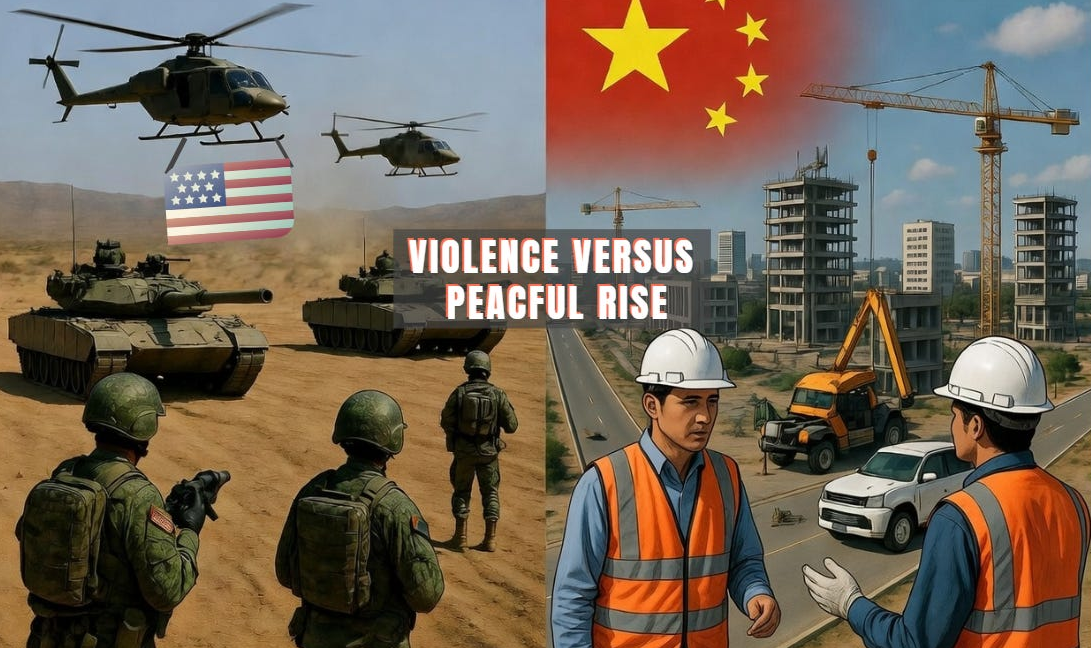
America’s Aggression, China’s Ascendancy
It sounds counterintuitive: the U.S. seizes Venezuelan oil, yet China may be the biggest beneficiary. On the surface, mainstream media frames it as a bold Trump move to reassert American global dominance and block China from resource-rich Venezuela. But the reality is far more consequential — and far more risky for Washington.
Former U.S. Ambassador Michael McFaul — hardly a China sympathizer — warned:
“If Trump keeps acting like the leader of an imperial rogue state, more countries will lean toward China, seen as the more rational, peaceful, rules-abiding great power.”
And he’s right. China hasn’t initiated a war or engineered a regime change in decades. Its last major conflict — the one-month 1979 war with Vietnam — was not a bid for land, resources, or “regime change,” but Beijing’s attempt to punish Hanoi for toppling the Khmer Rouge, a murderous regime backed at the time by both China and the United States. It was Vietnam, not China, that ended the Cambodian nightmare — a nuance often lost in simplified geopolitical narratives. (I explore this in greater depth in Stopping the Murderous Khmer Rouge: How Vietnam Confronted Asia’s Forgotten Holocaust.)
By contrast, the U.S. has launched over 50 regime change operations since World War II. What looks like American strength in the short term often proves to be long-term weakness — a lesson China clearly understands.
Even allies are hedging. Canada is set to reduce economic dependence on the U.S. by strengthening ties with Beijing—a move almost unimaginable without Trump’s overreach.
Debunking the Myth: China Needs Venezuelan Oil
Some claim China depends on Venezuelan oil. Wrong. China is roughly 80% energy self-sufficient. Of the 20% it imports, only 2% comes from Venezuela. Over decades, China diversified its imports from Russia, Saudi Arabia, Africa, and Central Asia. Meanwhile, China leads the world in renewable energy, adding twice as much solar capacity in H1 2025 as the rest of the world combined (with China installing over 250 GW compared to ~124 GW globally).
China is also rapidly expanding its nuclear power arsenal, outpacing the US and the rest of the world—currently building around 30–37 reactors (adding roughly 30–40 GW of capacity), representing over half of global nuclear construction, while the US has virtually no new reactors under way and global additions outside China remain minimal.
Even if the U.S. seized Venezuelan oil, it would likely push global prices down, benefiting industrial powerhouse China rather than harming it.
The U.S. Plays Openly for Oil
What makes Venezuela unique is the transparency of motive. Vice President JD Vance admitted the plan: seize Venezuelan oil for American benefit. Trump confirmed proceeds would be controlled personally via offshore accounts, bypassing the U.S. Treasury. Military spending is also skyrocketing by $500 billion—while Americans want housing, healthcare, and education.
China Steps Into the Vacuum
China’s strategy is the opposite: invest in trade, infrastructure, and stable relations. It is already the top trading partner to over 120 countries, with Africa signing tariff-free trade agreements with Beijing. As the U.S. withdraws from 66 international organizations, China quietly gains influence.
The Bottom Line
Which superpower is more rational, peaceful, and rules‑abiding? Evidence points to China. By focusing on trade, infrastructure, and energy independence, Beijing is positioned to benefit from U.S. overreach in Venezuela, while America undermines its own credibility and alienates allies.
Meanwhile, Washington’s aggressive policies carry serious domestic and global costs. Sky‑high military spending and foreign interventions contribute to an ever‑growing national debt that is projected to exceed historical peaks and squeeze federal resources.
This rising debt burden means larger interest payments consume a growing share of the budget — limiting funds available for critical priorities like infrastructure improvements, education, healthcare, and innovation, which are essential for long‑term economic growth and prosperity.
High debt also crowds out private investment, pushing up interest rates and diverting capital that would otherwise finance business expansion, innovation, and job creation — weakening long‑term economic growth.
It forces difficult fiscal trade‑offs, as rising interest payments consume an ever‑larger share of the budget and limit Washington’s ability to invest in infrastructure, education, healthcare, and workforce development — areas China systematically prioritizes to secure long-term prosperity and resilience.
Without fiscal reforms, combined with cuts to its hugely oversized military, the United States risks a future where economic flexibility is constrained, social services are trimmed, and its capacity to address both domestic needs and international challenges is weakened — undermining competitiveness and eroding the quality of life for ordinary Americans.
Trump’s Venezuela gambit may dominate headlines — but in the long term, it’s China that has structured its strategy to steadily improve and secure the prosperity of its citizens, while America risks weakening both its global standing and its domestic foundations.