
West Africa is in motion. The landscape of power, influence, and sovereignty is shifting in ways that defy Western preconceptions. For decades, this region has been dominated by foreign intervention, economic dependency, and post-colonial hierarchies imposed by France, the United States, and international institutions.
These powers promised stability, democracy, and development but delivered dependency, corruption, and insecurity. Now, countries such as Burkina Faso, Mali, and Niger are turning the tide. The revolutions underway are not merely military coups; they are movements for self-determination, sovereignty, and a rejection of centuries of external control.
Burkina Faso: The Vanguard of Revolution
Burkina Faso has become emblematic of this anti-imperial wave. In January 2022, the country experienced a military coup that removed President Roch Marc Christian Kaboré. The official justification cited security failures against jihadist insurgencies and the government’s inability to assert sovereignty against
foreign influence. Public response was notable: large segments of the population supported the new government, seeing it as a corrective measure against a system that had failed them repeatedly.
The military government in Burkina Faso quickly moved to reduce French influence, expelling French troops and curbing the role of French private military contractors. French operations, which had dominated counter-terrorism efforts for decades, were seen as ineffective and perpetuating dependence. By pivoting away from France, the junta signaled a revolutionary break, prioritizing national decision making over foreign oversight.
Economic sovereignty has also been emphasized alongside security. The government has begun renegotiating mining contracts and localizing control over strategic resources, aiming to ensure that wealth extracted from the country benefits Burkinabé citizens rather than foreign corporations. While challenges remain, the symbolic and practical assertion of autonomy marks a clear revolutionary trajectory.
Mali and Niger: Solidifying Regional Resistance
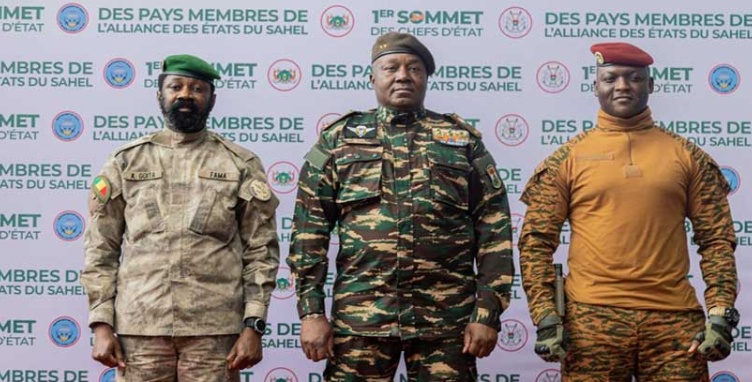
Burkina Faso’s revolutionary example has not remained isolated. Mali experienced a military coup in 2020, followed by another in 2021, reflecting the population’s frustration with weak civilian governments and persistent foreign domination. Niger joined the wave in 2023. Together, these countries formed the Alliance of Sahel States, a cooperative structure designed to coordinate military, political, and economic policy outside of Western oversight. The Alliance allows member states to pool security resources, defend against external pressures, and assert a collective anti-imperial stance.
This bloc represents more than defense. It is a conscious effort to reclaim agency in a region long treated as a pawn in global geopolitics. By withdrawing from ECOWAS mandates and rejecting Western interventions, these countries have demonstrated that sovereignty and regional solidarity take precedence over foreign approval. Local populations overwhelmingly perceive these actions as
restoring dignity and autonomy to nations long subordinated to external powers.
Russia’s Anti-Imperial Role and Its Left-Wing Legacy
Russia’s engagement in West Africa is often misunderstood in the West. Moscow’s current involvement is informed not only by strategic and geopolitical calculations but also by a historical self-image rooted in the Soviet anti-imperial tradition. During the Cold War, the USSR positioned itself as the champion of decolonization, providing support to liberation movements across Africa from Angola to Mozambique. That legacy continues to shape Russia’s perception of its role today, even under the post-Soviet state.
Unlike the Soviet Union, contemporary Russia does not promote Marxist-Leninist governance in partner states. Instead, it advocates a model of state-led capitalism with strategic intervention, where national sovereignty is paramount and foreign interference is resisted. For West African leaders, this approach is
attractive because it emphasizes security, economic independence, and political autonomy without imposing governance conditionalities or liberal democratic frameworks.
In Mali, Burkina Faso, and Niger, Russian military contractors and state-linked security advisors provide training, logistical support, and tactical advice. Local populations often see this positively because it enables their governments to defend against jihadist insurgencies and reduces reliance on French and European powers, which are widely perceived as self-interested and ineffective. In this context, Russian involvement is viewed not as neo-colonial imposition but as a continuation of the anti-imperial
tradition the Soviet Union once championed, reframed for the realities of the 21st century.
By invoking this historical anti-imperial posture, Russia positions itself ideologically as a counterbalance to Western interventionism. Its support is transactional and pragmatic rather than ideological in the classical communist sense, but it carries the symbolic weight of a global power standing against neo-colonial structures. This reinforces the revolutionary narrative in West Africa, where states are reclaiming agency, asserting sovereignty, and charting a path independent of Western dictates.
Revolutionary Achievements and Symbolic Victories
The early results of this anti-imperial revolution are tangible. French military bases have been withdrawn from key areas, signaling the end of decades of foreign presence. National governments have reclaimed control over borders, security operations, and resource management. The formalization of the Alliance of Sahel States creates a regional framework independent of Western influence, allowing for coordinated military and economic policy under African leadership.
Security gains are evident in Burkina Faso, where the government has implemented new border controls to limit jihadist movements. In Mali, joint operations with Russian-linked contractors have helped recapture territory previously dominated by insurgents. Niger has strengthened its internal security and intelligence operations, reducing the operational reach of terrorist groups. These are not minor victories; they represent tangible improvements in national sovereignty and territorial integrity.
These achievements resonate deeply with local populations. For citizens who have lived under foreign dependency, the new order offers the promise of self-determination, control over natural resources, and the ability to make security decisions without Western oversight. Unlike previous coups, which were often
viewed purely as power grabs, this wave is framed as a genuine restoration of national agency.
Historical Continuity: Anti-Colonial Revolution
The revolutionary wave in the Sahel is a continuation of West Africa’s long anti-colonial struggle. From the anti-French uprisings in Burkina Faso and Senegal in the early twentieth century to post-independence movements aimed at economic and political self-determination, the current trajectory is part of a historical continuum. What makes the present moment distinctive is the combination of military assertiveness, regional alliance, and pragmatic foreign partnerships that prioritize sovereignty over ideology.
These movements are aligned with traditional left-wing anti-imperial thought, emphasizing national independence, collective identity, and resistance to external domination. Unlike Western liberal frameworks that emphasize procedural democracy and conditional aid, the revolutionary governments prioritize practical control and regional self-determination, even if it entails authoritarian measures.
The Dangers and Contradictions
No revolution is without its contradictions. Reports of human rights abuses by security forces, including those affiliated with Russian contractors, have surfaced. Civilians, particularly from ethnic minority groups, have sometimes been caught in the crossfire of counter-insurgency operations. Economic development is uneven, and resource management is complicated by elite capture and global market pressures.
Yet these challenges exist within the context of a broader revolutionary goal: reclaiming autonomy and rejecting neo-colonial dependence. While governance and accountability remain imperfect, the ability of these states to chart independent courses, pursue regional alliances, and reduce reliance on former colonial powers constitutes a substantial shift in the historical balance of power.
Implications for the Global Order
The revolutionary wave in West Africa challenges global assumptions. Western powers have long treated the Sahel as a laboratory for governance, military strategy, and development interventions. The rejection of French and European influence, coupled with strategic Russian partnerships, signals a new multipolar order in African geopolitics. States that were once dependent are now asserting sovereignty, forming regional alliances, and defining their own strategies for security and economic development.
This movement also offers lessons for left-wing thought globally. True anti-imperialism demands support for national self-determination, even when it conflicts with Western narratives of liberal democracy. Revolutionary West Africa exemplifies a practical application of sovereignty politics, where security,
resource management, and independence take precedence over external ideological prescriptions.
Conclusion: Revolution or Restoration?
West Africa is in the midst of a transformative, anti-imperial wave. Countries such as Burkina Faso, Mali, and Niger are asserting sovereignty, rejecting foreign domination, and redefining regional power. Russian partnerships, informed by a historical anti-imperial ethos, facilitate these changes and provide alternatives to Western oversight. While human rights challenges and governance issues remain, the revolutionary nature of this moment is undeniable.