
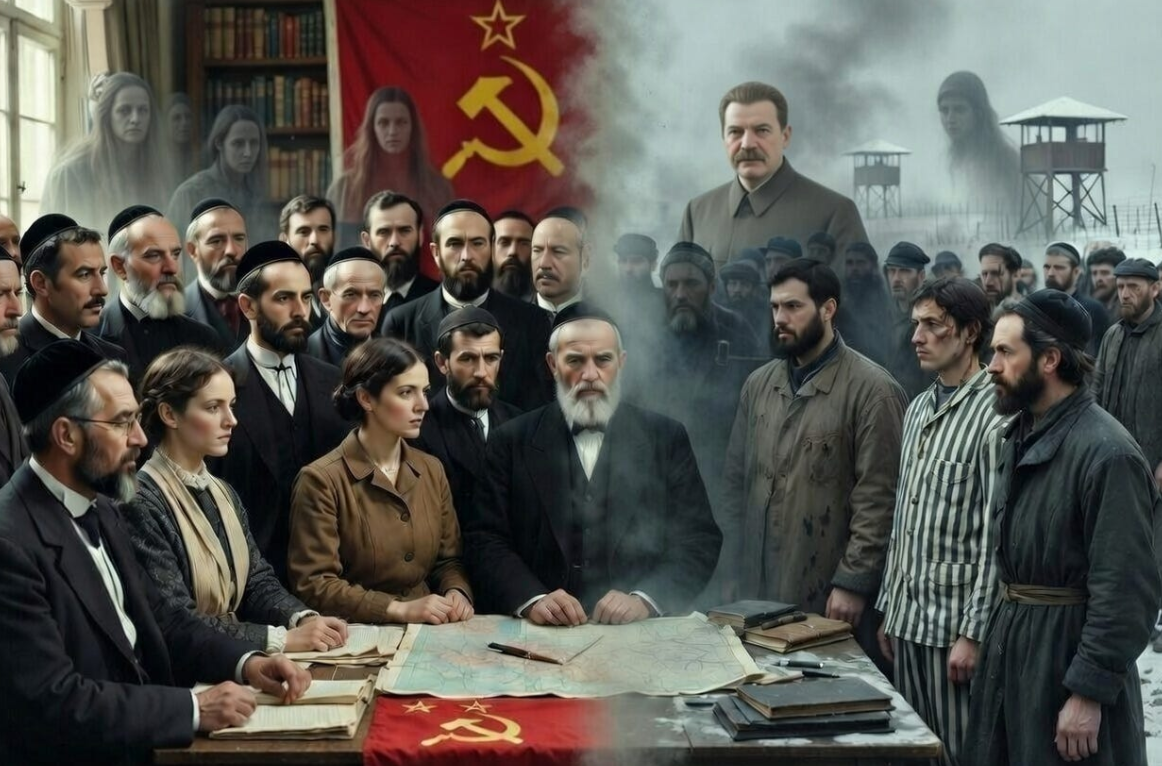
Echoes of 1789 in 1917: When the Revolution Turns on Its Makers
The phrase “a revolution that eats its own children” originated in the chaotic aftermath of the French Revolution, where idealistic leaders like Robespierre and Danton, who spearheaded the overthrow of the monarchy, ended up facing the guillotine themselves. This grim metaphor aptly describes the Bolshevik Revolution of 1917 in Russia, where early revolutionaries—many of them Jewish—helped forge the Soviet Union only to become victims of its repressive machinery under Joseph Stalin. Jews, long oppressed under the Tsarist regime, were disproportionately represented in the Bolshevik leadership due to their urban, intellectual backgrounds and attraction to radical ideologies promising equality. Yet, as the revolution consolidated power, it turned inward, purging perceived threats, including many of its Jewish founders. This article explores this tragic irony, drawing on historical accounts of Jewish involvement and subsequent persecution.
The Jewish Vanguard in the Bolshevik Ascendancy
The Bolshevik Revolution, led by Vladimir Lenin, promised to dismantle the autocratic Tsarist system and usher in a classless society. For many Russian Jews, who had endured centuries of pogroms, discriminatory laws, and confinement to the Pale of Settlement, communism offered a path to emancipation. As historian Richard Pipes noted, Jews were overrepresented in revolutionary movements because of their historical marginalization, which fostered a strong intellectual and activist class. In the early days of the Bolshevik Party—formed as a faction of the Russian Social Democratic Workers’ Party—Jews played prominent roles, not as a monolithic “Jewish conspiracy” (a myth debunked by scholars as antisemitic propaganda), but as individuals committed to Marxist ideals.
Key figures included Leon Trotsky (born Lev Bronstein), who organized the Red Army and was second only to Lenin in influence; Lev Kamenev (Rosenfeld), who served as the first head of state; Grigory Zinoviev (Radomyslsky), head of the Communist International (Comintern); and Karl Radek (Sobelsohn), a key propagandist. Other notable Jewish Bolsheviks were Yakov Sverdlov, the first president of the Soviet Union, and Maxim Litvinov (Wallach), who later became foreign minister. According to some estimates, while Jews comprised only about 4-5% of Russia’s population, they made up around 20-25% of the Bolshevik Central Committee in the 1920s, though overall party membership was far lower (less than 10%). This overrepresentation stemmed from Jews’ higher literacy rates, urban residency, and exclusion from traditional Russian society, making them natural allies in the fight against the Tsar.
Douglas Reed worked as a foreign correspondent for The Times in the 1920s and 1930s, and he reported from Moscow among several other European cities during his career. As an author (noted for his observations on the Soviet regime in works like The Controversy of Zion), he provided detailed figures highlighting this disproportionate Jewish involvement in early Bolshevik structures. Drawing from official publications and observations around 1918–1919, Reed reported:
- The Central Committee of the Bolshevik Party, which wielded supreme power: 3 Russians and 9 Jews.
- The next body in importance, the Central Committee of the Executive Commission (or secret police): 42 Jews and 19 Russians, Letts, Georgians, and others.
- The Council of People’s Commissars: 17 Jews and 5 others.
- The Moscow Cheka (secret police): 23 Jews and 13 others.
- Among the 556 high officials of the Bolshevik state: 458 Jews and 108 others.
- Among the central committees of small, supposedly socialist or non-communist parties: 55 Jews and 6 others.

These figures, while controversial and often debated for potential biases in Reed’s work, align with other contemporary accounts emphasizing Jewish overrepresentation in the revolutionary apparatus. Additional historical data from scholars like Mark Weber reinforces this: Jews constituted about 4.2% of the Russian Empire’s population at the turn of the century but made up around 10% of Bolshevik party membership in 1907 (and twice that in the rival Menshevik faction). In 1918, the Bolshevik Central Committee reportedly had 6 Jews out of 15 members (or 9 out of 12, per some reports). By 1919, three-quarters of the Cheka staff in Kiev were Jewish, underscoring their role in the regime’s security organs.
The revolution initially benefited Jews: Discriminatory laws were abolished in 1917, and Jewish cultural life briefly flourished with Yiddish schools, theaters, and newspapers. The Bolsheviks even criminalized antisemitism, viewing it as a tool of counterrevolutionary forces. However, this “golden age” was short-lived, as the regime’s paranoia and power struggles began to consume its own.
The Turning Tide: Stalin’s Rise and the Great Purge
Lenin’s death in 1924 sparked a brutal succession battle, with Stalin emerging victorious by 1928. Stalin, a Georgian with no Jewish heritage, consolidated power through purges that targeted “old Bolsheviks”—veterans of the 1917 revolution seen as potential rivals. Many of these were Jewish, as they had been integral to Lenin’s inner circle. The Great Purge (1936-1938), also known as the Great Terror, claimed over 700,000 lives, including a disproportionate number of Jewish intellectuals and party members.
Trotsky, exiled in 1929, was assassinated in Mexico in 1940 on Stalin’s orders. Kamenev and Zinoviev were tried in sham proceedings during the Moscow Trials of 1936, accused of plotting against Stalin, and executed. Radek met a similar fate in 1937. Other victims included Solomon Lozovsky, a trade union leader, and numerous Jewish commissars in the NKVD (secret police). While the purges were not explicitly antisemitic at first—Stalin’s regime targeted Poles, Latvians, and others too—they decimated the Jewish old guard. As one historian observes, the purges marked a shift from internationalist Bolshevism to a more nationalist, Russocentric Stalinism, resurrecting latent antisemitism as a political tool.
By the late 1930s, Jewish representation in high-level positions declined sharply. The Yevsektsiya (Jewish sections of the Communist Party), which had promoted Yiddish culture, was dissolved in 1930, signaling the erosion of Jewish autonomy.
Postwar Escalation: State-Sponsored Antisemitism
World War II temporarily masked Stalin’s growing antisemitism, as the USSR allied with the West against Nazi Germany and suffered immense losses, including over a million Soviet Jews murdered in the Holocaust. However, victory in 1945 unleashed a new wave of repression. Stalin, paranoid about “cosmopolitan” influences and perceived disloyalty, launched the “anti-cosmopolitan” campaign (1948-1953), which targeted Jewish intellectuals, artists, and professionals as “rootless cosmopolitans”—a code for Jews allegedly lacking Soviet patriotism.
This period saw the closure of Yiddish theaters, the arrest of Jewish writers like those in the Jewish Anti-Fascist Committee (e.g., Solomon Mikhoels, murdered in a staged car accident in 1948), and purges in academia and medicine. The campaign escalated with the infamous Doctors’ Plot in 1953, where prominent Jewish physicians were accused of conspiring to poison Soviet leaders, including Stalin himself. This fabricated plot, rooted in Stalin’s deep-seated hatred of Jews (exacerbated by his daughter’s marriage to a Jew and his suspicions of Zionist loyalties), led to widespread arrests and fueled public antisemitism. Rumors persisted of plans for mass deportations of Jews to Siberia, though Stalin’s death on March 5, 1953, halted the worst excesses.
Estimates of Jewish deaths under Stalin vary, but some sources claim over a million, including those from purges, forced labor in the Gulag, and wartime executions. This era transformed Soviet Jews from revolutionaries to suspects, with restrictions on religious practice, emigration, and cultural expression persisting until the USSR’s collapse.
The Irony and Enduring Legacy
The Bolshevik Revolution’s devouring of its Jewish children exemplifies the perils of political idealism: A movement born of liberation became a machine of oppression. Jews, who had flocked to Bolshevism seeking equality, found themselves ensnared in its web of suspicion. As Alexander Solzhenitsyn reflected in his work on Russian-Jewish history, the revolution’s brutality spared no one, not even its architects. This chapter in history underscores the fragility of alliances in radical movements and the resurgence of ancient prejudices under new guises.
Today, this history serves as a cautionary tale against oversimplifying ethnic roles in revolutions. While the myth of “Judeo-Bolshevism”—the false claim that Communism was a Jewish conspiracy—persists in some online circles, the reality was far more nuanced: Jewish individuals who joined the Bolsheviks were motivated by ideology, not ethnicity, and many were prominent in the early revolutionary leadership.
Yet when the revolution under Stalin turned against its own architects, many of these same figures paid dearly, becoming victims of the purges and terror alongside countless others. Remembering this allows us to confront the complex—and often tragic—dynamics of revolutionary violence without honoring or excusing victims who had themselves organized and carried out many of its crimes.