
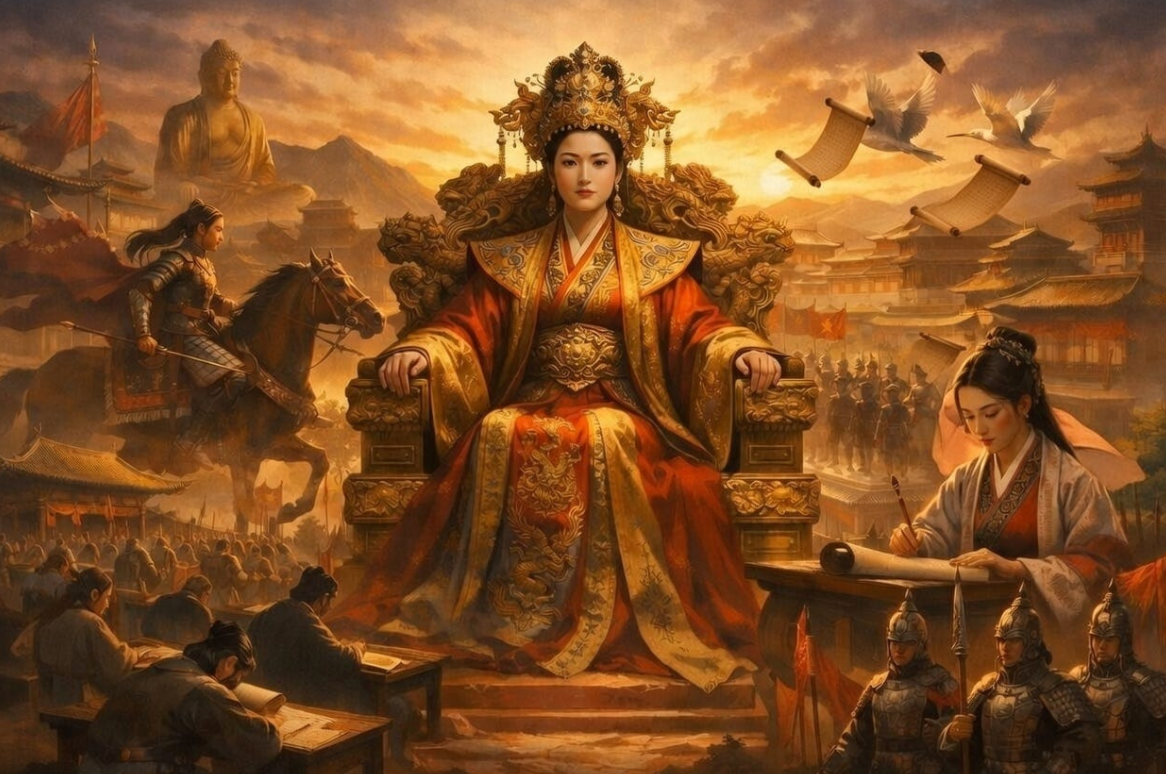
I. Princess Pingyang’s Legacy Meets Wu Zhao: The Tang Dynasty’s Window of Female Power
Wu Zetian was not content with the title of empress—she seized the throne herself and, from 690 to 705 CE, became the only woman in Chinese history to rule officially as emperor, bypassing the need for husbands or sons as imiddlemen.
The winter sun hung low over the palace roofs of Chang’an when a young girl named Wu Zhao first stepped through the crimson gates of the Tang imperial court. She was only fourteen, yet her mind was already sharper than many ministers twice her age.
The world she entered blended Confucian order with the vibrant cultural legacy of the nomadic North. The ruling family carried the blood of Xianbei horsewomen, and elite Tang women rode astride through the streets with unbound hair, studied poetry and history, owned and managed property, debated politics, engaged in commerce, attended Buddhist lectures, and—in rare cases—led military units, most famously Princess Pingyang, Li Yuan’s daughter, who raised and personally commanded an army of 70,000 troops to help establish the Tang Dynasty in 618 CE, earning her the title “Princess Pingyang of the Army”. Tang legal codes granted women significant property rights: a wife’s pre-marital assets remained hers, she could inherit portions of family property (especially in the absence of male heirs), and she retained control over her dowry—rights that were far more robust than in later dynasties. Divorce and remarriage remained acceptable, and women participated in public life more freely than in later eras.
This hybrid society—Confucian bureaucracy meeting steppe freedoms—was the world that made Wu Zetian possible.’
II. Seeds of Power in the Tang Court
Wu Zhao’s rise began with observation. She saw the harem as an administrative system with budgets, officials, and networks. She befriended literate palace women, memorized Buddhist sutras, and studied legal codes that acknowledged women’s property and inheritance rights.
She watched influential women like Princess Taiping suppress mutinies and shape court factions, and Shangguan Wan’er rise from palace slave to powerful secretary drafting edicts and policy. Women were visible—educated, mobile, and influential. And so she learned.
III. The Rise of the Female Emperor
After navigating palace intrigue, serving two emperors, raising two sons, and building alliances, Wu—now Wu Zetian—ascended the throne as emperor, not empress or regent.
Confucian scholars were unsettled by a woman wearing the imperial yellow reserved for the Son of Heaven. To legitimize her rule, she drew on Buddhism, commissioning prophecies and texts (including the forged Great Cloud Sutra) that portrayed her as the incarnation of Maitreya, the future Buddha, and a chakravartin (wheel-turning sovereign). This Buddhist framing circumvented Confucian gender barriers and secured popular and clerical support.
Yet she governed using Confucian principles—meritocracy, order, and moral duty—to stabilize and strengthen the realm.
Her Confucian-Inspired Merits
Wu Zetian broadened the imperial examination system, selecting officials by talent rather than birth. Under her rule:
- Commoners and minor gentry gained unprecedented access through self-registration, bypassing aristocratic recommendations.
- New formats like the “Zezhi” (policy essay) emphasized logic, governance, and judgment over rote recitation.
- She increased the number of successful candidates (dozens more jinshi annually, with averages exceeding fifty-eight in key periods).
- She introduced palace (dianshi) and military (wuju) examinations, diversifying recruitment.
- She promoted men based on ability, challenging hereditary aristocratic power.
Historians, even those hostile to a female ruler, acknowledged her as one of the greatest advocates of Confucian meritocracy in imperial history.
IV. After Wu Zetian: The Gates Begin to Close
When the Tang faded and the Song rose, Neo-Confucian thinkers like Zhu Xi sought to restore stricter order. Women were increasingly confined to the inner quarters. Foot-binding spread among elites, widows were pressured against remarriage, and chastity became an exalted virtue. Laws eroded Tang-era inheritance and property rights, treating dowries as husbands’ assets. Political influence through harem or regency was closed off.
By the Ming and Qing, society idealized the quiet, family-serving “virtuous woman,” often chaste for life if widowed. Thousands of chastity arches honored such sacrifice. The Tang’s freedoms faded into memory.
V. A New China, A New Landscape
The 20th century ended the empire and brought the socialist slogan: “Women hold up half the sky.” Today, Confucian family values coexist with state-promoted gender equality. Girls attend school just like boys; women excel in STEM fields, at universities, and in business—China leads the world in self-made female billionaires.
Yet hierarchies persist: women hold visible political and corporate roles but remain underrepresented at the highest levels, and many shoulder the “double burden” of career and traditional family duties—a landscape of progress, limits, opportunity, and continuity.
VI. Wu Zetian’s Shadow Over the Present
In textbooks, Wu Zetian is often depicted as ruthless and anomalous. Yet her life reveals what women can achieve in a Confucian society when conditions align: Tang hybrid culture, Buddhist ideological flexibility (including her Maitreya self-presentation), legal rights to property and mobility, and her own political genius.
Her greatest legacy lies in meritocratic reforms—expanding examinations, opening government to humble origins, and weakening aristocratic clans—that influenced Chinese governance for over a millennium.
Unlike Empress Dowager Cixi (1835–1908), who wielded immense power as regent behind weak emperors but never claimed the throne herself and is often blamed for resisting modernization and contributing to the Qing’s decline, Cixi did initiate late-stage reforms (the Late Qing Reforms of 1901–1911), abolishing the traditional imperial examination system, establishing modern schools and universities, sending students abroad, creating new ministries, and beginning to modernize the military and economy—yet these came too late and were limited in scope compared to Wu Zetian’s proactive, centuries-shaping institutional changes. Wu Zetian openly ruled as emperor, actively reformed institutions, and expanded meritocracy—earning her a more complex, sometimes admiring historical assessment despite contemporary criticism.
Compared to Cleopatra VII of Egypt (69–30 BCE), who ruled as queen through dynastic Ptolemaic tradition, allied with Roman powers (Julius Caesar and Mark Antony) to preserve her throne, and relied on personal charisma and diplomacy in a Hellenistic-Mediterranean context, Wu Zetian created her own legitimacy within a Confucian-Buddhist Chinese framework, ascended to the highest male-coded title of emperor, and focused on institutional reforms rather than foreign alliances—making her the more transformative sovereign in terms of domestic governance and bureaucratic legacy.
VII. From Wu Zetian’s Examinations to Modern China: A Thousand-Year Legacy
Wu Zetian transformed the examination system from an elite tool into a mechanism of social mobility aligned with the Confucian ideal of “selecting the worthy and capable.” She widened access, emphasized policy reasoning, and promoted talent over birth.
She was no modern feminist; as a pragmatic ruler in a patriarchal system, extending exams to women would have alienated her key allies without gain.
Today’s civil service exams (公务员考试) carry forward that logic: open to all backgrounds, focused on policy, law, and reasoning, and theoretically merit-based. Women participate in large numbers and frequently outperform men.
Although women are still greatly underrepresented, an increasing number now hold leadership positions in ministries, courts, diplomacy, and research. Notable examples include Fu Ying (former Vice Foreign Minister), Wu Yi (former Vice Premier, who led China’s national SARS response in 2003), and Tu Youyou (Nobel laureate in Medicine).
The Tang’s openness allowed exceptional female influence; modern meritocratic systems—partly rooted in Wu’s reforms—enable women’s participation through education and achievement.
Wu Zetian’s reign showed state power intersecting with female capability. Today’s bureaucracy reflects an evolved, more inclusive version of those meritocratic ideals—rewarding talent and offering expanding (though still evolving) paths for women.
VIII. Conclusion
Chinese women today found companies, serve in government, and lead research in a society balancing Confucian tradition with the modern realities of a socialist market economy. Wu Zetian’s story endures—not as an anomaly, but as a reminder of the limited yet genuine possibilities that once existed, and of the far greater potential available now.