
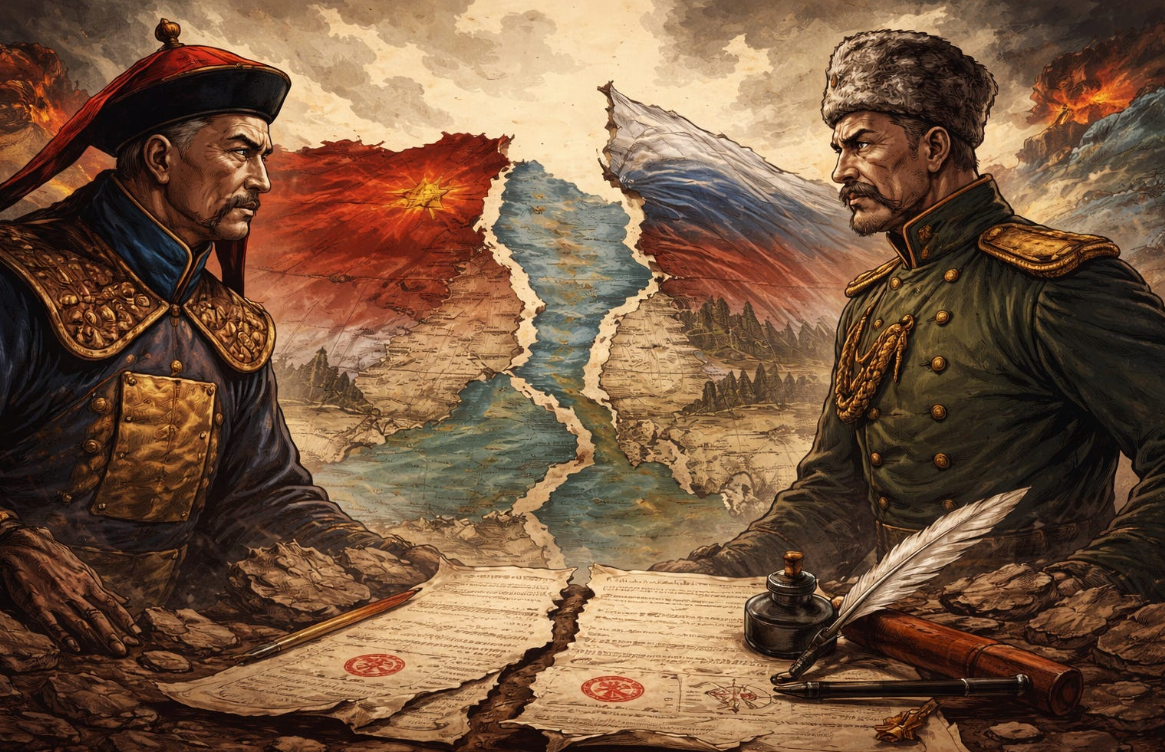
Unfinished Business: China’s History with Russia’s 19th-Century Treaties
China’s relations with former colonial or imperial powers vary widely, and its willingness to “forgive” or move on from historical grievances depends largely on whether issues were resolved through diplomacy or war. With Britain, France, and Japan, modern relations were recalibrated after territorial issues were settled. With Russia, the situation is more complex because the territorial changes of the mid-19th century—primarily the Treaty of Aigun (1858) and the Convention of Beijing (1860)—were never formally repudiated or reversed, and their legitimacy remains a subject of historical discussion inside China.
China in the Early 19th Century
At the start of the 1800s, the Qing dynasty governed one of the world’s largest economies, significant in population and cultural influence. However:
- China’s military technology lagged behind rapidly industrializing European states.
- The court maintained restrictive trade policies at places like Canton (Guangzhou).
- Western powers increasingly sought commercial access, particularly for tea, porcelain, and silk.
Opium Wars and the Shift in Power
Britain’s desire to balance its trade deficit with China led to expanded opium shipments from British-controlled India. The Qing government’s attempt to stop the opium trade in 1839 contributed to:
- First Opium War (1839–1842) → China defeated; Treaty of Nanjing ceded Hong Kong and opened several ports.
- Second Opium War (1856–1860) → Anglo-French forces captured Beijing; the Old Summer Palace was looted and destroyed.
These conflicts weakened Qing authority and accelerated foreign encroachment into China’s coastal and inland regions.
Territorial Pressures from Multiple Powers
During the same period:
- Britain aggressively consolidated influence in southern China.
- France expanded its reach in Southeast Asia.
- Germany and the U.S. acquired treaty rights and concessions.
- Japan modernized rapidly and later defeated China in 1894–1895, taking Taiwan.
China was not colonized outright, but it was divided into multiple spheres of influence, with foreign states seizing and controlling ports, trade, and infrastructure.
Russia’s Expansion in the Far East
While China fought wars in the south, Russia was expanding eastward across Siberia. Russia’s goals included:
- Securing access to the Pacific
- Establishing warm-water ports
- Consolidating empire-building efforts started under Peter the Great and continued by the Romanov dynasty
Treaty of Aigun (1858)
Signed between Qing official Yishan and Russian representative Nikolay Muravyov-Amursky, the treaty:
- Reassigned lands north of the Amur River to Russia
- Established joint control over land east of the Ussuri River pending later clarification
- Was signed under significant pressure while China was already engaged in conflicts with Western powers
Convention of Beijing (1860)
After Anglo-French forces advanced into Beijing, Russia mediated negotiations—but also obtained:
- Full control of territory east of the Ussuri River, including the area where Vladivostok was later founded in 1860
- Formal recognition of the earlier territorial changes
The combined area transferred to Russia in 1858–1860 is often cited as more than 1 million km², though estimates vary depending on definitions.
Why China’s View of Russia Differs
With Britain, Japan, and France, major territorial disputes were resolved in the 20th century:
- Hong Kong was returned by Britain in 1997.
- Japan withdrew from China at the end of World War II.
- France ended its colonial rule in Indochina after 1954.
In each case, foreign occupation or control ended, and formal agreements recognized new borders.
Russia, however:
- Retained all territory gained in the 1850s–1860s
- Did not renegotiate border treaties
- Viewed the agreements as legally binding and final
- Continues to administer the Russian Far East, including Primorsky Krai and Khabarovsk Krai
China’s Position
Modern China does not officially contest the current border, which was reaffirmed through a series of agreements:
- 1991 Sino–Soviet Border Agreement
- 2004 Supplementary Agreement, settling remaining river-island disputes
However, Chinese education and historical scholarship still refer to the 19th-century treaties as “unequal treaties” signed under coercion. The idea of “lost territories” appears in Chinese historiography and public discourse, though it is not an active policy goal.
Modern Geopolitics
Despite underlying historical tensions, China and Russia today maintain a strategic partnership driven by:
- Shared concerns about U.S. hostility
- Energy cooperation
- Military coordination
- Diplomatic alignment in the UN Security Council
However, analysts often describe the partnership as pragmatic, not rooted in deep historical trust.
Demographic and economic trends—such as Chinese migration and investment in the Russian Far East—occasionally raise concerns among Russian commentators, though official Russian policy does not frame this as a territorial threat.
Long-Term Questions
Scholars debate several issues:
- How historical grievances might influence future Sino-Russian relations
- Whether demographic or economic shifts could alter dynamics in the Far East
- How changes in Russia’s political stability or global power might affect the relationship
- How the United States and its allies would respond if Sino-Russian cooperation weakened or tensions rose
Most mainstream experts emphasize that China is not pursuing territorial revisionism against Russia today, but historical memory continues to shape public attitudes and long-term strategic thinking.
▪ ▪ ▪
Sources for Further Reading
1. Russian-Language Sources (Русская литература / Russian scholarship)
Primary and historical materials
🔗 Айгунский договор (EADaily) — Russian historical overview of the 1858 Treaty of Aigun, including signatories and territorial terms.
🔗 Русско-китайские договорно-правовые акты (Abirus.ru) — A collection of Russian-Chinese treaty texts from 1689–1916, including Aigun, Peking, and related border agreements (useful for original language research).
🔗 Пекинский договор 1860 года (RusKontur) — Detailed description of the Treaty of Peking’s provisions on borders and trade between Russia and China.
🔗 Русский Китай: очерки дипломатических отношений (President’s Library) — Historical text by Alexei Buksgevden on early Russia–China diplomacy through 1902, including treaties and frontier policy.
2. Modern scholarly work
🔗 Байзакова Л.М. — Российско-китайские отношения… территориальный кризис — Russian academic article analyzing the territorial issues surrounding the Aigun and Peking treaties and Russia’s diplomacy in the late 19th century.
🔗 Evgeny Bazhanov — Russian-Chinese Relations: Problems and Prospects — Catalog of scholarly works by Bazhanov, including Russian perspectives on historical and modern Russia–China relations and foreign policy.
(You can search this author’s publications in academic catalogs or WorldCat.)
3. Chinese / China-Focused Sources and Perspectives
🔗 Britannica: Treaty of Aigun — Provides the Chinese name for the treaty (瑷珲条约) and notes that Beijing initially resisted ratification, reflecting the basis for how the treaty has been viewed historically.
🔗 Carnegie Endowment analysis: Aigun, Russia, and China’s “Century of Humiliation” — English-language article citing Chinese historiographical framing of Aigun, including how Chinese narratives construed the treaties as imposed during weakness.
🔗 “Unequal Treaties” (Wikipedia) — Defines the broader category of 19th-century treaties China includes Aigun and Peking in, central to Chinese historical narratives of imperial encroachment.
🔗 中国和世界不平等条约制度概述 (SSRN: Unequal Treaties) — Scholarly overview of the doctrine of unequal treaties in Chinese international law and historiography, with discussion of how 19th-century treaties are interpreted in modern scholarship (note: external SSRN abstract).
🔗 Jiang Yi (2020 Russian-language Chinese academic article) — Article by a Chinese scholar (in Russian language academic publication portal) on the history of the China–Russia border question and its significance for intergovernmental relations, reflecting a Chinese research perspective published in Russian academic format.
4. General English-language Scholarly Context (Useful for cross-cultural comparison)
📌 These aren’t primary Chinese/Russian sources, but they synthesize both perspectives:
🔗 Britannica: Treaty of Aigun — Historical summary of terms and context.
🔗 **Britannica: Treaty of Peking (Beijing) ** — Places the 1860 treaty in context of confirmed boundaries.
🔗 Carnegie Endowment: Aigun, Russia, and China’s “Century of Humiliation” — Notes how Aigun has been discussed in Chinese historical memory.
🔗 Chatham House report (China and Russia PDF) — Academic analysis of the treaties’ impact on later Sino-Russian border relations and their “unequal treaty” framing.
🔗 Philip Snow — China and Russia: Four Centuries of Conflict and Concord — A comprehensive book covering over 400 years of Sino-Russian interactions, including 19th-century treaties and interpretations (searchable via major libraries).