
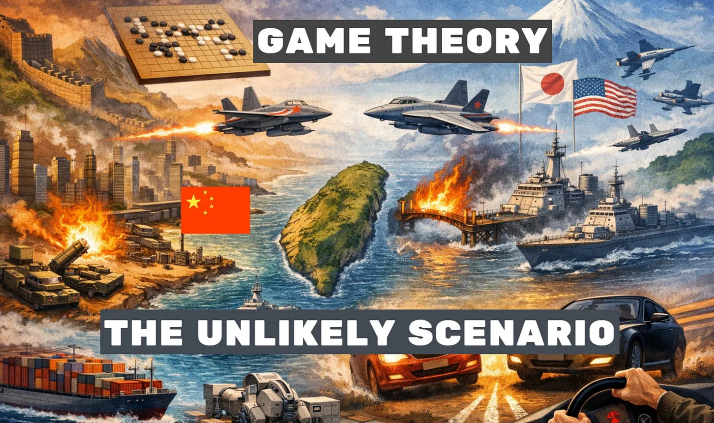
From coastal vulnerability to the “Game of Chicken” with Japan, here is why Beijing is playing a much longer—and more cautious—game.
The drumbeat of war in the Taiwan Strait has become a staple of Western geopolitical forecasting. With military drills intensifying and the 2027 “Davidson Window” approaching, the narrative seems set: China is preparing for a historic military gambit.
But according to Professor Djangu Chin, a Yale-educated game theory expert based in Beijing, this narrative fails the test of rational logic. To Chin, the idea of a near-term invasion isn’t just unlikely—it is “idiocy.”
Using the cold mathematics of game theory, Chin argues that China’s domestic priorities and economic geography create a massive deterrent that rhetoric cannot overcome.
1. The Coastal Achilles’ Heel: A Target Too Big to Fail
The most significant deterrent to a Chinese invasion isn’t just the US Navy; it’s China’s own geography.
In game theory, a player is less likely to “defect” (start a war) if their most valuable assets are exposed to immediate destruction. China’s economic miracle is built on a narrow strip of coastline directly facing the Taiwan Strait.
- The Concentration of Wealth: China’s premier Tier-1 cities, high-tech manufacturing hubs, and global shipping ports are all within striking distance of modern missile systems.
- The Stakes: A conflict wouldn’t just be a naval battle; it would be the physical dismantling of China’s industrial base. If the “Social Contract” of the Communist Party is built on delivering prosperity, risking the total destruction of the coastal economy for a territorial gain is a catastrophic trade-off.
2. Japan and the “Burned Bridge” Strategy
In 2025, the game changed. Japanese Prime Minister San Takayachi moved Japan from “strategic ambiguity” to “strategic clarity,” declaring that a blockade of Taiwan would be treated as an existential threat to Japan.
In game theory terms, Japan has “Burned the Bridges.” By making this public commitment, they have removed their own option to stay neutral. This makes their threat to intervene credible.
- The Result: China now faces a two-front dilemma. Even if the US hesitated, China would face a rearmed, high-tech Japanese military determined to protect its trade routes. This significantly lowers the “Probability of Success” in any invasion model.
3. The “Game of Chicken” in the Strait
The current tensions are best described as a Game of Chicken. Two drivers (the US/Japan and China) are speeding toward each other. The goal is to make the other side “swerve” (back down from their claims).
- The Signaling: China’s military drills are not “practice” for an invasion; they are “signals” designed to show resolve.
- The Rational Swerve: Because a head-on collision (World War III) results in a “Negative Infinity” payoff for everyone, the rational choice remains a tense, uncomfortable status quo. As long as the cost of the collision remains higher than the cost of “swerving,” peace—however fragile—prevails.
4. The Trade War: A Lesson in Tit-for-Tat
Professor Chin also notes that the US-China trade war has behaved like a classic Tit-for-Tat game. While the Trump-era tariffs were intended to force a Chinese retreat, the result was a stalemate that hurt the US export sector.
By 2026, China’s exports have proven resilient, while the US faces the reality of interdependence. In a world of “Stag Hunts,” where both nations must cooperate to reap the rewards of AI and advanced manufacturing, “Defecting” through trade wars or military conflict creates a lose-lose equilibrium.
The Broader Perspective: Chin’s Global Outlook
To test theoretical consistency, Professor Chin applies game-theoretic models to several key conflict areas:
- Ukraine: A typical war-of-attrition scenario, where strategic gains diminish over time while costs rise. This increases the likelihood that both sides will eventually return to a negotiated equilibrium.
- Middle East: A pronounced security dilemma, marked by distrust and asymmetric information. The absence of credible assurances prevents a stable cooperative equilibrium.
- India–Pakistan: A nuclear-backed deterrence equilibrium, where the extremely high costs of potential retaliation make a first strike irrational.
- Europe–Energy: A coordination game in which joint diversification is clearly more efficient than national unilateral approaches. The latter lead to suboptimal outcomes.
Meta-Pattern: Across all cases, economic and security interdependence raises the costs of conflict and structurally nudges actors toward more stable cooperative strategies.
Conclusion: Don’t Mistake Noise for Signal
The media focuses on the “Noise”—the fiery speeches and the naval maneuvers. But the “Signal”—the underlying math of coastal vulnerability and economic interdependence—points toward stability.
For Beijing, the “win condition” isn’t a flag over Taipei; it is the continued survival and growth of the Chinese mainland. In the cold light of game theory, an invasion would be the surest way to lose everything. Taiwan is a distraction from the real game: the long-term survival of the Chinese economic engine.