
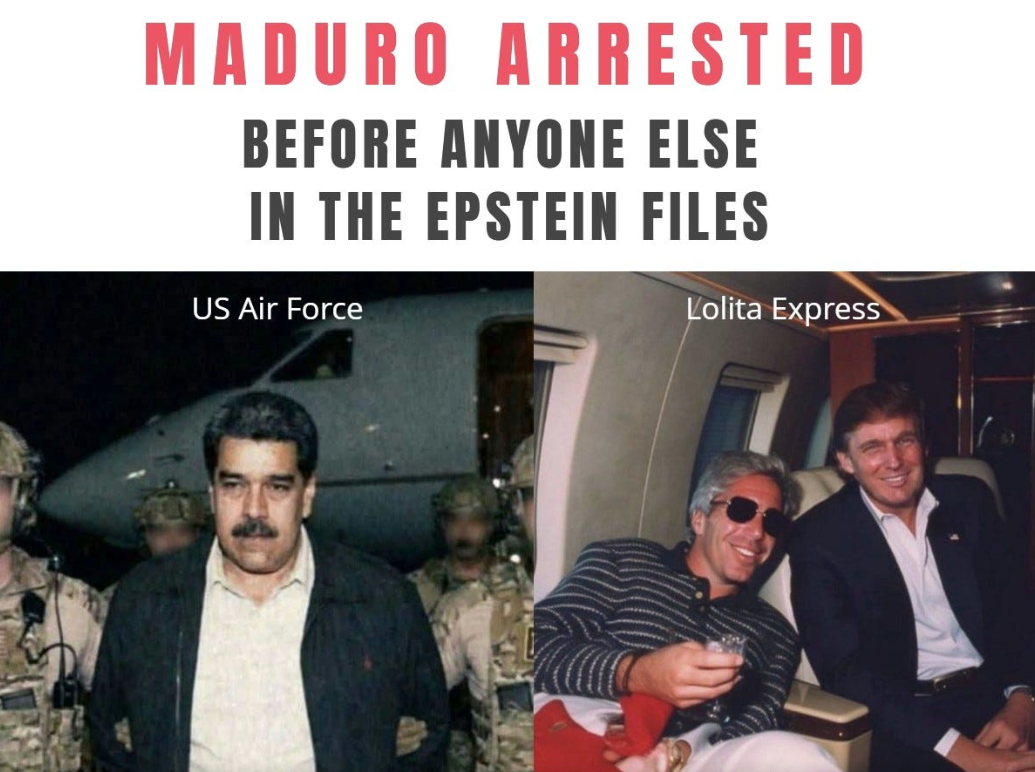
Just as the Epstein files threatened to expose some of the world’s most powerful figures, a sudden international crisis overnight diverted global attention. Conveniently for Washington, the focus shifted from the most politically explosive scandal in years to a manufactured villain abroad—Venezuela.
But what is really behind the Venezuela conflict?
Here is the entire, researched story step by step:
1. The Epstein Files and Political Expediency
Of course, the kidnapping of Venezuelan president Nicolás Maduro has nothing to do with the Epstein files—at least not at first glance. The publication of the Epstein files had been an election promise by then–presidential candidate Donald Trump. Once in the White House, however, he dismissed them, calling the documents a Democratic Party hoax and making clear he did not want them released. Despite Trump’s resistance, his administration was eventually forced—after months of delays, public outrage, and pressure from his own voter base—to make the files public.
When asked about photos of Bill Clinton appearing in the newly released Epstein documents, Trump did not attack Clinton as he often had in the past. Instead, he expressed sympathy for someone who appeared in the same files as he did:
- “I like Bill Clinton. I’ve always gotten along with Bill Clinton.”
- “I hate to see photos come out of him… it’s a terrible thing.”
- “Bill Clinton’s a big boy, he can handle it.”
2. Trump, the Clintons, and Elite Connections
Before his 2016 presidential run, Donald Trump had a friendly and socially connected relationship with Bill and Hillary Clinton. They moved in the same New York social circles, attended events together, and the Clintons were even invited to Trump’s 2005 wedding to Melania. Trump also donated to Bill Clinton’s campaigns in the 1990s and participated in Clinton Foundation events, reflecting financial and charitable support. Publicly, he spoke positively of Bill Clinton as president and praised aspects of Hillary Clinton’s work as Secretary of State.
This cordial relationship largely ended once Trump entered politics and adopted a confrontational posture toward the Clintons—a political tactic rather than a reflection of deep conviction, given Trump’s long history as a liberal-leaning, openly promiscuous figure who was not a devout Christian like many of his voters in the so-called Bible Belt.
The Epstein enterprise, however, revealed bipartisan elite complicity and Epstein’s close ties to American and Israeli intelligence agencies, reportedly collecting “kompromat” to exert influence over powerful figures.
3. Evidence Destroyed: Congressman Frank Mrvan Exposes FBI Tampering
The released Epstein files were heavily redacted: at least 550 pages were fully blacked out—including a 119-page grand jury document and a consecutive 255-page block—while hundreds more were partially obscured, hiding names, contact details, images, and other substantive content. Observers estimate that up to 90% of the material was redacted either in part or entirely. At least a dozen files briefly vanished from the Justice Department’s website, including one showing Donald Trump with Jeffrey Epstein, Melania Trump, and Ghislaine Maxwell, and only reappeared after the disappearance was noticed and publicly criticized.
Even more striking was the deletion of vast amounts of data—including extensive witness testimony—by the FBI, publicly described as a “technical mishap.” At a congressional oversight hearing, Congressman Frank Mrvan—an expert in data security and forensic analysis who is not easily fooled—presented evidence contradicting FBI Director Kash Patel’s claim that the 2.7-terabyte deletion on October 14 was a random failure.
According to Mrvan, 73% of the deleted data—around 1.97 terabytes—specifically targeted the Epstein investigation, including 847 permanently erased victim statements (312 from trafficking victims, 297 from assault victims, and 238 from witnesses), 234 videos, 12,476 phone records, and 89,234 emails. While other FBI investigations saw little or no loss, the selective deletion—supported by authenticated logs showing Patel’s digital signature, biometric verification, and physical presence—indicated intentional evidence tampering. Mrvan’s expertise and meticulous presentation exposed the deliberate destruction of critical evidence, leaving Patel’s defenses in pieces and sparking widespread outrage over institutional betrayal.
Given this context, it is easy to see why President Trump would have a significant motive to divert attention from these politically dangerous and embarrassing files.
4. Shifting Public Attention: Venezuela as a Convenient Distraction
Although the conflict with Venezuela was not triggered by the Epstein scandal, it came at a highly opportune moment: Suddenly, the world’s attention shifted to Venezuela and Iran, burying the Epstein documents and steering the public narrative towards Maduro, who was now portrayed as the main villain.
The case against Maduro and his wife Cilia Flores is a classic example of a show trial, where the verdict seems predetermined from the outset—regardless of the evidence. The possibility of Maduro’s release or even compensation could be seen as a massive humiliation for Washington, severely damaging the international standing of the U.S.
This situation fits into the broader worldview of the Trump administration, particularly that of Stephen Miller, who served as Senior Advisor for Policy. Miller, known for his hardline stance on immigration and national security, argued that the world is “governed by force” and that the U.S. should assert its global dominance through military, economic, and political strength.
Miller’s perspective is crucial here, as it mirrors the U.S. approach to Venezuela: not a fight for democracy or human rights, but a battle for control over strategic resources and geopolitical influence. The constant charges against Maduro and the demonization of his government are tools used to delegitimize him and advance U.S. interests, particularly in countering the growing influence of China and Russia in the region.
In reality, U.S. policy in the region is less concerned with combating dictatorships or drug crime, and more focused on securing Venezuela’s vast oil reserves and curbing the influence of rival powers. This aligns with Miller’s perspective on international relations, which emphasizes the use of raw power and violence—often in blatant violation of international law—as a means to maintain American hegemony.
5. The Weaponization of Media: Manufacturing Consent for Regime Change
U.S. preparations for war or regime change typically begin in the “information space,” with media headlines shaping public consent before physical strikes—as seen in Iraq, Libya, Iran, and now Venezuela. Targeted regimes are systematically vilified until public opinion accepts military intervention. Middle Eastern leaders, for example, were demonized through false claims—such as Saddam Hussein’s alleged weapons of mass destruction or Bashar al-Assad’s supposed chemical attacks—justifying military action even when pretexts were debunked.
In Maduro’s case, the U.S. has claimed involvement in drug trafficking, though no public evidence supports this. He has also been labeled a “communist.” In the case of Maduro, the U.S. claimed involvement in drug trafficking, although this was not publicly substantiated. Additionally, he was branded as a “Communist.” However, conservative commentator Tucker Carlson dryly pointed out that Maduro’s government had banned abortion, same-sex marriage, pornography, and gender reassignment, describing Venezuela in these areas as “socially conservative.”
The drug-trafficking pretext is further undermined by Trump’s pardon of former Honduran President Juan Orlando Hernández, labeled a “cocaine kingpin” from one of Latin America’s largest trafficking networks. Even if Maduro were implicated, the Honduran operation vastly overshadows him. Furthermore, if Trump were truly focused on combating drugs that have killed millions, he would target Mexican cartels and refuse donations from the Sackler family, which profited massively from the opioid and fentanyl crises, paying $7.4 billion in settlements to victims.
Ironically, the world’s largest money-laundering hubs—where drug cartels legally transform their illicit billions into clean profits—are located in Miami, Texas, and Connecticut. It seems that abducting a South American president is easier than shutting down these U.S. services that are indispensable to the cartels.
The Israeli Prime Minister Benjamin Netanyahu is now wanted by the International Criminal Court (ICC) on charges of war crimes and crimes against humanity. Yet instead of detaining him and transferring him to The Hague, the United States and other governments continue to receive him as though nothing were amiss. Meanwhile, comparatively flimsy allegations of illicit drug activity against Maduro carry more political weight in Washington than the far more extensively documented mass atrocities committed against an entire population in Gaza for which Netanyahu’s government stands accused.
6. Sun Tzu and the Projection of Strength
Sun Tzu’s principle from The Art of War—“When you are weak, appear strong”—appears to have guided the U.S. military buildup off Venezuela’s coast. Although the U.S. retains vast military power and the world’s largest GDP, it is widely perceived as an empire in decline—due to China’s rise (its PPP economy now a third larger than America’s), NATO’s failure to defeat Russia in Ukraine, the inability to overthrow Iran, struggles in Gaza, and the falling dollar. Domestically, this perception of declining U.S. power helped fuel Donald Trump’s 2024 re-election under the MAGA slogan, which implied that America had lost its greatness and sought to reclaim it.
Since his re-election, the U.S. has aggressively reasserted itself: joining Israel in its 12-day military war against Iran escalating tensions with Russia by arming Ukraine, imposing sanctions on numerous countries, threatening to annex Canada and Greenland, and renaming the Department of Defense the War Department. These actions serve both as domestic propaganda and as a signal to the world of U.S. dominance. The current focus is Venezuela, with a massive naval fleet stationed off its coast and a no-fly zone imposed—a prelude to military action. Not just the abduction of Venezuela’s president, but a full-scale war would represent a decisive regime-change operation, shaping the future of the U.S. empire amid a rapidly shifting global economic landscape.
7. Historical Context: Venezuela and U.S. Imperial Ambitions
Venezuela embodies Simon Bolivar’s vision of an independent, united Latin America, clashing with the U.S. Monroe Doctrine, which claims the Western Hemisphere as America’s sphere of influence and seeks to exclude powers like China and Russia. Venezuela’s vast natural resources intensify this tension: it possesses the world’s largest proven oil reserves—worth at least $18 trillion—along with untapped gas, gold, iron, and other minerals. For much of the 20th century, a tiny elite tied to U.S. corporations monopolized Venezuela’s resources, sending the profits abroad while most Venezuelans struggled in dire poverty.
The 1970s Arab oil embargo temporarily enriched Venezuela’s elite on a massive scale, but it also set the stage for the 1980s oil glut, as global economies sought alternative energy sources and prices collapsed. Heavily dependent on oil exports, Venezuela plunged into a debt crisis—$34 billion in debt against just $300 million in reserves—while 70% of the population lived in poverty, inflation soared, and deficits mounted. International lenders demanded austerity and economic liberalization, including cuts to public spending, privatization of key sectors, and the removal of subsidies. Despite being elected on an anti-austerity platform, President Carlos Andrés Pérez implemented these measures, dismantling fuel subsidies that were vital for a population earning an average of just $8 per month. The resulting 1989 El Caracazo uprising was violently suppressed, further eroding the government’s political legitimacy.
8. Rise of Hugo Chavez
From this chaos emerged Hugo Chavez, a military officer turned revolutionary politician. Elected in 1998, he effectively nationalized the oil industry, redirecting profits from Western markets to social programs in healthcare, housing, education, and food. Chavez’s Bolivarian Revolution explicitly invoked Bolivar’s vision of an independent Latin America free from U.S. control and neoliberal influence.
This directly threatened U.S. interests: a nation with massive oil reserves asserting sovereignty challenged the petrodollar, U.S. dominance, and the Monroe Doctrine. Over the past two decades, U.S. efforts to overthrow Venezuela have been motivated by strategic economic and geopolitical interests, not by concerns for democracy, human rights, or drug trafficking—the latter serving merely as a smokescreen.
9. Economic Stakes and Global Shifts
U.S. dominance has rested for 80 years on the dollar and energy control, linked via the petrodollar system. BRICS nations—China, Russia, India, Brazil, South Africa—are building alternatives, trading oil in non-dollar currencies like the yuan. Examples include Saudi Arabia-China oil deals and India buying Russian oil in yuan despite sanctions. Venezuela’s growing ties with China (large investments), Russia (military and intelligence support), and Iran (sanctions-bypassing advice) make it “strategically dangerous.” If Venezuela joins BRICS and finalizes non-dollar oil deals, it could undermine dollar hegemony, weaken U.S. power, and accelerate multipolarity. Controlling Venezuelan oil is thus absolutely central to shaping global power in the coming century.
10. U.S. Regime Change Today: Strategies in the Context of Geopolitical Realignment
Opposition figures previously supported by the United States include María Corina Machado, Nobel Peace Prize winner for the “democratic transition,” who has committed to opening Venezuela to foreign investment—including $1.7 trillion in oil, gas, mining, and infrastructure—favoring privatizations and U.S. multinationals while actively supporting the overthrow of Maduro, echoing the policies of Venezuela’s pre-Chávez elite.
A Washington-loyal regime could threaten China by halting heavily discounted oil deliveries and questioning the approximately $67 billion in Chinese investments in Venezuela—including loans, infrastructure projects, and energy initiatives largely tied to the country’s vital oil sector—either in U.S. interests or under U.S. pressure.
U.S. influence in Venezuela spans two decades: increasingly severe sanctions, combined with Venezuela’s political missteps, led to hyperinflation, unrest, and repeated coup attempts.
The recent escalation involved targeted assassinations and infrastructure attacks, drawing on tactics previously used in Iran. The deployment of the USS Gerald R. Ford (capable of launching over 75 aircraft) and the establishment of a no-fly zone enabled airstrikes and the abduction of President Maduro and his wife. Reports indicate the strikes on Caracas claimed dozens of lives, including military personnel, civilians, and Maduro’s Cuban bodyguards. Among the confirmed civilian victims was an 80-year-old woman killed when a U.S. airstrike hit a residential building in Catia La Mar near Caracas.
The United States is determined to topple the remaining Venezuelan government if it does not submit to American dictates and is prepared to escalate as needed—likely with similar ambitions toward other targets like Colombia and Iran. Trump stated that the U.S. would “temporarily” lead Venezuela and control the oil industry during a transition, though details remain unclear.
This is far from routine; it represents an “all-or-nothing” mission by the U.S. empire to defend core interests amid a rapidly shifting global power structure. Venezuela’s survival is uncertain, but the stakes are clear: control over oil, preservation of dollar dominance, and preventing a global power shift at any cost.
11. Threats, Bribery, and Betrayal
The secular Syrian government of Bashar al-Assad was not overthrown after a fierce battle between Islamist militias supported by the U.S., Turkey, and Israel and the superior Syrian military. Instead, the commanders of the Syrian army were simply bribed, allowing the HTS groups and their leader Ahmed al-Sharaa (formerly Abu Mohammad al-Jolani) to pass without resistance. Al-Sharaa, who began his career with al-Qaeda and made a name for himself through brutal methods, later seized power in Damascus. In the U.S., he had long been on a “Wanted List” as a wanted terrorist.
The events in Venezuela show striking parallels to those in Syria. The removal and abduction of President Nicolás Maduro would have been impossible without coordination between U.S. authorities and influential actors within the Venezuelan state apparatus. The CIA has been heavily involved in the country for years, actively seeking officials who can be won over with money, the promise of a comfortable life in the U.S., or the fear of direct consequences for their resistance.
Officials who fear for their lives if they continue to oppose U.S. interests, and who are also poorly paid, are easily swayed. This once again demonstrates how skillfully the CIA combines power, intimidation, and material incentives to break loyalties and secure political control from within.
The operation was clearly an “inside job,” with reports—including from former U.S. intelligence officer Larry Johnson—indicating betrayal within Maduro’s inner circle. Someone from his environment is said to have provided information about his whereabouts and ensured there was no military resistance.
Ultimately, it was a combination of a U.S. special forces operation and an internally orchestrated Venezuelan political coup.
It is nothing new under the Latin American sun that politicians betray their own party members. For example, deputies of left-wing leaders later made a shift from left to right:
- Lenín Moreno in Ecuador, who turned against Rafael Correa
- Michel Temer in Brazil, who broke with Dilma Rousseff and reversed the policies of the Workers’ Party
Delcy Rodríguez could also turn away from chavista positions once she is firmly in power. She would have good reason to do so: If she sticks with them, she will become the next target of the U.S.—President Trump has already threatened her—and she likely knows that she won’t end up in a court in New York, but in a coffin.
12. The Empire’s Great Miscalculation
The U.S. massively overestimates Venezuela’s oil reserves—the very resources that are truly at the heart of its entire campaign. The claim that Venezuela possesses the “world’s largest reserves” is nominally correct (around 303 billion barrels of proven reserves according to OPEC and EIA, as of the end of 2024), yet it is strongly exaggerated.
Most comes from the Orinoco Belt and is extremely heavy crude: highly viscous, very expensive to extract and refine, and thus mostly uneconomic at current prices and technologies—in clear contrast to light Saudi oil.
Moreover, Venezuela’s oil industry is severely degraded.
Industry experts state that restoring production would take more than 10 years and cost tens to hundreds of billions of dollars (estimates range from $58 billion for basic infrastructure to over $100 billion for significant growth).
With global oil oversupply and U.S. shale breakeven prices of 60–70 USD/barrel (currently trending upward), American companies have little incentive to invest.
Attempts to push oil prices down to 50 USD/barrel through increased supply would be pointless: they primarily harm U.S. producers (shale), mainly benefit China as the biggest beneficiary of cheap oil, and would barely weaken Russia noticeably.
Another indicator: if the resources were truly so enormously profitable, China would have fully developed them already. In fact, China’s involvement remains modest (e.g., a private project with around $1 billion for 60,000 barrels per day by 2026); while most exports go to China, major state-owned companies are pulling back.
Other mineral wealth (rare earths, etc.) is also likely inflated—similar to earlier cases in Ukraine (gas and minerals) or Afghanistan (lithium, copper, etc.). Many claims about rare earths, coltan, or nickel in Venezuela are unverified or purely theoretical; they are often illegally mined without bankable reserves.
In summary: Venezuela’s resources are gigantic on paper, but high extraction costs, lacking infrastructure, and market realities make them far less attractive than often claimed. Sources like OPEC, EIA, Reuters, and Al Jazeera unanimously confirm these nuances.
Global attention is currently focused on Venezuela: a massive fleet off the coast and a no-fly zone could signal further military operations. Not only the president’s abduction, but a full-scale war in Venezuela or Colombia could force a decisive regime change, revive the Monroe Doctrine, and redefine the future of the U.S. empire in a changing global economic system.
Yet, as in the Iraq War when President Bush declared “Mission accomplished” from an aircraft carrier before the great, years-long chaos began that left a “failed state,” things could also backfire spectacularly in Venezuela.