
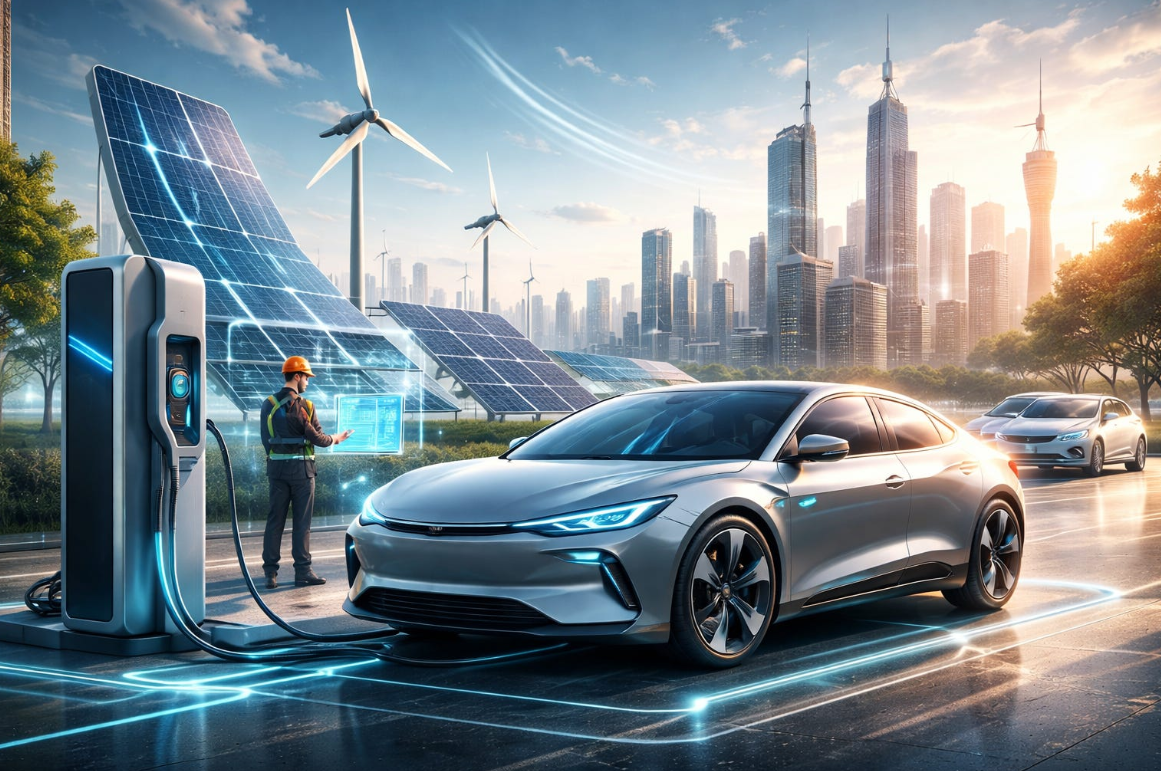
China’s EV Efficiency Mandate: A Global Game-Changer
Starting January 1, 2026, China will enforce mandatory energy-consumption limits for battery-electric passenger cars. Unlike voluntary guidance, this is a hard cap: vehicles that exceed the limit cannot be sold.
This regulation marks a major paradigm shift in the EV industry, reshaping manufacturing, engineering, and resource strategies—not just in China, but globally.
From Bigger Batteries to Smarter Efficiency
For years, EV competition focused on driving range, often by installing ever-larger batteries. This approach increased vehicle weight and energy consumption.
China’s new mandate flips the model: the focus is now overall efficiency, measured in kilowatt-hours per kilometer. With China as the world’s largest EV market, this move will influence global design norms far beyond its borders.
Weight-Based Standards, Stricter Than Ever
Instead of a single benchmark, the limits are weight-based, recognizing differences across vehicle types.
- Thresholds are roughly 11% stricter than previous recommendations.
- Mandatory enforcement is designed to drive genuine innovation, not create loopholes.
China’s approach signals a serious tightening of global EV regulation.
Engineering Implications: The Whole Vehicle Matters
Compliance requires improvements across the entire EV system, not just the battery.
Powertrain Efficiency: Optimize motors, inverters, and transmissions to reduce energy losses.
Lightweight Design: Reduce mass using advanced materials and optimized structures to lower energy demand.
Aerodynamics: Minimize drag to save energy, especially at highway speeds.
Thermal Management: Efficiently control battery and motor temperatures to prevent waste and extend component life.
Software-Driven Energy Control: AI systems will optimize range, charging, routing, and energy use in real time.
Efficiency is no longer just a battery concern—it’s a system-level mandate.
Battery R&D and System-Level Management
The battery alone is no longer the solution – even the batteries themselves are being questioned. Research and development now focus on:
- New materials
- Optimized charge/discharge cycles
- Intelligent pack management
The goal: smaller, smarter batteries – instead of the largest possible battery – integrated into a highly efficient vehicle system.
Global Impact: Competition Redefined
China’s mandate forces automakers to innovate rapidly, preparing for future efficiency and carbon regulations worldwide.
- Industrial discipline: Accelerates learning curves and gives an edge to firms mastering full-system efficiency.
- Supply chain signals: Less energy per kilometer reduces pressure on batteries, critical minerals, and charging infrastructure.
China’s scale makes this strategically significant, reinforcing its global EV leadership.
Beyond Vehicle Efficiency: Grid Integration
This is just the first step. The future will focus on integration with the power system:
- Optimized charging
- Load shifting
- Vehicle-to-grid interactions
- Energy storage integration
- Smart algorithms aligning charging with grid constraints
Oversized batteries are counterproductive. Success lies in balanced size, high efficiency, and robust charging or swapping networks.
Infrastructure, Constraints, and the Path Forward
China has heavily invested in domestic manufacturing and national charging networks, enabling its EV adoption success.
Challenges remain:
- Uneven charging coverage
- Reliance on non-renewable electricity
- Environmental impact of battery production
Tens of thousands of engineers are working on these issues. One success is already evident: Chinese EVs are significantly more efficient than combustion-engine cars today.
The new standards will amplify these advantages, cementing China’s leadership and pushing the global EV market toward intelligent, system-level efficiency rather than “battery maximalism.”
Anyone observing the global EV landscape can see: China is tightening the screws – and the rest of the world must follow. Range alone is no longer enough; intelligent, integrated, cost-saving, and highly efficient solutions are becoming the new standard.