
The Ancient Name They Said Didn’t Exist
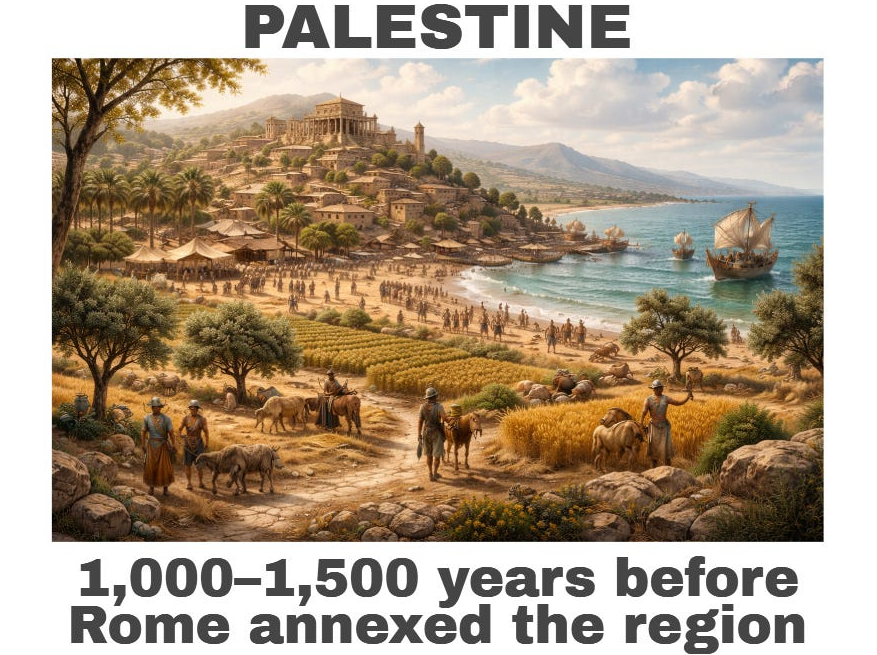
Many people assume that the name “Palestine” was invented by the Romans—a narrative often promoted in Zionist discourse for political reasons. In reality, the term is far older, reaching back to some of the earliest written records in human history.
A Landscape of Layers
The historical nomenclature and genetic continuity of the region known as Palestine reveal a deep and intricate tapestry of human settlement. The name “Palestine” predates the Roman period by many centuries and appears in a range of ancient sources.
Egypt, the Sea Peoples, and the Earliest Mentions
Egyptian inscriptions from the Late Bronze Age (circa 1300 BCE) reference a group called the Peleset—written as PLST in hieroglyphs—who are widely associated with the Philistines, one of the so-called “Sea Peoples.”¹ These groups, including the Philistines, arrived in the Levant from the Aegean during the early 12th century BCE. They settled along the Canaanite coast, developing a distinctive culture in cities such as Ashkelon. Although early interpretations linked their presence to Egyptian strongholds under Ramesses III, recent archaeological and genetic research suggests a far more nuanced picture.
From Assyria to Herodotus: Palestine in the Classical World
The Assyrians later used the term Palastu to describe parts of this same region. Herodotus, writing in the 5th century BCE, referred to Palaistinê as a district of Syria extending from Phoenicia to Egypt and noted cultural practices such as circumcision among communities near Gaza. From the Late Bronze Age onward, “Palestine” became one of the most widely used names for the area, gradually superseding earlier designations like Djahi, Retenu, and Canaan.
Netanyahu says he is currently reading the book Jews vs. Rome: Two Centuries of Rebellion Against the World’s Mightiest Empire by author Barry Strauss. When asked why he chose it, he said: “Well, we lost that one. I think we have to win the next one.”

Netanyahu, the butcher of Gaza and the promoter and initiator of endless wars in the Middle East, has justified military actions against Palestinians (e.g., in defenceless Gaza as self-defense), Arab militias (e.g., Hezbollah), and Iran (e.g., as a supposed nuclear threat) by invoking historical survival themes.
Crossroads of Civilizations
Because of its location at the crossroads of Africa, Asia, and Europe, the Levant—including Palestine—has long been a meeting point of cultures. This geography facilitated constant waves of migration, trade, and cultural exchange. The Early Bronze Age (c. 3600–1100 BCE) witnessed the rise of urban societies in the southern Levant, characterized by fortified towns and distinctive burial traditions. After the collapse of this first urban cycle roughly 4,200 years before present, parts of the region transitioned toward pastoral lifeways, although some urban centres endured in Transjordan.
What Genetics Reveals
Genome-wide studies from Bronze and Iron Age archaeological sites in the southern Levant show that these populations—often grouped under the label “Canaanite”—emerged from earlier local Neolithic communities and mixed with groups related to the Chalcolithic Zagros and Bronze Age Caucasus. This non-local ancestry increased over time, reflecting gradual admixture rather than sudden population replacement.
Ancient Echoes in Modern Peoples
Modern populations continue to carry these ancient signatures. Lebanese genomes, for example, show Anatolian and other regional components accumulated over thousands of years. DNA from early Iron Age Philistines at Ashkelon reveals an additional European-related component coinciding with their arrival—evidence of migration, not domination or displacement. Even animal DNA supports this: Iron Age pig remains in Israel shift from Near Eastern to European haplotypes, aligning with Philistine migration patterns.
Continuity, Not Replacement
Despite these movements, one theme stands out: deep genetic continuity.
Modern Palestinians are closely related to the Bronze Age inhabitants of the region, including the Canaanites—evidence of a long-standing core population that absorbed newcomers over millennia. This heritage is not uniform but richly layered, shaped by centuries of cultural contact and integration.
The Sea Peoples Revisited
The “Sea Peoples,” and their role in the Late Bronze Age collapse, remain major subjects of research. Egyptian texts describe them as invaders, but archaeology suggests a more complex dynamic in which they contributed to broad social and cultural changes across the eastern Mediterranean. The Philistines, as part of this movement, developed a distinctive material culture reflected in diet, agriculture, and debated cultural markers such as dog consumption.

A History Too Deep to Erase
Ultimately, the history of Palestine—its names, peoples, and cultures—reveals a region defined not by rupture, but by continuity woven through change. The modern Indigenous population inherits a legacy that is profoundly ancient, profoundly mixed, and deeply rooted in the land. Attempts to erase or rewrite this history for political purposes—namely, the displacement of Palestinians and their replacement through the project of an ethnocentric “Greater Israel”—cannot overturn the archaeological, textual, and genetic record. Such efforts do not merely form another chapter in a long and often painful history; they may represent its saddest episode—yet even this will endure, as Palestine’s history has always persisted despite every attempt to obscure it.