
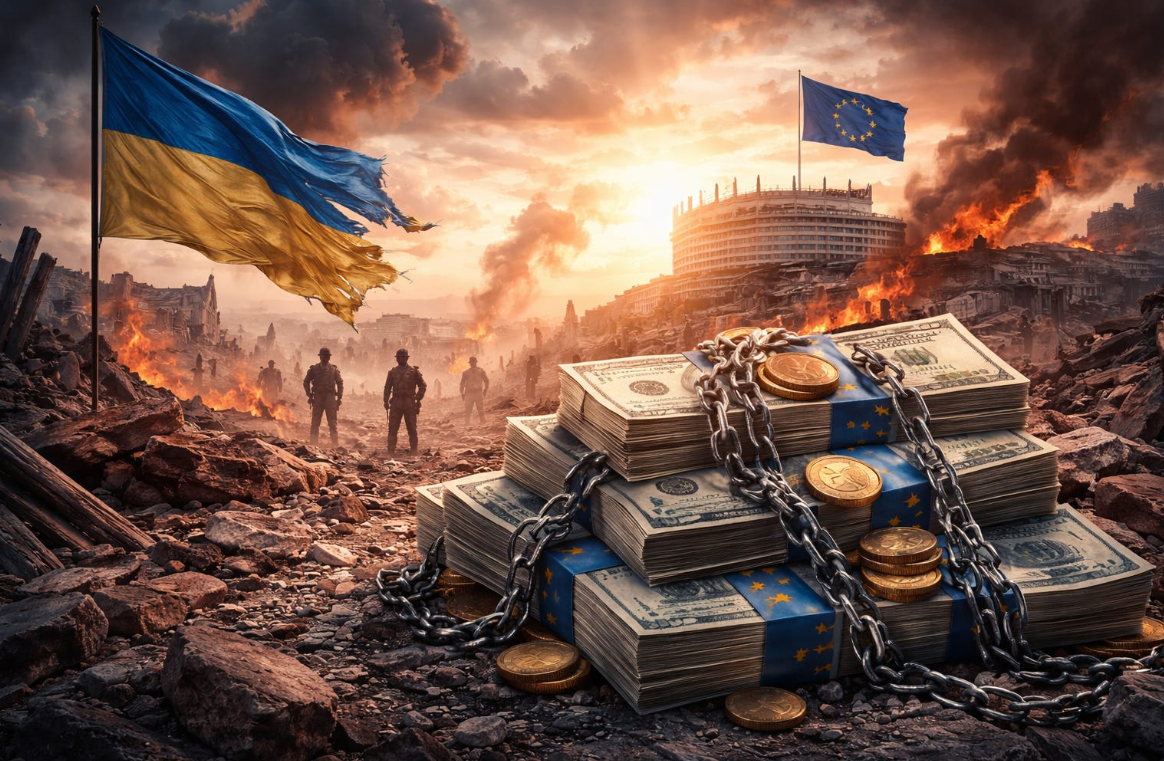
Ukraine on Life Support
Since the Russian invasion in 2022, the Ukrainian economy has been almost entirely dependent on external financing from the EU, the US, and multilateral institutions. Due to territorial losses, destroyed infrastructure, and extremely high military expenditures, domestic revenues cover only a fraction of the state’s financial needs. Public debt has now exceeded 100% of GDP, while access to international capital markets is blocked. Even earlier, EU loans were frequently extended instead of being repaid regularly, effectively turning them into quasi-grants—despite ongoing corruption investigations that revealed systemic deficiencies within the Ukrainian state apparatus.
For 2026, a budget deficit of around 18.4% of GDP is expected; according to the EU and IMF, external financing needs range between €70–81 billion. Government representatives warn that the promised funds will not even cover a single year—raising the prospect of an acute financial crisis no later than mid-2026.
The €90 Billion Lifeline
In December 2025, the EU heads of state and government approved an interest-free loan of €90 billion for 2026–2027 to avert a state bankruptcy at the beginning of 2026. The earlier plan to finance the package using profits or collateral from approximately €210 billion in frozen Russian central bank assets was abandoned due to legal, political, and financial risks—especially over Belgian fears of Russian retaliation against Euroclear. The EU will instead raise the funds through joint bonds backed by the EU budget. Ukraine would only have to repay if Russia were to make future reparations; otherwise, further extensions or subsequent coverage via frozen assets would remain possible. For EU taxpayers, annual interest costs of around €3 billion will begin in 2028.
It is important to note, however, that while the headline figure is €90 billion, only roughly €50 billion will actually be available for Ukraine’s budget, as approximately €40 billion is expected to go toward repaying previous loans. Critics, including Hungary’s Prime Minister Viktor Orbán, describe the arrangement as a historic “war loan,” arguing that it links European financial interests to the continuation of the conflict and complicates any move toward de-escalation, since a negotiated settlement without Russian reparations would require immediate repayment of the principal.
A Financing Model Like No Other
This creates a financing model with few parallels in recent economic history. During the Greek debt crisis of 2011–2015, aid tranches from the EU, ECB, and IMF were granted only under strict conditions: deep structural reforms, tax increases, cuts to pensions and social systems, and permanent oversight by the Troika. The goal was to restore Greece’s solvency and tie funding to verifiable benchmarks.
Another comparison is the US Lend-Lease program during the Second World War. Although often remembered as nearly unconditional support, it operated under clear rules—including material guarantees such as gold deliveries, the expectation of repayment once the war ended and economies recovered, and the explicit exclusion of confiscating enemy assets. The UK and USSR deposited gold in the US during the war to secure assistance and later repaid their loans. After the war, the USSR and the US debated repayment for decades, settling in 1972 for $722 million tied to trade advantages, with the remaining sum paid by Russia in 2006.
Ukraine, by contrast—neither an EU member nor a formal NATO ally—now receives aid on a historically unprecedented scale: without real collateral, without adequate oversight, and based on rolling refinancing’s rather than clearly defined repayment rules. The difference could hardly be greater.
Massive Western Financial Aid – a Bottomless Pit
Western countries—especially the EU and the U.S.—have already provided Ukraine with hundreds of billions of dollars/euros in aid, grants, and loans. This includes direct budgetary support, military aid packages, and financial guarantees or emergency lending.
Despite this, Ukraine continues to face severe financial strain because the war has devastated its economy, tax revenue has collapsed, and government spending—especially defense—is enormous. Foreign aid is now the main way the budget survives.
The new €90 billion EU loan, funded through international bond markets, is not a grant but long-term debt Ukraine must repay. Because it is financed through bonds, EU taxpayers cover the interest, not Ukraine. Interest is expected to be high, possibly exceeding €10 billion per year, depending on market rates. The EU’s justification—that profits from frozen Russian assets will cover interest—is widely described as unrealistic. Another loan—€45 billion from the G7—is reportedly being rolled over indefinitely.
The EU still pays about €3 billion per year in interest on previous loans alone, meaning Ukraine receives the principal to spend while Europe absorbs the accumulated interest and the debt burden grows. After the new €90B loan, Zelensky argued the money was insufficient for drone production, air-defense interceptors, basic military equipment, and long-term security needs.
At the same time, Europe’s political unity is fracturing, making approval of large financial packages increasingly difficult. Public and political appetite for endless aid is waning, as European economies struggle under sanctions and the high cost of energy following the replacement of cheap Russian supplies with substantially more expensive alternatives. Meanwhile, U.S. political hardliners show little willingness to commit further, suggesting that funding fatigue is emerging on both sides of the Atlantic.
At the core of this situation is the reality that, without foreign loans and aid, the Ukrainian state would likely face financial collapse. Its military resistance relies heavily on continued Western funding, and the rapid deterioration on the battlefield will make approving new aid increasingly difficult. Whether this mounting financial pressure will push Ukraine toward negotiations and meaningful concessions—or ultimately precipitate a change of regime in Kyiv through battlefield developments—remains uncertain.
Odessa: The Strategic Prize
Rather than signing the peace agreement negotiated in Istanbul and initialed by Kyiv and Moscow in April 2022—a deal that, according to participants, would have preserved Ukraine’s territorial integrity—the Ukrainian president, bowing to Western pressure, refused to finalize it and continued the war with Western backing “for as long as it takes.”
In retrospect, this decision has proven disastrous. Ukraine’s military position has steadily weakened amid a grinding war of attrition.
Russian forces continue to make incremental territorial gains in eastern and southern Ukraine, including full capture of Siversk in Donetsk Oblast and advances toward Hulyaipole in Zaporizhzhia Oblast. Logistical hubs such as Pokrovsk have fallen under Russian control.
Russia’s attritional strategy, bolstered by superior manpower and resources, is steadily gaining the upper hand. The collapse of Ukraine’s military defenses is becoming increasingly likely in the months ahead.
There is no longer any speculation about whether Russia will take Odessa, but when. Odessa is a strategically important port founded in 1794 by Catherine the Great that secures access to the Black Sea.
Its capture would turn Ukraine into a landlocked state, make its economic survival more difficult, disrupt trade and supply routes, and significantly reduce NATO’s ability to dominate the region and pose a serious threat to Russia.
Recruitment Crisis and Military Limits
While Ukraine is effectively bankrupt, underfunded and losing on the battlefield, it is also approaching the limits of its mobilisation capacity.
The head of the secret service, Kyrylo Budanov, has described recruitment as a ‘catastrophic failure’. Independent assessments consider sustained military endurance beyond the summer of 2026 to be uncertain – a timeframe that coincides with the expected financial bottlenecks.
Russia’s Economic and Military Resilience
Meanwhile, Russia is proving remarkably resilient, both militarily and economically. Inflation and growth are stable, public debt stands at 17 to 19% of GDP – well below the level of many Western European countries – and foreign exchange reserves have returned to pre-war levels.
Industrial production, agriculture and current account surpluses contribute to economic stability. Compared to the highly indebted European economies, Russia appears remarkably robust.
The Clock Is Ticking – and an Inevitable Reckoning Looms
The latest EU funding marks a turning point: political will can no longer mask harsh economic realities. Time is running out for Ukraine—financial exhaustion and mounting military pressure will intensify as the strategic balance shifts even more in Russia’s favor in the coming months.
This is a reality that can no longer be ignored. The West’s attempt to strategically defeat Russia – or even break it up into smaller pieces – has backfired.
Instead, the West, especially Europe, has harmed itself the most, undermining its own economy and the prosperity of its citizens. It is only a matter of time before the public recognises this and begins to question the self-serving political elites responsible for these disastrous decisions. It is therefore not surprising when political scientists argue that Western societies are on an irreversible path towards civil war