
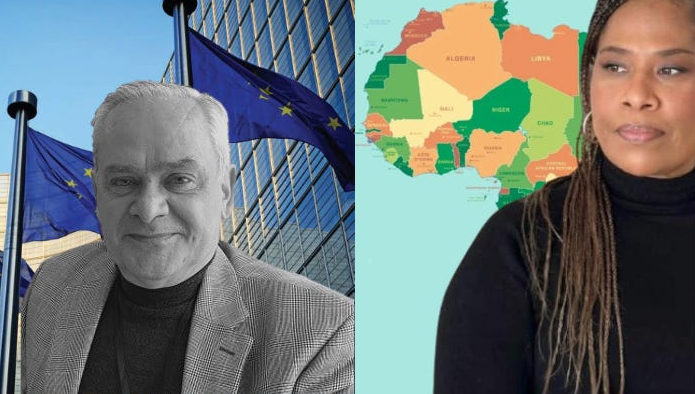
Recent media attention surrounding the European Union’s sanctions against Jacques Baud has revealed a striking imbalance in coverage and concern—particularly when contrasted with the near silence surrounding the case of Nathalie Yamb, who was in fact the first Swiss citizen sanctioned by the EU.
Jacques Baud is a Swiss former intelligence officer and security analyst who served in the Swiss Army, NATO, and the United Nations, specializing in intelligence, counter-terrorism, and arms proliferation. Since leaving public service, he has become a public commentator and author, gaining prominence after 2022 for his analyses of NATO and Western policy, especially in relation to the war in Ukraine.
His positions have proven controversial. Western politicians and media outlets highly critical of Russia accuse him of echoing Russian-aligned narratives, while more neutral observers describe him as an independent analyst challenging dominant and increasingly partisan Western policy positions. Baud firmly rejects the accusations, insisting that his work relies exclusively on Western sources and that he is being targeted for offering analyses that diverge from mainstream Western narratives.
As a result of EU sanctions, Baud faces a travel ban within the EU and the freezing of any assets held in EU jurisdictions. His case has been widely discussed in European media—sometimes inaccurately presented as the first instance of an EU sanction against a Swiss citizen—and often framed as a troubling precedent for freedom of expression and democratic debate within Europe.
Yet far less attention has been paid to the case of Nathalie Yamb, despite the fact that she was sanctioned earlier, in June 2025, whereas Baud was sanctioned in December 2025, and despite the reality that the consequences she faces are arguably more severe.
The Case of Nathalie Yamb
Nathalie Yamb is a Swiss–Cameroonian dual national, born in 1969 in La Chaux-de-Fonds, Switzerland, where she also resides. She holds a Swiss passport and is a prominent pan-Africanist and anti-colonial activist, known for her uncompromising criticism of Western—particularly French—neo-colonial influence in Africa. She remains a persistent thorn in the side of the Parisian elite.
Through social media and public speaking, Yamb has built a large francophone following, presenting her activism as political advocacy grounded in freedom of expression, sovereignty, and democratic accountability. She explicitly challenges Western state power and foreign interference in African political and economic affairs.
In 2019, she gained international prominence after delivering a speech at the Russia-Africa Summit in Sochi. She was later expelled from Ivory Coast because her activities were deemed incompatible with the interests of the Ivorian elites, who follow the instructions of their long-time colonial master, France.
In June 2025, the European Union placed Yamb under sanctions, making her the first Swiss citizen targeted in this sanctions wave. The EU accuses her of amplifying narratives aligned with Russian interests and of contributing to what it terms “foreign information manipulation and interference.” Crucially, these measures are not based on judicial findings or criminal convictions, but on executive determinations largely tied to her public commentary, reporting, and travel.
Disproportionate Consequences
The consequences for Yamb are severe and far-reaching. Although Switzerland is not a member of the EU, Swiss banks froze her accounts, effectively enforcing EU sanctions domestically. She is also barred from entering or transiting EU territory, including EU airspace.
In practical terms, this results in near-total restrictions on mobility. If she is abroad, she risks being unable to return to Switzerland; if she remains in Switzerland, leaving the country becomes extremely difficult without navigating EU-controlled airspace. Unlike Baud—who benefits from extensive professional, institutional, and social networks—Yamb faces these measures with far fewer protections.
Critics argue that her case exemplifies draconian and legally untested executive overreach, in which political dissent is punished without transparent evidence, due process, or meaningful judicial scrutiny. From this perspective, the sanctions mark a troubling precedent: mechanisms originally designed to target foreign actors are now being applied to Western citizens engaged in political speech.
A Racial and Political Double Standard?
Despite the gravity of her situation, Yamb’s case has attracted minimal sustained coverage in mainstream European media. Supporters argue that this silence reflects a deeper racial and political double standard. While concern is readily expressed when a white Swiss elite figure is sanctioned, a Black Swiss activist advocating African sovereignty is marginalised and portrayed primarily through allegations of foreign influence.
Yamb has denied all accusations, describing the sanctions as politically motivated and a direct attack on freedom of expression. She has announced her intention to challenge the measures legally.

Forum Geopolitica observed that the influential Weltwoche had finally started paying attention to Baud’s situation—while the rest of the Swiss media remained asleep. I was the first to comment on the article, calling out their omission of Nathalie Yamb’s case and supplying the details they’d failed to include.

Meanwhile, her political influence has continued to grow in parts of Africa. In 2025, she was appointed special adviser to Niger’s military leader, General Abdourahamane Tiani, and granted a diplomatic passport by Nigerien authorities—developments that have further irritated Paris and its allies in Brussels.
Supporters see Yamb as a fearless defender of African sovereignty and a fighter against neo-colonial domination. Critics in European and French-language media smear her as a mouthpiece for Russian narratives.
What is rarely questioned is whether the EU’s reaction reflects not only geopolitical fears, but also a deeper unwillingness on the part of European elites to tolerate open criticism – especially from a black woman who, unlike Jacques Baud, questions the power of the West and French neo-colonialism in Africa.