
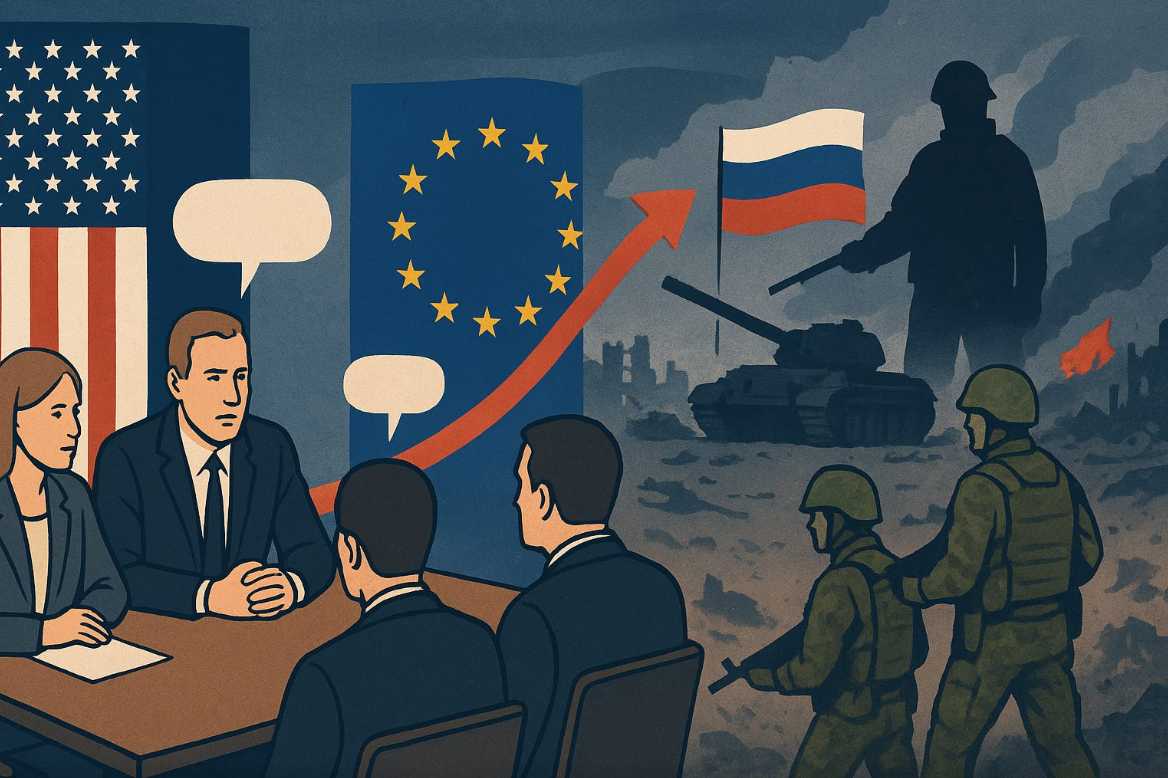
If we analyze what could loosely be described as “diplomacy” in the Ukraine conflict since President Trump took office in January, a clear pattern emerges. The United States has moved away from the confrontational stance of the Biden administration, while the European Union has held to it. Washington puts forward proposals far from what Moscow could accept, yet still marking a departure from the rigid line of the Biden era. Predictably, Ukraine protests and European governments react indignantly. Their strategy is based on regaining lost territory and inflicting a strategic defeat on Russia, supported by nineteen rounds of sanctions. Together, European states and Kyiv reject U.S. proposals, even though no structured or fully developed concept has ever been made public. Consultations between Washington, Kyiv, and European capitals are increasing. As commentator Yves Smith noted on Naked Capitalism, Western governments spend most of their time negotiating with one another while losing sight of the fact that real talks must take place with the opposing side.
Under this paradigm, the prospect of a negotiated agreement is minimal. Europe is actively obstructing the process, not to resolve the conflict but to prolong it. European elites aim for a ceasefire—rather than peace—in order to retrain and rearm Ukrainian forces and continue the war with Russia, thereby pulling the United States deeper into the conflict. This strategy is driven by desperation: politically and economically, Europe currently has only limited means to unify NATO or the EU—and therefore does so under the banner of supporting Ukraine. Although both Ukrainians and Russians are Slavic peoples, the conflict is portrayed in Europe as a defense of European civilization against the East.
The resistance to Trump’s peace efforts is unmistakable. EU officials such as Kaja Kallas—who repeatedly spoke of breaking Russia into several parts even before her appointment as Vice President of the European Commission—rejected the implementation of his peace plan, signaling that Europeans are guiding Zelensky to reject any settlement. Europe’s strategy appears aimed at ensnaring the U.S. in a prolonged conflict and using the war to secure its own political and strategic relevance. Moral considerations have largely been abandoned in favor of cynical power plays.
Economic pressure plays a central role. Europe faces massive energy shortages and skyrocketing costs, especially in the United Kingdom and Germany. Industries reliant on cheap Russian energy have collapsed, unemployment is rising, and elites fear social unrest. Any political party advocating reconciliation with Russia or withdrawal from NATO is deliberately undermined—economically, legally, or through scandals. This political containment, sometimes described as a “cordon sanitaire,” prevents challengers on the right or left from gaining influence.
The result is a recurring cycle: U.S. proposals are revised to resemble the uncompromising stance of the Biden era, fail, and begin anew. This cycle has repeated several times:
- In early March, an alleged U.S. attempt to secure a ceasefire was undermined by European and Ukrainian objections, after which Washington denied any proposal had been on the table.
- At the meeting with Putin in Anchorage, Trump appeared to agree to a revised version of the “Istanbul Plan,” but reversed after pressure from Ukraine and European governments, prompting Russia to accuse Washington of breaking its word.
- After the phone call between Trump and Putin, European officials claimed Trump had been prepared to freeze the conflict along existing front lines—the most generous terms Ukraine could have hoped for at that point—yet withdrew the offer after another round of objections. Recently, European officials reportedly traveled to Geneva with their own proposal treating Russia as a defeated party, despite Moscow having the advantage. Russia predictably rejected it.
Core message: The U.S., Ukraine, and Europe are not negotiating with Russia at all. They are negotiating with one another—often against one another—while pretending that real talks are taking place.
Meanwhile, the military situation in Ukraine continues to deteriorate. Russian forces are advancing methodically, and Ukrainian defensive lines are increasingly fragile. Cities such as Sloviansk and Kramatorsk are becoming encircled, and if they fall, the rest of the Donbas is likely to follow quickly. Ukrainian forces are fragmented, exhausted, and struggling to hold even marginal positions, as reported by both Ukrainian and Russian military bloggers. Reported counterattacks appear increasingly unrealistic. Video material shows destroyed Ukrainian vehicles along supply routes, underscoring the failure of counteroffensives and the ongoing encirclement.
Russian operations in Zaporizhzhia, Pokrovsk, Myrnohrad, and Severodonetsk are progressing in a coordinated manner according to clear operational plans. Moscow’s advances suggest that key targets, including Sloviansk and Kostiantynivka, could fall sooner than optimistically projected by Western analysts. The combination of military success and diplomatic patience strengthens Russia’s negotiating position: it has no incentive to accept maximalist demands from Europe or the U.S. Any plan that treats Russia as defeated, demands reparations, or requires territorial concessions without guarantees is doomed to fail. Moscow can point to the Anchorage agreement as the only viable framework—the Americans agreed but later withdrew.
Meanwhile, the Ukrainian leadership increasingly acknowledges the seriousness of the situation. Former government spokesperson Yulia Mendel publicly warned that delays in negotiations worsen Ukraine’s position—a rare recognition of battlefield imbalance. Russia, by contrast, feels no pressure to hurry; time works in its favor.
Russia’s diplomatic engagement is aimed primarily at satisfying international partners such as China, India, Brazil, and South Africa, who urge Moscow to appear open to negotiations. Even these states increasingly hold the U.S. responsible for stalled talks, arguing that Washington never committed to concrete terms and repeatedly retreated from its own proposals. From their perspective, it is the West—not Russia—that refuses to face political reality.
Europe remains in denial, unable to admit that Russia is advancing, Ukraine is losing territory and manpower, and Russia’s military-industrial capacity is stable. Acknowledging reality would undermine post–Cold War assumptions about EU integration, NATO expansion, and Europe’s global influence. Consequently, European powers insist on peace plans demanding Russia’s capitulation and pressure the U.S. for more sanctions, more weapons, and more political measures—even at the expense of their own economies.
In Washington, neoconservatives and members of Congress call for “honorable” peace terms only under maximalist Ukrainian and European conditions. Trump, lacking political willpower and domestic backing, repeatedly yields to this pressure and returns to proposals shaped more by European and Ukrainian lobbying than by the original Anchorage framework. The cycle repeats predictably.
Realistic voices like Julia Mendel emphasize that Ukraine is bleeding, and that human life and national existence outweigh symbolic gestures. Her warnings underscore what Europe and the U.S. struggle to accept: repeated maximalist proposals prolong suffering without delivering results.
From Trump’s perspective, the war in Ukraine is being lost. His overriding priority is to avoid a “fall of Saigon” or “fall of Kabul” moment. He likely recalls that the two U.S. presidents in office during those events—President Ford and President Biden—both suffered severe political consequences. In Biden’s case, his approval ratings never recovered after the fall of Kabul. Although other factors contributed to his decline, that episode seemed to linger in the background. Ultimately, it became impossible for him to continue, and as we know, he withdrew his candidacy ahead of the 2024 election.
Trump is determined not to become another president who watches an allied capital collapse while in office. He has seen what happened to his predecessors and is deeply anxious about the same fate befalling him. He is therefore doing everything he can to prevent such an outcome. He now understands that Russia will never accept the so-called Kellogg plan — freezing the conflict rather than achieving a permanent peace or anything resembling it. That realization is ultimately what drives him to put forward a new proposal.
But under current dynamics, the war will continue. Russia maintains operational momentum, Ukrainian forces are increasingly constrained, and European and U.S. diplomacy remains trapped in repeated cycles of negotiation, counteroffers, and failure. Genuine breakthroughs are unlikely, and attempts to force Moscow into agreements without concessions are doomed. Russia can rely on patience, strategic clarity, and the ability to play the West against itself, while Europe clings to illusions of power. If the West fails to recognize battlefield reality and negotiate on Russian terms, and instead holds to maximalist expectations, the war will continue, human losses will grow, and Europe’s political illusions will steadily collapse.