
The Myth of the Collapsing Market
Over the past two decades, if you’ve followed international financial news, you’ve repeatedly heard one story about China: the impending collapse of its real estate market. The images are familiar—glittering, futuristic ghost cities, entire cities full of empty skyscrapers. The alarming statistics are well known: in metropolises like Beijing and Shanghai, real estate prices rival those of Boston or San Francisco.
Yet the annual per capita income in these Chinese cities is less than one-tenth of that of their American counterparts. By all traditional Western measures, this is not just a bubble—it is a bubble of historic proportions. The world has been waiting for 20 years. Experts have built careers predicting its imminent collapse. And yet it hasn’t happened. Ghost cities rise, prices keep climbing, and somehow the system does not break down.
The Country That Did Not Fail
This has become one of China’s most puzzling financial paradoxes. It is, as Chinese economist Keyu Jin describes, another example of “the country that did not fail.”
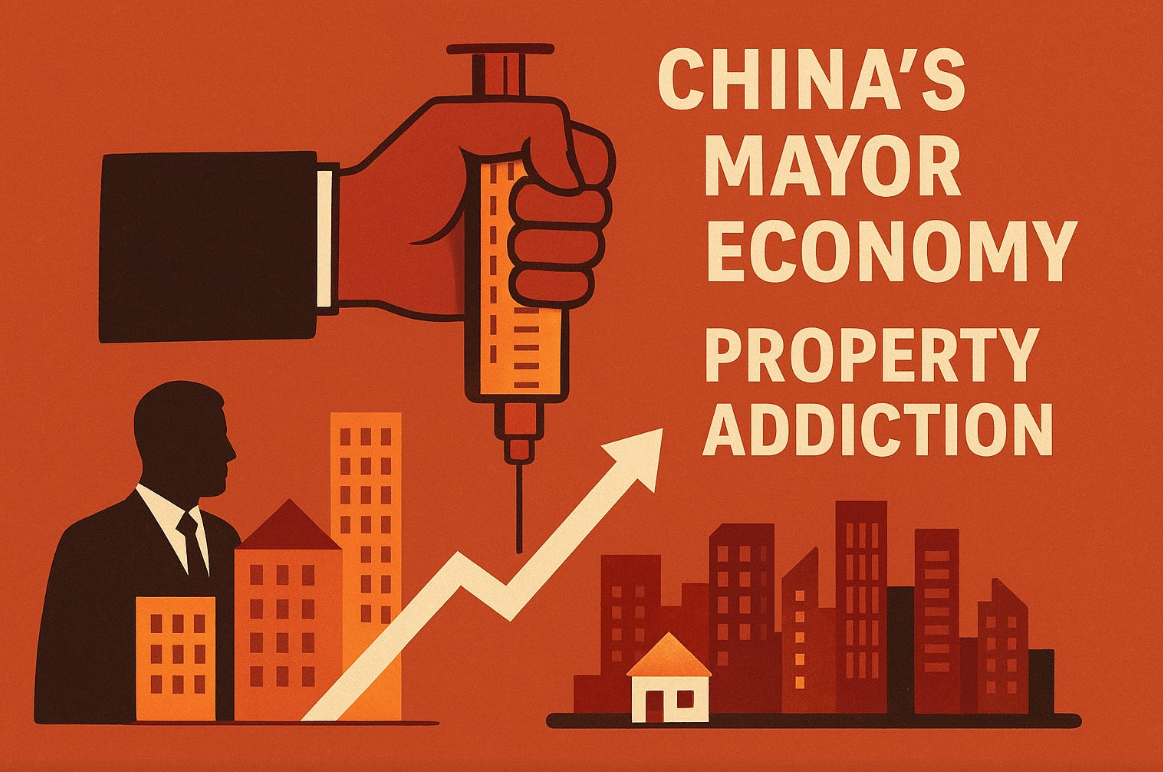
Housing as an Addiction
And that’s why Jin deliberately uses the word “addiction.” This is not a normal market driven by healthy supply-and-demand fundamentals. It is a dependency—an industrial policy on steroids that is rewarding in the short term but toxic in the long run.
A Universal Dependence
And this addiction is universal. The state is addicted to real estate for revenue. Households are addicted to real estate as a savings vehicle. Companies are addicted to real estate as collateral. Western analysts see a bubble and predict a crash. But that is a misunderstanding. This is not a bubble in the Western sense—it is the engine, the primary financing mechanism of the entire Chinese growth model.
The Dealers, Not the Buyers
To understand why this drug is so powerful, you cannot begin with the buyers. You have to start with the dealers. In China, the main dealers are not private developers—they are local governments. To understand China’s real estate market, you must forget everything about municipal finance. You have to understand the “mayor economy.” Keyu Jin explains this in her book The New China Playbook: Beyond Socialism and Capitalism, a must-read for anyone who wants to understand China beyond media headlines.
Where My Perspective Comes From
Many readers ask where I get my insights into China. The answer is simple: I learn from Chinese academics like Keyu Jin; from friends and acquaintances in China; from conversations with both Chinese citizens and foreigners on the ground; and from my regular visits. I have done business in China and have traveled there countless times over the past 40 years.
Challenging Western Narratives
For example, I once read an analysis by Sun Liping, a well-known sociology professor at Tsinghua University, explaining that China experienced around 180,000 “mass incidents” annually—public protests or collective disputes. Spread over the year, that amounts to about 400–500 protests per day. His conclusions were based on internal government data and sociological research. This is one reason why I am skeptical when Western media portray China as a dictatorship that ruthlessly suppresses all forms of protest.
Another example: Western media— from the BBC to German magazine Der Spiegel—claimed that Winnie-the-Pooh images were banned throughout China. Yet in stores and on online platforms I have personally seen Winnie-the-Pooh products in all sizes and colors, clearly disproving these reports.

Social Media and Public Feedback
Recently, when the Chinese government proposed expanding visas for foreign workers, I noticed the intense criticism on social media. I checked WeChat myself and found that around 500 million posts discussed the topic in just a single day. If one relied solely on Western media—which often claim that social media in China is heavily censored—one would consider such public discourse impossible. Shortly afterward, the People’s Daily acknowledged the public concern and announced that the feedback would be incorporated into policymaking. Is that Chinese dictatorship or Chinese democracy?
These experiences do not mean that China is free from censorship or control – but they do show that Western narratives are extremely biased and one-sided and do not reflect the more complex reality. They cannot be relied upon.
The Mayor Economy
The central architecture of the Chinese state consists of political centralization paired with economic decentralization. This is crucial. The central government in Beijing sets major strategic directions, but delegates implementation to thousands of local officials, governors, party secretaries and mayors. Here lies the cleverness of the meritocratic system: it aligns their incentives.
In the West, a mayor worries about re-election. In China, a mayor’s career – his rise within the party – is directly tied to his economic performance. For decades, this performance was measured by a single, all-powerful indicator: GDP growth. This led to the so-called “GDP cult.” Local officials became hyper-motivated CEOs, almost like venture capitalists in their own jurisdictions. Their task was simple: grow, grow, grow – a system that paved the way out of poverty for hundreds of millions of people.
The Birth of Addiction
But in 1994, the central government introduced two laws that changed China forever: the tax-sharing reform and the Budget Law. The tax reform re-centralized revenue, taking most of it away from mayors and sending it to Beijing. The Budget Law simultaneously transferred spending responsibility—roads, schools, hospitals, all the engines of GDP—to local mayors.
Think about it: the state created a class of CEOs judged solely on growth, and then took their money away. To make matters worse, the law prohibited deficits or direct borrowing. How can you invest billions in infrastructure if you have no revenue and cannot borrow? The central government gave them a lifeline: the right to lease land. And with that, the addiction was born.
Mayors no longer just managed land—they monetized it. At its peak, land sales accounted for 30–40% of all local revenue. This created a perverse, self-reinforcing incentive loop:
- A mayor needs to build a new subway to boost GDP.
- To fund it, he leases land to property developers.
- To get the highest price, he restricts supply and ensures the subway makes surrounding land more valuable.
- The newly valuable land is then used as collateral to borrow more money, which funds more infrastructure, increasing land values further.
Mayors became addicted to a rising real-estate market—it was essential for their survival. Real estate in China is not just an asset; it is the foundation of the entire mayor economy.
The Buyers: Social Necessity and Affordability
Who buys the accordingly expensive product? The users: Chinese households. Why would a rational family pay Boston-like prices on Beijing-like incomes? The West sees this as irrational speculation, but in the Chinese context it is rational, driven by two forces absent in Western economies: social necessity and lack of alternatives.
Social Necessity
First: social necessity. Home ownership is not just a preference—it is a prerequisite for life. It is tied to marriage. The one-child policy, combined with traditional preference for sons, created an imbalanced gender ratio and an extremely competitive marriage market. A bachelor’s marriageability depends directly on material possessions: home and car. A 2010 Shanghai Daily survey found that 80% of mothers opposed their daughters marrying non-homeowners.
Affordability: The Six-Wallet Phenomenon
Second: affordability. Young couples cannot buy property alone—they rely on the “six-wallet phenomenon”: the wallets of the couple plus the four parents (sometimes grandparents too). Buying a home is a collective, intergenerational project.
No Other Safe Investment
But even that does not fully explain the addiction. It comes from the second driver: there is nowhere else to put money. China is a nation of savers, but financial policy kept bank interest rates below inflation. The stock market was a casino dominated by retail speculators. With deposits losing value and the market unreliable, only real estate remained. For decades it was the only accessible, reliable investment vehicle with high returns—the savings account, retirement fund, and pension plan in one.
A Toxic Co-Dependency
This created a toxic co-dependency. Mayors became addicted to land sales for revenue. People became addicted to land purchases for savings. Both were trapped in the same game, pushing prices ever higher. Ghost cities were not failures—they were symptoms of the mayor economy. Poor children wear oversized clothes; the state builds the city first, and the population grows into it later. Examples like Chandong, once a ghost city, now have over 70% occupancy and house hundreds of financial institutions.
Real Estate Addiction Spreads Across the Economy
But the real danger was not the ghost cities—it was how this addiction spread to the rest of the economy. Real-estate booms distort corporate incentives. Companies with nothing to do with housing—motorcycle firms, pharmaceutical companies, appliance makers—began hoarding land as premium collateral. This fueled the rise of real-estate giants like Evergrande, debt-financed conglomerates expanding into sectors where they had no expertise and depended entirely on rising land values.
The Government’s Attempted Detox
The Chinese government was aware that this was a drug. In 2020, President Xi set out to lead the country through withdrawal: housing should serve life, not speculation, he emphasized. The “Three Red Lines” policy cut off loans to over-indebted developers and triggered the Evergrande crisis. It was a deliberate withdrawal – the party was over, and the flickering lights went out.
Can China Quit?
That is apparently the trillion-dollar question. Real estate “steroids” have so far been the entire financing model of the mayoral economy. When the market is throttled, the real estate sector shrinks, land sales collapse, mayors run out of money, and GDP growth stagnates. Each time, the government must stimulate the market again to keep the system alive. The drug is toxic, but also a lifeline: both a growth engine and a source of systemic risk.
The mayoral economy cannot function without it. And that is why, according to Keyu Jin, this is an addiction that no one – mayors, citizens, or companies – can escape. However, in this point, she seems to be wrong.
Signs of Change
In fact, the Bloomberg chart shows that capital has already been shifted from the stagnating real estate sector into high-growth manufacturing industries. There is no doubt that the real estate sector, which drove China’s economy for decades, is in crisis. But since 2021, it has no longer contributed to growth, as the following chart shows:

Property sector in China: negative growth since 2021 © Bloomberg

China’s central bank has released statistics on growth rates in industry, real estate, and services. The data show that the industrial sector is given top priority, while the real-estate sector continues to receive only very limited support. © People’s Bank of China
Since 2021, however, the real estate sector has no longer contributed to growth. What Western media often overlook is that it has not played the decisive role in the Chinese economy for years and certainly does not have the potential to drag the entire economy into a collapse. Surprisingly, GDP continues to grow by a notable 4 to 5 percent despite the real estate crisis. Nevertheless, the sector does have a noticeable impact on consumer confidence – unsurprisingly, Chinese households are increasingly investing in gold.
The Chinese real estate market defies all expectations because it is more than just an economic factor: it forms a social, political, and financial nervous system, whose “drug effect” will still be felt for a long time. The diversion of capital into high-growth sectors, however, noticeably cushions the impact and marks the beginning of a new phase in China’s economic development.