
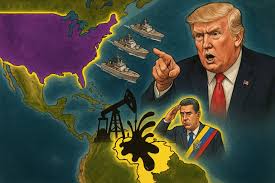
For years Washington has treated Venezuela as a small country that must eventually bow to its power. One more Latin state to be brought back into the orbit of the old Monroe Doctrine. One more government to be bent or broken. Yet as United States naval activity increases in the Caribbean and senior American officials talk openly about regime change, Caracas has responded in a way that many in the West still do not understand. Venezuela is not preparing to wage a conventional war that it knows it cannot win. It is preparing something far more dangerous to any occupier. It is preparing an asymmetric people’s war.

In the language of the Venezuelan military this means a national defense built on irregular units scattered across the entire country. It means sabotage of critical infrastructure. It means making any occupying force choke on the cost of staying. It means turning cities into obstacles and turning the countryside into a swamp that drains every invading soldier and every treasury that pays for him. And above all it means a political and ideological war that rallies volunteers not only from Venezuela but from across Latin America and from every anti imperialist corner of the world. The United States is preparing for a war of tanks and planes. Venezuela is preparing a war of time, exhaustion, and political collapse. And it is a kind of war that Washington has repeatedly shown it cannot win.
The Logic of Asymmetric Defense
The Venezuelan government has openly admitted that its conventional forces are not built to match United States firepower. No one in Caracas is pretending that Venezuelan tanks are going to defeat American Abrams or that Venezuelan naval vessels will defeat US destroyers. That is not the plan and it never was. Venezuelan planners have studied the Iraq and Afghanistan occupations, the Syrian civil war the collapse of American influence in Libya, the retreat from Vietnam, and the failure of US sponsored forces in Somalia. The lesson is clear. The United States excels at destroying states. It is catastrophic at pacifying them.
This is why Venezuelan defense doctrine has shifted entirely to asymmetric resistance. The objective is not to stop the United States from entering. The objective is to make sure that they can never stay.
Recent documents released through investigative reporting inside Venezuela show a detailed structure for what is called prolonged resistance. This involves more than two hundred decentralized bases for small units across the national territory. These units would operate autonomously if communications collapse. They would strike supply lines, burn fuel depots, sabotage ports, cut off water pumping stations, and create a state of constant pressure.
This is not theory. It is a system designed by officers who have studied how urban militias in Iraq and tribal networks in Afghanistan bled the largest military on earth.
Washington can win any battle it wants. Caracas plans to win the war.
The Militia State
The Venezuelan government has spent years building not only an army but a mass militia structure that involves hundreds of thousands of civilians. In Western commentary this is often presented as a political stunt or a show of strength for domestic audiences. It is much more serious. The Bolivarian Militia is
designed as a distributed reserve of fighters who know their streets, who know their mountains, who know which warehouse stores fuel and which electrical substation keeps which region alive. No foreign army can easily map this. The Venezuelan militia is not an auxiliary to the main force. It is the backbone of any resistance.
Exercises inside the country have recently involved not just regular troops but militias, police forces, community defense groups, and civil administrators who are trained to operate under siege conditions. If an invasion happens the Venezuelan state intends to continue governing even under aerial bombardment. Government offices have relocation plans. Communications networks have redundant backups. Food distribution is decentralized. This is a state preparing for attrition, not collapse.
For the United States this is the nightmare scenario. The American military has never been able to defeat a state that is prepared to disperse its structures, arm its civilians, and let time grind the invader down.
A Magnet for International Volunteers
Any invasion of Venezuela would trigger a wave of volunteers unlike anything seen in the Western Hemisphere since the Spanish Civil War Latin America has endured two centuries of interference, coups, and economic extraction from Washington. A United States assault on Caracas would send thousands of leftist fighters from Bolivia, Nicaragua, Cuba, Colombia, and Brazil straight to the Venezuelan front. Beyond the region there would be volunteers from Africa, the Middle East, and parts of Europe, particularly from groups that see Venezuela as a symbol of resistance against neoliberal imperialism.
Caracas knows this. The government does not need to call for international brigades. They will come spontaneously. A war against Venezuela would not be a local conflict. It would be a political earthquake that unifies anti imperialist movements worldwide.
The United States military does not want to fight a war that becomes a global rallying cry for every anti colonial movement of the twenty first century. But that is precisely what would happen.
The United States Cannot Win a War of Time
Washington keeps preparing for short sharp interventions. Shock and awe. Decapitation strikes. Quick occupations. But asymmetric warfare has never been conquered by such tactics. Iraq was supposed to take months. It took decades and still ended in defeat. Afghanistan was supposed to take weeks. It became the longest war in United States history and ended with American aircraft evacuating allies from rooftops while the Taliban walked into Kabul without firing a shot.
A war in Venezuela would be far worse for Washington. Venezuela is bigger than Iraq. It has denser urban areas than Afghanistan. It has mountains, rivers, jungles, and deserts that make mechanised warfare extremely difficult. It has millions of people who see themselves as part of a Bolivarian project that is explicitly built on national sovereignty and popular resistance to external domination. And it has a political culture that has spent decades preparing for the possibility of an invasion.
The United States has never won this kind of war. And it is not ready to start winning now.
The Revolutionary Spirit of the Bolivarian State
To understand why Venezuela believes it can survive and even defeat a United States invasion, one must understand the Bolivarian ideology. It is not a standard nationalist doctrine. It is a fusion of left wing anti imperialism, Latin American solidarity, and an almost spiritual belief in the right of small nations to resist
empire. It draws from the independence movements of the nineteenth century, from the Cuban revolution from the long anti colonial struggles in Africa, and from every corner of the global south.
For Venezuelans this is not just politics. It is identity. It is the belief that sovereignty is worth more than stability and that a people can survive hardship if the cause is just. A United States invasion would not break this spirit. It would multiply it.
Could the United States Actually Lose
Yes. In fact it is the most likely outcome. Washington could flatten Venezuelan air bases. It could seize Caracas for a moment. But it could not govern it. It could not pacify Maracaibo. It could not control the Orinoco basin. It could not protect its supply lines from militias who know every kilometre of land. The war would become a slow grind of roadside bombs, sniper attacks, sabotage, economic collapse, and political bleeding. Eventually voters in the United States would ask the same question they asked during Iraq and Afghanistan. What are we doing here. And why are our soldiers dying in a country that does not want us.
That question would be the beginning of the end. Venezuela does not need to win military victories. It only needs to make the United States question itself. Few empires survive that moment.
A War That Should Never Happen
The Venezuelan government is not suicidal. It is not seeking conflict. It is preparing for survival. But the message from Caracas is unmistakable. If the United States invades it will face a war without front lines, without timetables, and without an exit that does not look like humiliation.
In the twenty first century the age of simple invasions is over. The age of people’s war has returned. And if Washington wants to test that truth in the mountains, jungles, and barrios of Venezuela, it will discover very quickly that history does not favour empires.