
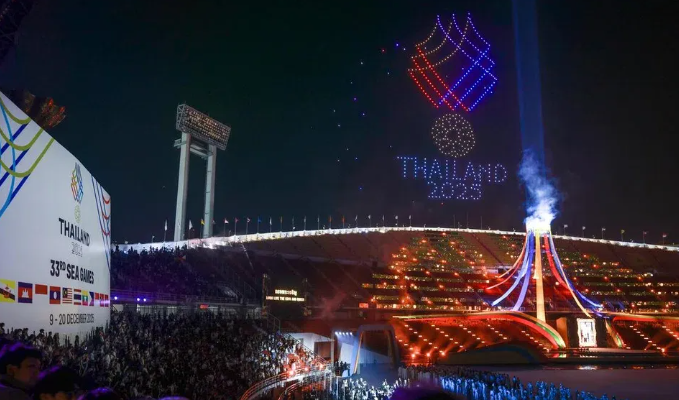
The 33rd Southeast Asian Games in Thailand were supposed to be a celebration of sport, regional unity, and ASEAN cooperation. Instead, the event descended into chaos, embarrassment, and political theatre, exposing the fragility of both the Games and the regional bloc that sponsors them.
The most glaring failure was Cambodia’s withdrawal, a dramatic act that underscored how the event was overtaken by the nationalist propaganda of Thailand and overshadowed by an ongoing invasion by Thailand on Cambodia.
Organizational Chaos and Disasters
From the outset, the Games were plagued by problems. Severe flooding forced the relocation of numerous events, creating logistical nightmares. Schedules were rushed, venues overcrowded, and organizational errors were rampant. The opening ceremony, meant to showcase Thailand’s leadership and hospitality, instead highlighted these flaws: technical glitches, mistakes with flags, and mismanaged performances created a spectacle of incompetence. Where there should have been precision and pageantry, there was confusion and disarray.
Even the competitions themselves suffered. Events were disrupted due to scheduling mishaps or venue problems, while a high-profile cheating scandal in the esports tournaments further tarnished the host nation’s reputation. Thailand’s inability to manage controlled competitions reflected broader mismanagement and lack of preparation.
Cambodia’s Withdrawal and Regional Tensions
The most striking political moment of the Games was Cambodia’s withdrawal. On the second day of competition, the entire Cambodian delegation pulled out, citing serious safety concerns amid escalating border clashes with Thailand. Families of athletes feared for their children, and officials were forced to prioritize safety over participation. This unprecedented exit sent shockwaves throughout Southeast Asia, underscoring the collision of sport and geopolitics.
Cambodia had initially marched in the opening ceremony, but within 24 hours, artillery fire and reports of casualties made participation untenable. What should have been a festival of friendly competition became a grim reminder of the region’s unresolved conflicts. Athletes, officials, and spectators were left to confront the uncomfortable reality that sporting events cannot exist in isolation from political and military realities.
Nationalist Propaganda and Thailand’s Agenda
Thailand’s government treated the Games as an opportunity for domestic nationalist messaging. Broadcasts emphasized Thai dominance, and medal victories were framed as national triumphs rather than individual achievements. Crowds were urged to cheer enthusiastically for Thai athletes, and Thailand ended the Games with a record haul of gold medals, celebrating the victory amid Cambodia’s absence.
The Games became a platform for projecting power and reinforcing domestic political narratives. Where other hosts might have tempered celebrations due to ongoing conflict, Thailand amplified them, using sport to consolidate nationalist sentiment and divert attention from military engagements along the Cambodian border. The result was a stark contrast: behind the ceremonies and medals, civilians and displaced populations endured violence and uncertainty.
Aftermath and Lessons
The closing ceremony attempted to mask the absence of Cambodian athletes with fireworks and fanfare, but the void was visible. Thailand’s successes were overshadowed by organizational failures, political exploitation, and the human consequences of conflict. Social media across Southeast Asia highlighted the contradictions: a sporting event meant to foster unity was instead a demonstration of one nation leveraging an international stage to assert dominance.
The 2025 SEA Games will be remembered not for athletic excellence, but for disarray, division, and political theatre. Cambodia’s forced withdrawal, the exploitation of sport for nationalist propaganda, and the exposure of ASEAN’s inability to mediate or protect members all combined to make this edition of the Games a cautionary tale. It revealed the fragility of regional cooperation, the vulnerability of smaller states, and the ease with which sport can be politicized in the service of power.
In the end, Thailand may boast about medal counts and ceremonies, but the true legacy of the 2025 SEA Games is a stark reminder: when politics, nationalism, and conflict intrude, even the most carefully planned sporting event can fail catastrophically, leaving the principles of unity and camaraderie in tatters.